Who was Patanjali? Explore the historical context, authorship of the Yoga Sutras, and what is actually known about his life and time.
Patanjali: Who Was He and When Did He Live?
In almost every discussion of Yoga, one name appears with a certain consistency, Patanjali. His association with the Yoga Sutras has made him a central figure in the understanding of Yoga as a structured discipline.
And yet, when one looks more closely, a curious situation emerges.
We rely heavily on his work, but we know very little about him.
This contrast, between influence and historical certainty, is worth examining carefully.
The Name Behind the Yoga Sutras
Patanjali is traditionally credited as the author of the Yoga Sutras of Patanjali, a concise and systematic text that outlines the principles and practices of Yoga.
The text itself is composed of short aphorisms, known as sutras. These are not explanations in the modern sense, but distilled statements that require interpretation.
Within these sutras, a complete framework is presented: covering the nature of the mind, the causes of disturbance, and the methods through which clarity can be established.
Because of this, Patanjali is often regarded not just as a writer, but as a compiler or systematizer of existing knowledge.
Was Patanjali a Historical Individual?
The question of whether Patanjali was a single historical person is not as straightforward as it may seem.
Unlike later figures in history, there are no detailed biographies, no clear accounts of his life, and no direct records that establish his identity with certainty.
What exists is attribution.
The Yoga Sutras are consistently associated with the name Patanjali. But beyond this, information becomes limited.
Some traditions identify him as a sage. Others link him to grammatical works or medical texts. However, whether these references point to the same individual remains uncertain.
This does not diminish the significance of the Yoga Sutras. It simply means that the focus remains on the work rather than the person.
When Did Patanjali Live?
The question of time is equally complex.
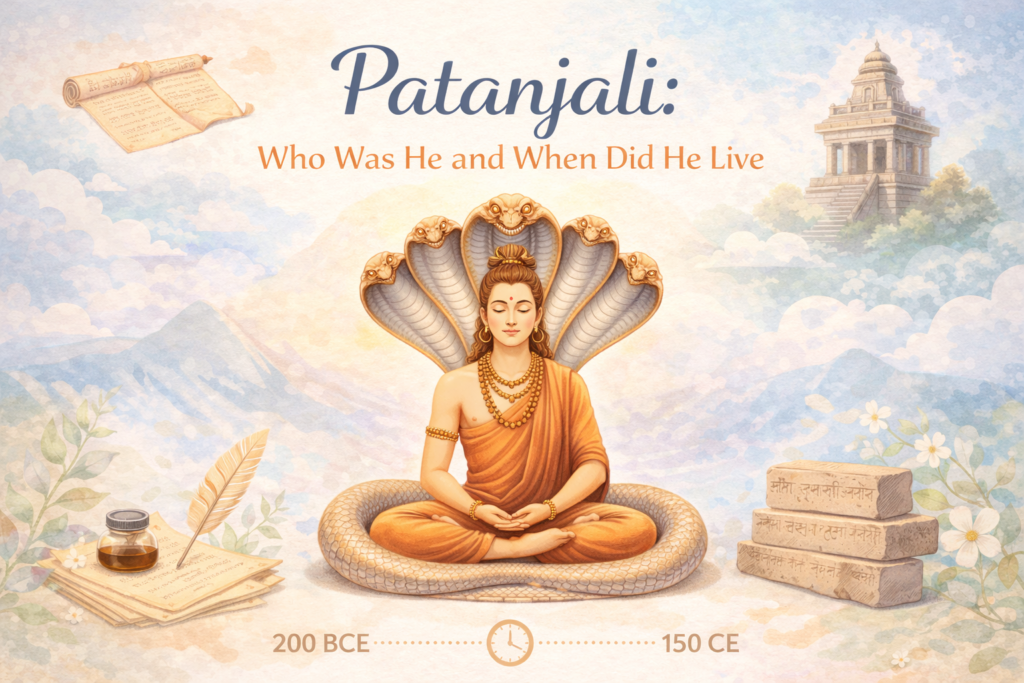
Scholars generally place the composition of the Yoga Sutras somewhere between the 2nd century BCE and the 4th century CE. This range is based on linguistic analysis, cross-referencing with other texts, and historical context.
However, this is an estimate, not a definitive date.
The absence of precise historical records means that any exact claim about Patanjali’s lifetime would be speculative.
It is more accurate to say that the Yoga Sutras belong to an early classical period of Indian thought, rather than to assign a fixed year.
Why There Is So Little Information
From a modern perspective, the lack of biographical detail can seem unusual.
But in the context in which these texts emerged, it is not unexpected.
The emphasis was not on the individual author, but on the validity of the knowledge being presented.
Texts were often preserved, transmitted, and commented upon over generations. The authority of the teaching did not depend on personal history, but on its consistency and applicability.
In this sense, the absence of detailed information about Patanjali reflects a different approach to knowledge, one that prioritizes the content over the personality behind it.
Patanjali as a Compiler of Knowledge
There is a view, supported by the structure of the Yoga Sutras, that Patanjali did not create an entirely new system, but organized existing teachings into a coherent framework.
The brevity of the sutras suggests that they were intended to be studied alongside commentary and guidance, rather than as standalone explanations.
This further supports the idea that Patanjali’s role may have been that of a systematizer, bringing together various strands of Yogic thought into a unified presentation.
If this is the case, his contribution lies not only in what he wrote, but in how he structured it.
The Influence of the Yoga Sutras
Regardless of the uncertainty surrounding his life, the influence of Patanjali’s work is clear.
The Yoga Sutras provide one of the most systematic presentations of Yoga available. They define key concepts, outline stages of practice, and establish a clear direction.
Terms such as Chitta, Vritti, Abhyasa, and Vairagya have become central to the understanding of Yoga largely through this text.
Even when Yoga is interpreted in different ways, the framework established in the sutras continues to be referenced.
Separating History from Interpretation
Over time, various stories and interpretations have developed around Patanjali.
Some describe him in symbolic terms. Others attribute additional works to him.
While these accounts may hold cultural or traditional significance, they are not always historically verifiable.
For a clear understanding, it is useful to distinguish between:
- What can be reasonably supported (the Yoga Sutras and their attribution)
- What belongs to later interpretation or tradition
This distinction allows the discussion to remain grounded.
Why the Question Still Matters
It may seem that knowing the exact details of Patanjali’s life is not necessary.
To some extent, this is true. The Yoga Sutras can be studied and applied without biographical information.
However, the question still matters because it shapes how the text is approached.
If one assumes a fixed identity without evidence, it can lead to unnecessary conclusions. If one recognizes the limits of what is known, the focus remains on the content itself.
This keeps the engagement with the text more direct.
A Different Kind of Legacy
In modern contexts, influence is often tied to personal recognition: biographies, achievements, historical records.
Patanjali represents a different kind of legacy.
His work has endured, been studied, interpreted, and applied across centuries, even though details about his life remain uncertain.
This suggests that the value of the text does not depend on the visibility of its author.
Approaching Patanjali Today
For someone beginning to explore Yoga, the question of who Patanjali was can be a starting point.
But it is not the endpoint.
The Yoga Sutras are not meant to be read as historical documents alone. They are intended to be studied, reflected upon, and applied.
Understanding their structure and intent is more relevant than reconstructing the biography of their author.
Patanjali remains one of the most influential figures associated with Yoga, yet one of the least historically defined.
He is known primarily through the Yoga Sutras, a text that presents a clear and structured approach to understanding the mind and its fluctuations.
While the exact details of his life and the precise time in which he lived remain uncertain, the significance of his work is not diminished by this lack of information.
If anything, it shifts the focus to what matters most, the clarity of the teaching itself. And for anyone engaging seriously with Yoga, that clarity continues to be relevant.