
Struggling with anxiety in a fast-paced world? Learn how Yoga offers a practical approach by working on breath, focus, and the patterns of the mind.
Yoga for Anxiety: Understanding the Problem and the Real Solution
Anxiety is no longer an occasional experience. For many people today, it has become a constant background state: subtle at times, overwhelming at others.
It shows up as restlessness, overthinking, difficulty in focusing, or a persistent sense that something is not quite settled. Even in the absence of immediate problems, the mind continues to move.
What makes this more complex is that modern life, in many ways, amplifies this condition. Constant stimulation, irregular routines, and continuous engagement with information leave very little space for the mind to settle.
In response, solutions are often sought in quick methods, distraction, temporary relaxation techniques, or surface-level coping strategies.
Yoga approaches the issue differently.
Instead of asking how to reduce anxiety temporarily, it asks a more fundamental question: what is happening within the mind that makes anxiety possible?
Anxiety Through the Lens of Yogasastra
In the Yoga Sutras of Patanjali, the mind is described as a field of constant movement.
Thoughts, impressions, and reactions arise continuously. This movement is referred to as Vritti.
When these movements are excessive or unregulated, the mind becomes unstable. Attention shifts rapidly, and there is little continuity.
Anxiety can be understood within this framework- not as an isolated problem, but as a manifestation of this instability.
The more the mind moves without control, the more it generates scenarios, anticipations, and reactions. This creates a loop that reinforces itself.
Yoga does not treat anxiety as something separate from the mind. It addresses the underlying pattern.
Why Modern Conditions Intensify Anxiety
While the structure of the mind has not changed, the conditions in which it operates have.
Today, the mind is rarely at rest. Even in moments of physical stillness, it is engaged scrolling, processing, reacting.
This constant input increases the frequency of mental fluctuations.
The result is not just tiredness, but fragmentation. Attention becomes scattered, and the ability to remain steady reduces.
In such a state, anxiety is not surprising. It is a natural outcome of an overstimulated system.
The Role of Breath: A Direct Entry Point
The Hatha Yoga Pradipika highlights a key relationship: the connection between breath and mind.
When the breath is irregular, the mind tends to be unstable. When the breath becomes steady, the mind begins to settle.
This is not theoretical. It is observable.
In moments of anxiety, breathing often becomes shallow or rapid. This reinforces the sense of unease.
By consciously regulating the breath, one can influence the state of the mind directly.
Simple practices, slow, even breathing, with attention, can begin to reduce the intensity of mental movement.
This does not eliminate anxiety immediately, but it creates a shift.
Stabilizing Attention: The Core of the Practice
One of the central difficulties in anxiety is the inability to hold attention.
The mind moves from one thought to another, often without awareness. Each thought triggers another, creating a chain.
Yoga addresses this through practices that develop attention.
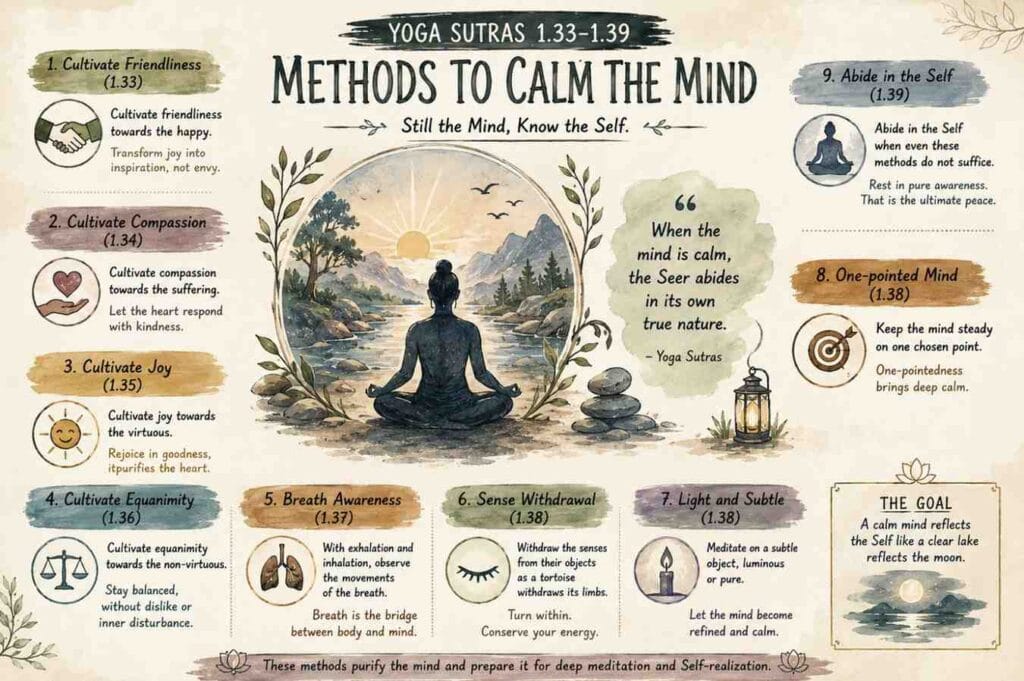
In the Yoga Sutras, this is referred to as Dharana: the ability to hold the mind on a single point.
This could be the breath, a sound, or a simple point of focus.
At first, attention does not stay. It moves repeatedly.
The practice is not to prevent movement entirely, but to bring attention back consistently.
Over time, this reduces fragmentation.
The Perspective of the Bhagavad Gita
The Bhagavad Gita offers another insight that is directly relevant to anxiety.
It describes Yoga as equanimity: a state in which the mind is not constantly disturbed by changing circumstances.
Anxiety often arises from anticipation- what might happen, what could go wrong, what needs to be controlled.
The Gita does not suggest ignoring action. It suggests performing action without becoming mentally entangled in outcomes.
This reduces the internal pressure that contributes to anxiety.
It shifts focus from constant prediction to present engagement.
Why Quick Solutions Do Not Work
Many modern approaches to anxiety focus on immediate relief.
While these may provide temporary comfort, they do not address the underlying pattern of the mind.
As long as the structure of mental activity remains unchanged, anxiety tends to return.
Yoga does not promise instant results. It offers a process.
This process requires consistency, but it leads to more stable changes.
A Practical Yogic Approach to Anxiety
For someone dealing with anxiety today, the application of Yogic principles does not need to be complex.
It can begin with three simple areas:
1. Breath Regulation
Spend a few minutes daily observing and gradually slowing the breath.
The aim is not control through force, but creating steadiness.
2. Attention Training
Choose a simple point of focus: such as the breath.
Bring attention to it. When it moves, bring it back.
This repetition is the practice.
3. Reducing Overstimulation
Limit unnecessary input- constant scrolling, noise, and fragmented attention.
This creates space for the mind to settle.
The Role of Consistency
One of the most important aspects is consistency.
Occasional practice has limited effect. Regular, simple practice creates gradual change.
This aligns with the principle of Abhyasa in the Yoga Sutras, steady effort over time.
The changes may not be immediate, but they accumulate.
What Actually Changes
With consistent practice, the changes are subtle but significant.
The intensity of thoughts may reduce slightly. The gap between thoughts may increase.
Reactions become less immediate.
These changes may seem small, but they alter the overall experience.
Anxiety does not disappear instantly, but its grip weakens.
A Realistic Understanding
It is important to approach this realistically.
Yoga is not a quick fix for anxiety. It is a method of working with the mind at a foundational level.
The results depend on practice, not on expectation.
At the same time, it offers something that temporary solutions cannot, a way to gradually reduce the underlying cause.
Anxiety, in today’s context, is often treated as a problem to be managed.
Yoga approaches it as a condition to be understood.
Through the insights of the Yoga Sutras, the Bhagavad Gita, and the Hatha Yoga Pradipika, it becomes clear that anxiety is connected to the instability of the mind and the conditions that intensify it.
By working with breath, attention, and lifestyle, Yoga provides a practical path toward stability. It does not remove difficulty from life, but it changes how that difficulty is experienced. And in that change, anxiety begins to lose its constant presence.