Lately, the term “somatic yoga” has been appearing more often, raising an important question: what does it really mean in the context of traditional Yoga? This article explores it through awareness, breath, and classical Yogic principles.
What Is Somatic Yoga? A Clear Look at a Modern Trend
In recent years, the term “somatic yoga” has started appearing more frequently, across online platforms, therapy spaces, and wellness discussions. It is often described as a gentle, slow, and awareness-based form of movement.
For many, it is presented as something new. A different kind of Yoga. Sometimes even as a corrective to more physical or performance-driven practices.
But when you look more closely, an important question arises:
Is somatic yoga actually new, or is it a modern way of describing something that has always been part of Yoga?
To answer this properly, it is necessary to separate the terminology from the underlying principles.
What Does “Somatic” Actually Mean?
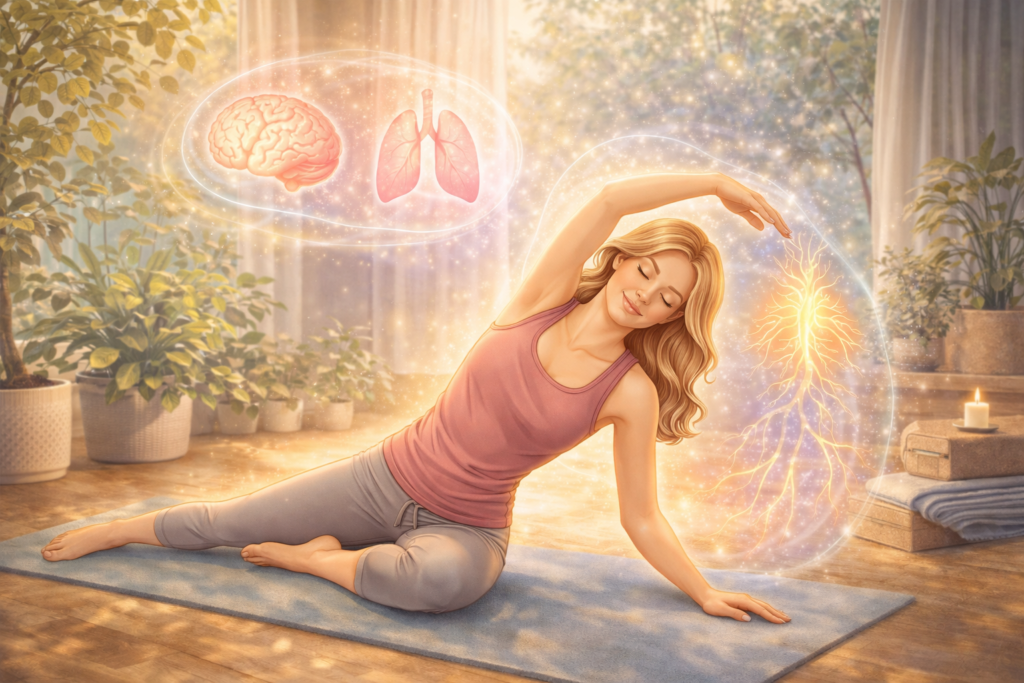
The word “somatic” comes from the idea of the body as experienced from within.
It refers to internal awareness: how movement feels, rather than how it looks.
In this sense, somatic practices emphasize:
- Slow, deliberate movement
- Awareness of sensation
- Reduced emphasis on external form
- Attention to subtle changes within the body
At a surface level, this may appear distinct from Yoga as it is commonly practiced today.
But when viewed through classical Yogic texts, the overlap becomes clearer.
The Role of Awareness in Classical Yoga
In the Yoga Sutras of Patanjali, Yoga is not defined by movement, but by the condition of the mind.
This shifts the focus immediately.
Movement, posture, and breath are not ends in themselves. They are part of a process aimed at stabilizing attention and reducing mental fluctuation.
For this to happen, awareness is essential.
Without awareness, movement becomes mechanical. With awareness, even simple movement becomes part of a deeper process.
This is where the idea of “somatic” begins to align with Yogic principles.
Movement: From External Form to Internal Experience
Modern Yoga often emphasizes alignment, posture accuracy, and visible progress. While these have value, they can shift attention outward.
Somatic yoga reverses this direction.
Instead of asking, “Am I doing this posture correctly?” the focus becomes, “What is happening within the body as I move?”
This shift is significant.
In the Hatha Yoga Pradipika, physical practices are not presented as performance. They are meant to prepare the system: to make it steady, balanced, and suitable for deeper practices.
This preparation depends not just on movement, but on how that movement is experienced.
Fast, distracted movement does little to stabilize the system. Slow, attentive movement does.
Why Somatic Yoga Is Becoming Popular Now
The rise of somatic yoga is not accidental.
Modern lifestyles are increasingly:
- Sedentary yet overstimulated
- Physically inactive but mentally overactive
- Structured externally but disconnected internally
As a result, many people feel a disconnect between body and mind.
Somatic approaches address this directly. They reintroduce awareness into movement.
This is why they are often associated with:
- Stress reduction
- Nervous system regulation
- Improved body awareness
However, it is important to understand that these outcomes are not separate from Yogic principles. They are consistent with them.
The Breath–Body–Mind Connection
One of the key ideas in the Hatha Yoga Pradipika is the relationship between breath and mind.
When breath is irregular, the mind tends to be unstable. When breath becomes steady, the mind begins to settle.
Somatic yoga often emphasizes slow breathing along with movement. This is not a new discovery, it reflects an existing principle.
When movement is synchronized with breath and observed carefully, it begins to influence the internal state.
This is where somatic practice becomes more than just gentle exercise.
Is Somatic Yoga Different from Traditional Yoga?
The answer depends on how Yoga is understood.
If Yoga is reduced to physical postures performed quickly or mechanically, then somatic yoga appears different.
But if Yoga is understood through its classical framework, the distinction becomes less sharp.
The emphasis on awareness, internal observation, and steady attention is already present.
Somatic yoga can therefore be seen not as a new system, but as a re-emphasis of certain aspects of Yoga that are often overlooked.
The Importance of Slowing Down
One of the defining features of somatic yoga is its pace.
Movements are slow, sometimes minimal. This can feel unusual, especially for those accustomed to faster practices.
But this slowness serves a purpose.
When movement slows down, awareness increases. Subtle patterns become noticeable, tension, imbalance, habitual movement.
This aligns with the broader Yogic aim of observation.
Without slowing down, these patterns often remain hidden.
A Practical Approach to Somatic Yoga
For someone interested in this approach, the practice does not need to be complicated.
It can begin with simple steps:
- Move slowly and deliberately
- Pay attention to sensation rather than appearance
- Coordinate movement with breath
- Avoid pushing into discomfort
- Notice changes rather than forcing outcomes
These principles may appear basic, but they change the quality of practice.
A Common Misunderstanding
There is a tendency to treat somatic yoga as a separate category, distinct from Yoga.
This can create unnecessary confusion.
The term itself is modern. The principles it points to are not.
Understanding this helps avoid fragmentation. It allows practice to remain connected to its broader context.
Where It Fits in Today’s Context
In today’s environment, where speed and stimulation are constant, practices that emphasize slowness and awareness have a particular relevance.
Somatic yoga addresses a gap that many people experience, a lack of connection between what they do physically and how they feel internally.
By reintroducing this connection, it becomes easier to move toward steadiness.
Somatic yoga, as it is commonly described today, is not entirely new. It reflects a way of practicing that emphasizes internal awareness, slow movement, and attention to experience.
When viewed through the lens of classical Yoga, these elements are already present, though not always emphasized.
The growing interest in somatic approaches may therefore be less about innovation and more about rediscovery.
A return to aspects of practice that were always there, but not always noticed.