The 8 limbs of Yoga explained in a simple and practical way. Understand Patanjali’s step-by-step path to mental clarity and stability.
The 8 Limbs of Yoga Explained Simply
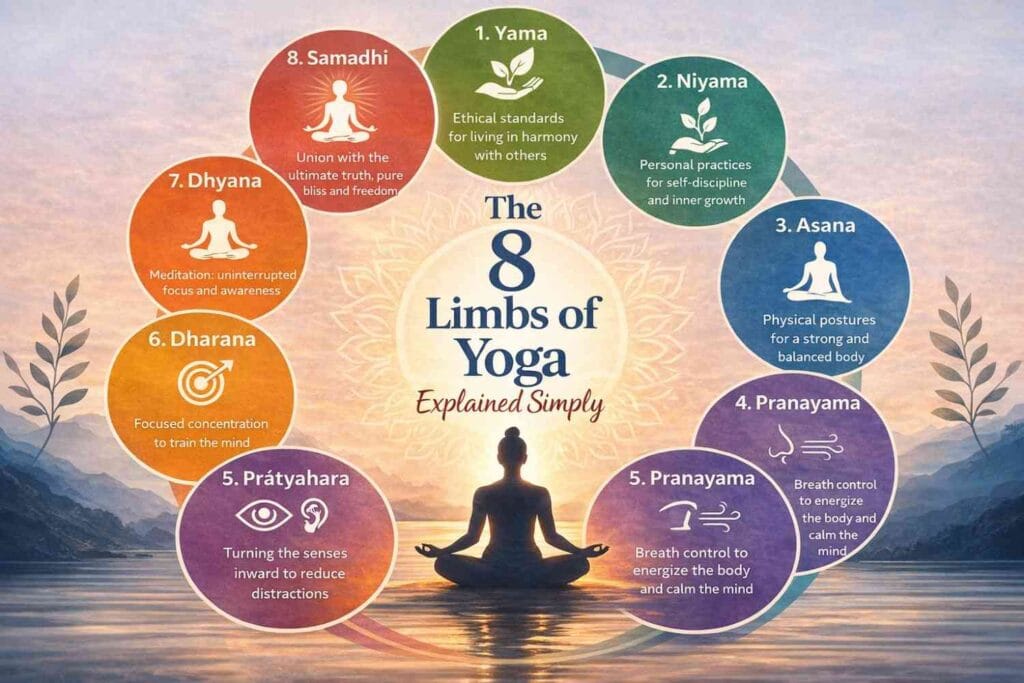
When the word “Yoga” is heard, it is often reduced to postures or breathing techniques. But in the classical understanding of the Patanjali Yoga Sutras, Yoga is not a single practice, it is a complete path. This path, known as Ashtanga Yoga, describes eight interconnected limbs that guide the practitioner from outer discipline to inner stability.
These limbs are not separate techniques to be picked randomly. They function together as a system. The earlier limbs establish balance in behavior and daily life, reducing disturbance, while the later limbs refine attention and awareness. This creates a natural progression from external alignment to internal clarity.
Understanding this changes how Yoga is approached. Instead of focusing on isolated practices, it becomes clear that each aspect supports the whole. Postures, breath, and meditation are not independent goals, but parts of a structured process that gradually leads toward steadiness and deeper understanding.
Why the Eight Limbs Exist
The eight limbs are not meant to be followed as a checklist where each step is completed and left behind. They function as a framework, a way of understanding and working with the different layers of experience that shape how the mind and attention operate.
In the Patanjali Yoga Sutras, this structure exists as a response to the complexity of the human system. The mind is not influenced by a single factor; it is shaped by behavior, habits, physical condition, breath, sensory input, and patterns of attention. If these remain unexamined or unaligned, stability cannot develop.
The eight limbs address this by offering a practical way to work with each of these aspects. Some focus on how one lives and interacts, others on the body and breath, and others on the refinement of attention itself. Each limb supports a different part of the process, but together they create a unified approach.
Seen in this way, the eight limbs are not steps to complete, but conditions that support clarity. They exist so that the path toward steadiness is not abstract, but grounded in how one lives, practices, and observes.
1. Yama – How You Relate to the World
The first limb, Yama, addresses how one lives in relation to others and the world. It focuses on behavior, not as a set of imposed rules, but as a way of reducing disturbance at its source. In the Patanjali Yoga Sutras, principles such as non-harm, truthfulness, and moderation are presented as foundations for stability, not as moral obligations to be followed blindly.
When behavior is reactive, inconsistent, or driven by impulse, it creates friction, both externally in relationships and internally in the mind. This friction does not remain limited to action; it carries forward into thought, emotion, and attention. As a result, the mind becomes unsettled, making it difficult to sustain any deeper form of practice.
Yama works by creating a basic level of order. When actions are aligned and consistent, there is less conflict to process afterward. The mind is not burdened by constant reaction, and attention is not pulled in multiple directions. This does not make the practice easier in a superficial sense, but it makes it possible to move further without interruption.
In this way, Yama is not separate from meditation or awareness, it is what allows them to develop. Without stability in how one relates to the world, the mind remains too disturbed to settle into deeper clarity.
2. Niyama – How You Regulate Yourself
If Yama establishes how one relates to the outer world, Niyama turns inward. It deals with how one maintains order within, through habits, discipline, and inner orientation. In the Patanjali Yoga Sutras, practices such as cleanliness, contentment, self-discipline, and reflection are not presented as ideals, but as practical conditions that influence the stability of the mind.
When internal habits are irregular or scattered, the mind reflects that instability. Constant dissatisfaction, lack of discipline, or absence of reflection creates agitation that carries into every aspect of practice. Even if external behavior is aligned, inner inconsistency can still disturb attention.
Niyama works by creating a steady internal environment. Cleanliness supports clarity, contentment reduces unnecessary striving, discipline builds continuity, and reflection brings awareness to one’s own patterns. These are not abstract qualities, they directly affect how stable and consistent the mind can remain.
In this way, Niyama complements Yama. Where Yama reduces external disturbance, Niyama reduces internal disturbance. Together, they create a foundation where attention can begin to settle without being constantly pulled by habit or reaction.
3. Asana – Stability in the Body
Asana is often the most visible and emphasized aspect of Yoga today, but in the Patanjali Yoga Sutras, it is described with striking simplicity: a posture that is steady and comfortable. This simplicity is deliberate. It shifts the focus away from performance, complexity, or physical achievement, and toward stability.
The purpose of Asana is not flexibility or external form. It is to create a condition where the body can remain still without strain. If the body is restless, uncomfortable, or unstable, it continuously pulls attention toward itself. This makes sustained observation difficult.
A steady posture removes this distraction. When the body is stable, it no longer demands constant adjustment. This allows attention to remain where it is placed, without interruption.
In this sense, Asana is not separate from deeper practices, it supports them directly. It prepares the body so that it does not become an obstacle, allowing stillness to develop without resistance.
4. Pranayama – Regulation of Breath
After posture becomes steady, attention naturally moves to the breath. Pranayama refers to the regulation of breathing, but it is not limited to a physical adjustment. In the Patanjali Yoga Sutras, breath is understood as closely connected to the state of the mind.
This connection can be observed directly. When the breath is uneven, rushed, or strained, the mind often reflects the same pattern, restless and unsettled. When the breath becomes slow, even, and steady, the mind begins to follow that rhythm.
Pranayama works by stabilizing this connection. It does not force the mind to become calm; instead, it influences the conditions that allow calmness to arise. As the breath becomes regulated, the fluctuations of the mind begin to reduce naturally. This makes attention easier to sustain without constant effort.
5. Pratyahara – Turning Attention Inward
Pratyahara is often one of the least understood limbs because it is not as visible as posture or breath. It refers to a shift in how attention relates to sensory input. It is not about shutting off the senses, but about reducing their constant influence over attention.
In ordinary experience, attention is continuously pulled outward, by sounds, sights, and other forms of stimulation. This movement is automatic and often goes unnoticed. As long as attention is driven entirely by external input, it becomes difficult to direct it consciously.
Pratyahara introduces a change in this pattern. The senses remain active, but they no longer dominate attention. Instead of being pulled outward automatically, attention begins to remain where it is placed.
This shift is essential. Without it, concentration cannot develop, because attention would continue to move with every external stimulus. Pratyahara creates the condition where attention can begin to stabilize inwardly.
6. Dharana – Holding Attention
Dharana marks the beginning of deliberate concentration. Here, attention is placed on a single point, such as the breath, a sound, or a chosen object, and the intention is to keep it there.
At this stage, the nature of the mind becomes immediately clear. Attention does not remain steady. It moves repeatedly, shifting from one thought or sensation to another. This movement is not a failure of practice, it is the starting point of understanding how attention functions.
Dharana is not about preventing distraction entirely. It is about the process of returning. Each time attention moves away, it is brought back to the chosen point. This repeated return gradually strengthens the ability to remain focused.
Over time, this develops steadiness. Attention begins to stay for longer periods, not because it is forced, but because it becomes less scattered. Dharana, therefore, is the foundation for deeper states of concentration, where attention is no longer fragmented but continuous.
7. Dhyana – Continuous Attention
When Dharana becomes more stable, it naturally develops into Dhyana. This is what is commonly referred to as meditation, but in the Patanjali Yoga Sutras, it is described with precision. The shift from Dharana to Dhyana is subtle, yet important.
In Dharana, attention is repeatedly brought back to a chosen point. There is effort involved, because attention continues to move away. In Dhyana, this repeated effort begins to reduce. Attention no longer breaks as frequently. Instead, it starts to flow continuously toward the object.
This continuity is what defines Dhyana. The mind is not forced to remain, it remains more naturally. There is less interruption, less fragmentation, and a growing sense of steadiness. The practice moves from effortful holding to a more sustained, uninterrupted awareness.
8. Samadhi – Absorption
Samadhi is described as the culmination of this process, where the distinction between the observer and the object of attention begins to dissolve. It is not a state that can be achieved through force or direct effort.
As described in the Patanjali Yoga Sutras, Samadhi arises when the earlier limbs have developed sufficiently. When attention is steady, uninterrupted, and free from distraction, the separation between “observing” and “what is observed” becomes less defined.
Because of this, Samadhi is not approached as a goal to chase. It is not something to be created. It is a natural outcome of a process where all supporting conditions are in place. When the system is prepared, this state arises on its own.
How the Limbs Work Together
Although the eight limbs are often listed separately, they function as a connected system. Each limb supports a different aspect of stability, and together they create a complete structure for practice.
- Yama and Niyama establish order in behavior and internal discipline
- Asana and Pranayama stabilize the body and regulate the breath
- Pratyahara reduces the influence of external distraction
- Dharana, Dhyana, and Samadhi refine and deepen attention
This interconnectedness is essential. Each limb prepares the ground for the next. When one aspect is neglected or isolated, imbalance can arise. For example, focusing only on posture without addressing behavior or attention may create physical stability, but not mental clarity.
The eight limbs, therefore, are not independent techniques, but parts of a single process. When understood and approached together, they guide the practitioner from external alignment to internal steadiness in a structured and natural way.
Why Modern Practice Feels Incomplete
In many modern settings, Yoga is often reduced to Asana. While this supports physical health, it does not address the full structure described in the Patanjali Yoga Sutras. Without the other limbs, the deeper purpose remains untouched.
This is why regular posture practice may still leave the mind unsettled, the system is only partially engaged.
A Simple Way to Begin
For beginners, the eight limbs do not need to feel complex. They can begin with small, consistent steps: becoming aware of behavior, creating routine, practicing stable postures, observing the breath, and gently training attention.
Over time, these naturally connect and support each other.
A Common Misunderstanding
The eight limbs are often treated as levels to achieve, which creates unnecessary pressure. They are not milestones, but parts of a single process.
They develop together, not strictly one after the other. Understanding this keeps the practice simple, steady, and practical.
The eight limbs of Yoga provide a complete framework for understanding and stabilizing the mind.
They show that Yoga is not limited to posture or breathing, but includes behavior, discipline, awareness, and attention.
When understood simply, they offer clarity.
Not as a theory to memorize, but as a structure to observe and apply gradually.
And within that structure, Yoga becomes less about doing more, and more about understanding better.