Struggling with anxiety, overthinking, or constant worry? Learn how to understand and reduce anxiety using proven methods from yoga, Ayurveda, and ancient scriptures. Discover practical techniques to calm your mind, improve clarity, and regain control over your thoughts and emotions.
Anxiety is one of the most widespread psychological experiences in the modern world. It is often understood as a disorder or weakness, but both ancient Indian scriptures and modern neuroscience suggest that anxiety is a natural outcome of certain patterns of thinking, attachment, and physiological responses.
Texts such as the Yoga Sutras of Patanjali, the Bhagavad Gita, and Ayurvedic treatises like the Charaka Samhita offer a systematic understanding of the mind and its disturbances. These frameworks, when combined with modern research on brain function and behavior, provide a comprehensive method to understand and deal with anxiety.
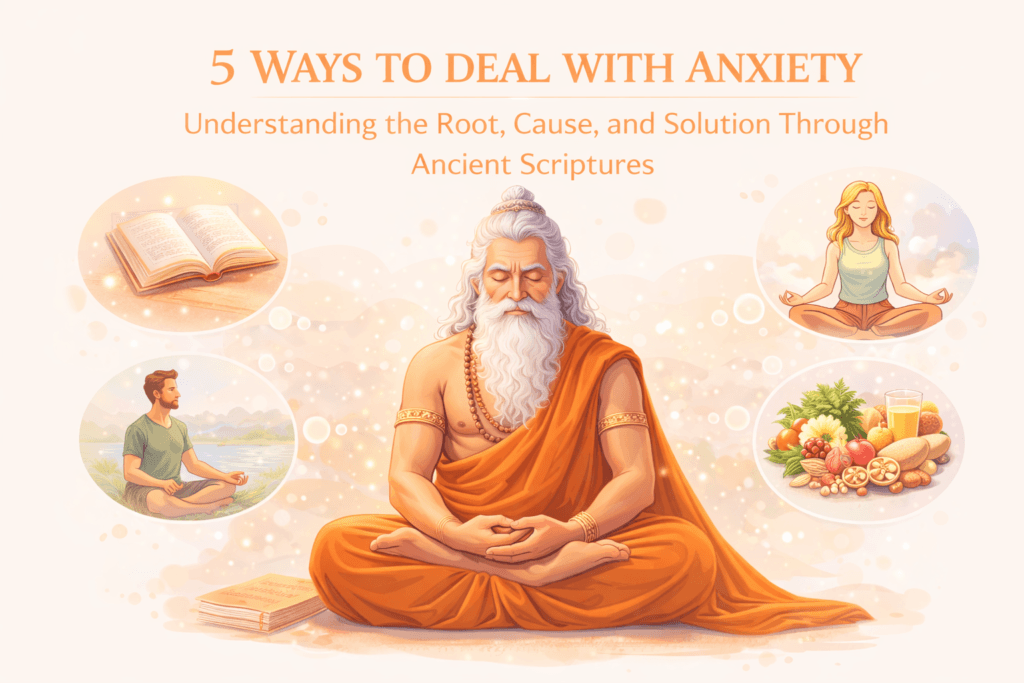
This article explores the nature of anxiety, its underlying causes, and five structured approaches rooted in traditional knowledge that can help reduce its intensity and improve mental clarity.
1. Understanding Anxiety as a Process
Anxiety is not a single event or feeling. It is a process involving thought, emotion, and physiological reaction.
At the cognitive level, anxiety begins with thoughts about the future. These thoughts are often hypothetical and based on uncertainty. At the emotional level, these thoughts create feelings of fear or unease. At the physiological level, the body responds through increased heart rate, shallow breathing, and muscular tension.
These three layers interact continuously. A thought creates an emotional reaction, which affects the body, and the body’s response further reinforces the thought. This creates a feedback loop that sustains anxiety over time.
In the Yoga Sutras of Patanjali, this continuous movement of the mind is described as vrittis, or fluctuations. Anxiety can be understood as a condition where these fluctuations become intense, repetitive, and difficult to disengage from.
2. The Root Causes of Anxiety
Ancient texts do not treat anxiety as random or purely external. They identify specific internal causes.
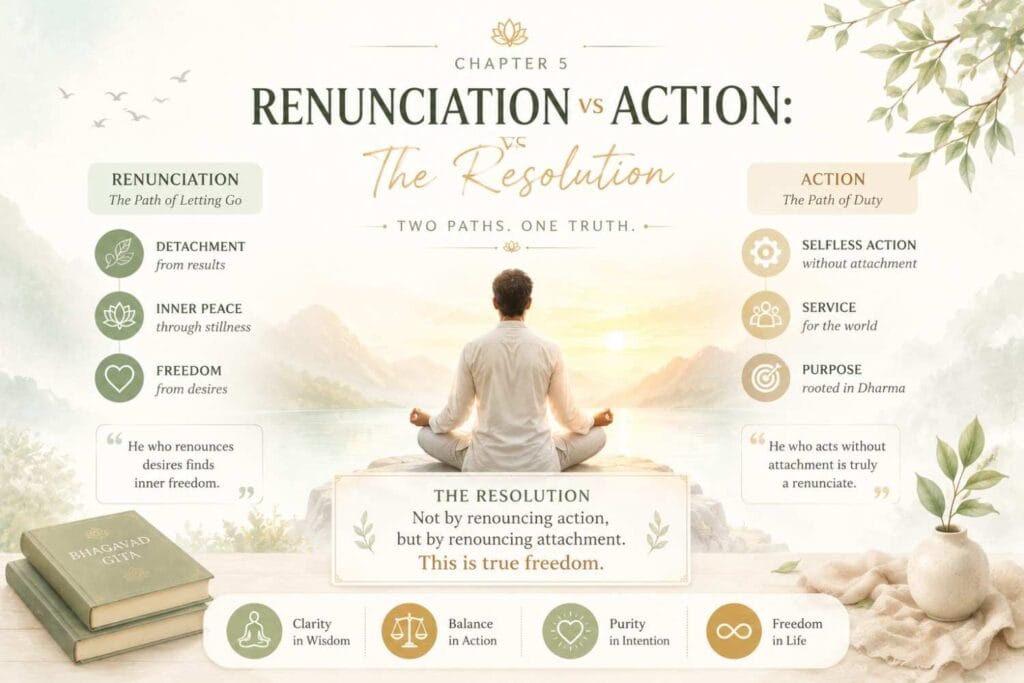
One of the primary causes is attachment to outcomes. When an individual becomes dependent on a specific result, uncertainty about that result generates fear. This idea is clearly expressed in the Bhagavad Gita, where attachment to the fruits of action is described as a source of mental disturbance.
Another cause is identification with thoughts. Instead of observing thoughts as temporary mental events, individuals tend to identify with them. This makes every thought feel personal and significant, increasing its emotional impact.
Desire and aversion also play a role. Desire creates expectations, while aversion creates resistance. Both lead to tension when reality does not match expectation.
Ayurveda adds a physiological perspective. According to the Charaka Samhita, imbalance in the Vata dosha, which governs movement and activity, leads to restlessness, instability, and anxiety.
Modern neuroscience complements these ideas. Overactivity in the brain’s default mode network, which is responsible for internal thinking and self-referential processing, is associated with excessive rumination and anxiety.
Method One: Non-Attachment (Vairagya)
The first method involves reducing attachment to outcomes.
In the Yoga Sutras, non-attachment is defined as freedom from craving and dependence. This does not mean a lack of interest or effort. It means performing actions without psychological dependence on their results.
Attachment creates a mental structure in which the mind constantly evaluates possible outcomes. This evaluation generates uncertainty, and uncertainty generates anxiety.
By reducing attachment, the individual reduces the intensity of this evaluation process. The mind becomes less occupied with hypothetical scenarios and more grounded in present activity.
Practically, this can be applied by focusing on effort rather than result. Instead of asking whether a situation will succeed or fail, attention is directed toward performing the task effectively.
Over time, this reduces fear and creates emotional stability.
Method Two: Action Without Attachment (Karma Yoga)
The second method is closely related but focuses specifically on action.
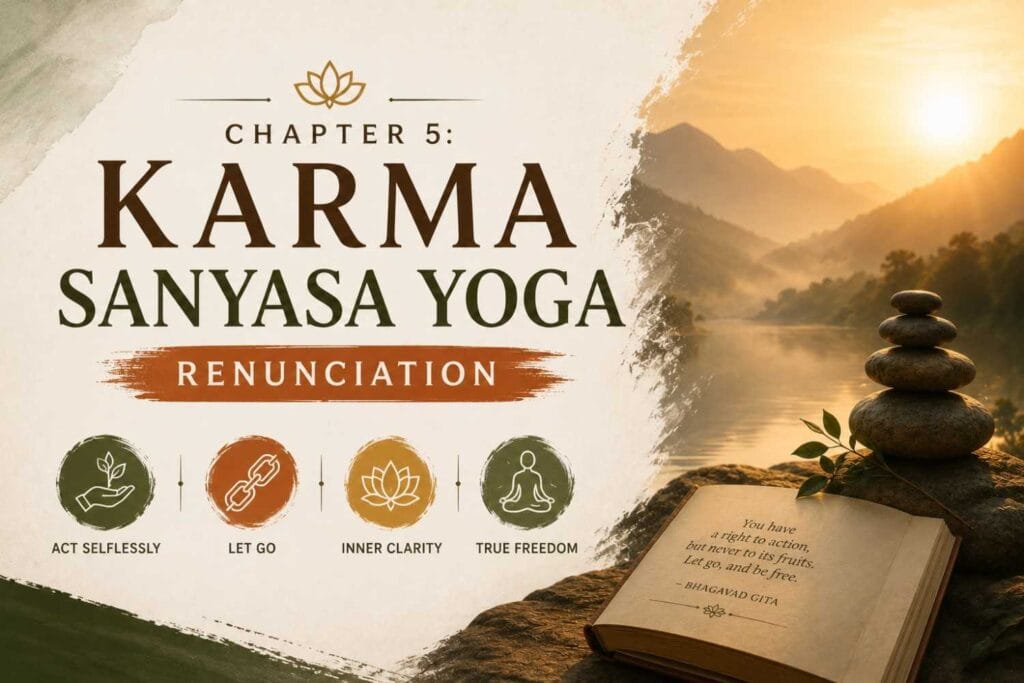
The Bhagavad Gita introduces the concept of Karma Yoga, which emphasizes action without attachment to outcomes.
Anxiety often leads to inaction. When individuals overanalyze possible consequences, they become hesitant to act. This hesitation increases mental activity and reinforces anxiety.
Karma Yoga addresses this by encouraging action despite uncertainty. The focus shifts from controlling outcomes to performing actions correctly.
From a psychological perspective, action interrupts the cycle of rumination. When attention is engaged in meaningful activity, the mind has less capacity to generate repetitive anxious thoughts.
This method is particularly effective in situations where anxiety leads to avoidance. By acting, the individual breaks the cycle of overthinking and gradually builds confidence.
Method Three: Observation of Thoughts
The third method is based on observing thoughts rather than reacting to them.
In the Yoga Sutras, the goal of yoga is described as the stilling of the fluctuations of the mind. This does not imply forceful suppression. It refers to a natural calming that occurs when the mind is not constantly engaged.
Observation involves recognizing thoughts as events occurring within the mind. Instead of identifying with them, the individual maintains a position of awareness.
When a thought arises, it is noticed without judgment or reaction. It is neither suppressed nor followed. This reduces the energy that sustains the thought.
Modern research on mindfulness supports this approach. Studies show that observing thoughts without reacting reduces activity in brain regions associated with rumination.
With practice, the individual begins to see that thoughts are temporary and not inherently meaningful. This reduces their emotional impact and weakens anxiety patterns.
Method Four: Regulation Through Breath
The fourth method focuses on the relationship between breath and the nervous system.
Breathing patterns are closely linked to emotional states. Rapid, shallow breathing is associated with anxiety, while slow, controlled breathing promotes calmness.
Yogic practices emphasize pranayama, or breath regulation, as a means of influencing the mind. By consciously slowing the breath, particularly the exhalation, the parasympathetic nervous system is activated. This system is responsible for relaxation and recovery.
Modern studies have shown that controlled breathing can reduce stress hormones and improve emotional regulation.
A simple practice involves inhaling slowly and exhaling for a slightly longer duration. This creates a calming effect within minutes and can be used during moments of acute anxiety.
Method Five: Consistent Practice (Abhyasa)
The fifth method is consistency.
The Yoga Sutras emphasize that mental stability is achieved through sustained practice. Occasional effort is not sufficient to change deeply ingrained patterns.
Anxiety is often the result of long-standing habits of thinking and reacting. These habits are reinforced over time and cannot be reversed instantly.
Consistent practice gradually weakens these patterns and replaces them with more stable responses.
From a neuroscientific perspective, this is explained through neuroplasticity. Repeated behaviors strengthen certain neural pathways while weakening others.
Daily practices such as observation, breath regulation, and mindful action create long-term changes in how the mind operates.
Integration of All Methods
Each of the five methods addresses a different aspect of anxiety.
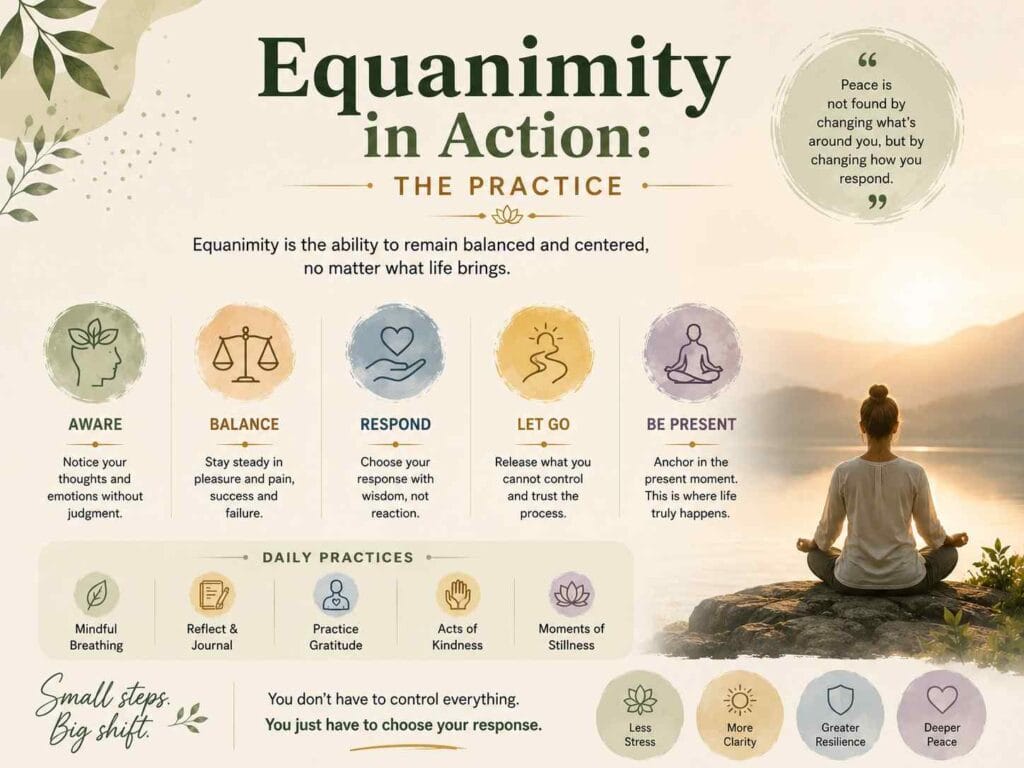
Non-attachment reduces dependence on outcomes. Action reduces overthinking. Observation reduces identification with thoughts. Breath regulation calms the body. Consistent practice ensures long-term change.
When applied together, these methods form a comprehensive system that addresses anxiety at multiple levels.
Final Words
Anxiety is not merely a problem to be eliminated. It is a signal arising from the interaction of thought, emotion, and physiological processes.
Ancient scriptures and modern science both suggest that anxiety cannot be resolved through control or suppression. It requires understanding, observation, and gradual adjustment of behavior and attention.
By applying the principles of non-attachment, mindful action, observation, breath regulation, and consistent practice, individuals can reduce the intensity of anxiety and develop greater clarity and stability.