Learn the complete body scan mindfulness technique through the wisdom of the Yoga Sutras, Bhagavad Gita, and Hatha Yoga Pradipika. Deeply researched and practical.
Introduction
Within many modern mindfulness traditions, the body scan is presented as a relaxation or stress-reduction technique. While these benefits are real, reducing the practice to relaxation alone overlooks its deeper significance.
At its core, the body scan is a discipline of awareness. It is the systematic observation of bodily experience without immediate reaction, judgment, or identification.
Although the specific phrase “body scan” does not appear in classical yogic texts, the foundational principles behind the practice are deeply consistent with teachings found in the Yoga Sutras of Patanjali, the Bhagavad Gita, and the Hatha Yoga Pradipika.
All three traditions repeatedly emphasize:
- awareness of internal experience
- observation without attachment
- regulation of attention
- steadiness of mind
- and refinement of consciousness through disciplined practice
The body scan can therefore be understood not merely as a therapeutic method, but as a practical application of yogic awareness. The body becomes the field through which attention is stabilized.
Instead of allowing the mind to move continuously toward memory, distraction, anxiety, or anticipation, awareness is gradually anchored within direct experience. This process appears simple externally. Yet internally, it reveals how restless, reactive, and conditioned the mind often is.
For this reason, the body scan is not only a method of relaxation. It is a method of observation.
Awareness and the Body in Yogic Thought
Classical yoga does not treat the body as separate from the mind. The relationship between body, breath, nervous system, and attention is considered deeply interconnected.
In the Yoga Sutras of Patanjali, Patañjali repeatedly emphasizes observation of mental fluctuations (vṛttis) and the cultivation of steady awareness. However, direct observation of the mind can initially be difficult because thought moves rapidly and often unconsciously.
The body provides a more accessible entry point. Physical sensation is immediate. It exists in the present moment. Unlike abstract thinking, bodily experience can be observed directly. This is one reason many contemplative traditions begin by stabilizing awareness through the body before progressing toward subtler observation of thought itself. Similarly, the Hatha Yoga Pradipika repeatedly emphasizes preparation of the body and nervous system as a foundation for steadiness of mind. Āsana, breath regulation, and internal awareness are not treated as isolated practices. They are interconnected methods for reducing agitation and refining attention.
The body scan reflects this same principle.
Attention moves systematically through the body not to analyze it intellectually, but to cultivate sustained, non-reactive awareness.
What Is a Body Scan?
A body scan is a structured mindfulness practice in which attention is guided slowly and systematically through different regions of the body while observing physical sensation with clarity and without immediate reaction.
At first glance, the practice appears simple. The practitioner merely notices sensation. Yet this simplicity is precisely what makes the practice profound.
In ordinary life, awareness is usually scattered across thought, memory, planning, emotional reaction, stimulation, and external activity. Attention rarely remains in direct contact with present bodily experience for sustained periods of time.
The body scan reverses this tendency. Instead of allowing awareness to move continuously outward toward distraction or mental activity, attention is gradually anchored within the body itself.
As awareness moves through the body, the practitioner may begin noticing many different forms of sensation, including:
- muscular tension
- warmth or coolness
- pressure
- tingling
- pulsing
- heaviness or lightness
- subtle vibration
- discomfort
- tightness
- restlessness
- or even areas where little sensation appears to exist at all
Importantly, the purpose of the practice is not to force these sensations to change. Nor is the goal to manufacture relaxation artificially or produce unusual experiences. The body scan is fundamentally observational rather than manipulative. This distinction is essential.
Most people relate to bodily sensation unconsciously and reactively. Sensation immediately triggers psychological response:
- discomfort creates resistance
- pleasure creates attachment
- numbness creates impatience
- restlessness creates distraction
- tension creates frustration
These reactions happen rapidly and often automatically. The body scan interrupts this habitual cycle.
Instead of reacting immediately, the practitioner learns to observe sensation directly before automatic psychological interpretation fully takes over. For example, discomfort may simply be observed as sensation before the mind transforms it into irritation or aversion. Pleasant sensation may be noticed without compulsively trying to prolong it.
This develops an entirely different relationship with experience. Awareness becomes less reactive and more stable. Over time, the practitioner begins recognizing that sensations continuously arise, shift, intensify, soften, and disappear on their own. They are dynamic rather than fixed.
This observation is deeply important because it gradually weakens compulsive identification with momentary experience. The body scan therefore becomes more than a relaxation method. It becomes training in sustained awareness, attentional steadiness, and non-reactive observation.
The Philosophical Foundation of the Practice
The body scan aligns closely with one of the central principles found throughout the Yoga Sutras of Patanjali and the Bhagavad Gita: Awareness must gradually become distinct from automatic identification with mental and sensory experience.
Ordinarily, human consciousness becomes immediately absorbed in reaction. Pleasant sensation creates grasping. Unpleasant sensation creates resistance. Neutral experience is ignored entirely. This cycle operates continuously and unconsciously within daily life.
The mind becomes conditioned to move automatically toward attraction and away from discomfort. As a result, inner steadiness becomes difficult because attention remains dependent upon changing conditions. The body scan changes this relationship fundamentally. Instead of reacting immediately to sensation, the practitioner learns to remain present with experience as it unfolds.
This shift may appear subtle, but philosophically it reflects one of the deepest movements within yoga itself. Awareness begins observing experience without becoming completely entangled within it.
This mirrors teachings repeatedly emphasized throughout the Bhagavad Gita:
- acting without compulsive attachment
- remaining steady amidst changing conditions
- observing without losing clarity
- and developing equanimity toward pleasure and discomfort alike
Similarly, in the Yoga Sutras, Patañjali repeatedly emphasizes observation of mental fluctuations (vṛttis) rather than unconscious identification with them.
The body scan provides a direct experiential entry into this process. The practitioner begins observing that sensation itself is not the primary problem. The deeper issue is often the unconscious reaction layered onto sensation. Pain becomes amplified by resistance. Pleasure becomes destabilizing through attachment. Restlessness strengthens through impatience.
By observing sensation without immediate reaction, the practitioner gradually develops equanimity. This does not mean emotional suppression or numbness.
It means the ability to remain aware without becoming fully controlled by every changing sensation or impulse. The body scan therefore becomes much deeper than physical relaxation.
It trains the nervous system and attention to remain more stable amidst change. And through this process, awareness begins separating from compulsive reactivity.
Preparing for the Practice
Although the body scan appears straightforward externally, preparation significantly influences the quality and depth of attention during practice.
Classical yogic systems consistently emphasize that the condition of the environment, posture, breath, and nervous system affects the stability of awareness.
For this reason, preparation is not secondary. It is part of the practice itself.
Before beginning, it is helpful to:
- choose a quiet and relatively undisturbed environment
- minimize unnecessary sensory distraction
- allow the body to settle comfortably
- maintain natural breathing
- and approach the practice without excessive force or expectation
The aim is not rigid concentration. Aggressive effort often creates tension rather than awareness. Instead, attention should remain steady but relaxed. This balance is extremely important. Too much effort can produce agitation, frustration, and mental strain. Too little alertness can lead to dullness, drifting attention, or sleep.
The practitioner gradually learns to cultivate what might be called alert relaxation, a condition in which the body softens while awareness remains awake and attentive.
The posture itself may vary depending on the intention and context of practice.
Some practitioners sit upright in a stable meditative posture. Others practice lying down, particularly when the intention involves deeper physical relaxation or nervous system regulation. If lying down, however, an important distinction must be maintained: the body should relax without collapsing into unconsciousness.
The purpose is awareness, not sleep. This is why posture matters even in seemingly passive mindfulness practices. The body should feel supported enough to release unnecessary tension while still maintaining enough alertness for observation to remain clear. Breathing should generally remain natural.
There is no need to manipulate or control respiration aggressively unless specific breath practices are intentionally being combined with the scan. Natural breathing helps maintain steadiness without creating additional mental effort.
Over time, proper preparation creates the internal conditions necessary for deeper observation. The nervous system settles. Attention becomes less fragmented. And awareness gradually becomes capable of sustained contact with direct experience.
Step-by-Step Body Scan Technique
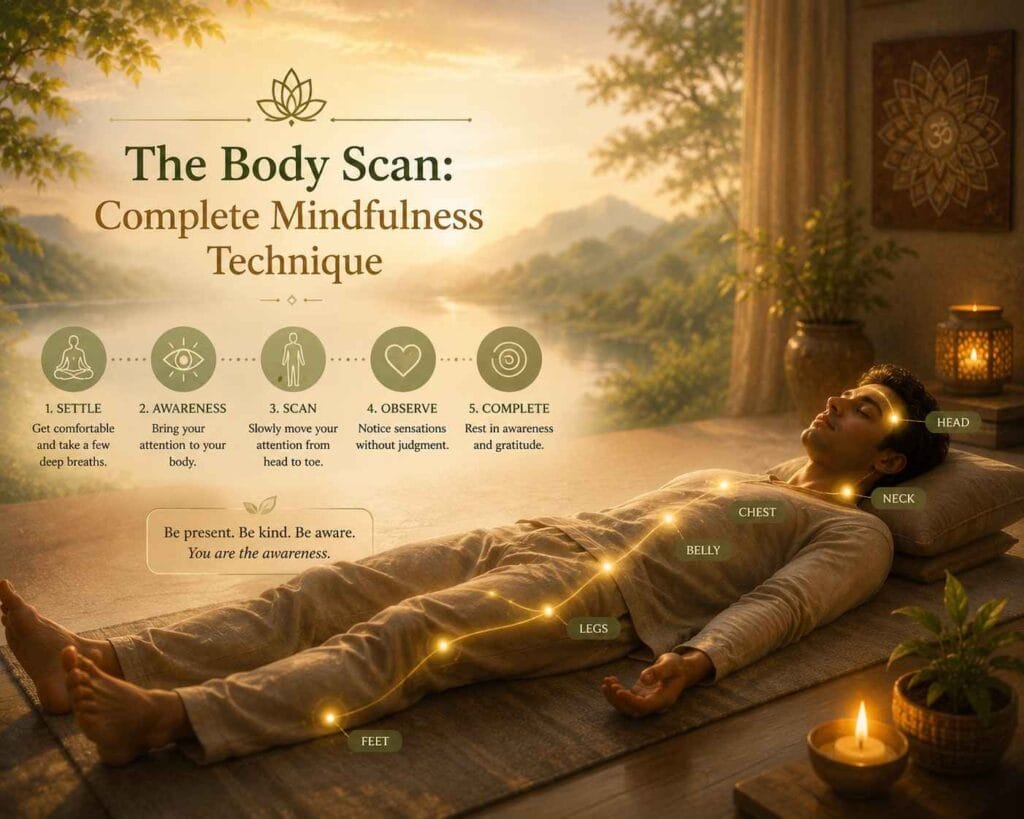
1. Establish Stillness
Begin by allowing the body to become physically still. Notice the contact points between the body and the floor, mat, or chair. Allow breathing to remain natural rather than controlled.
The first stage is not deep concentration. It is settling. Attention gradually withdraws from external stimulation and begins orienting inward.
2. Bring Attention to the Breath
Before scanning the body, briefly observe the natural movement of breathing.
Notice:
- the rise and fall of the abdomen
- movement within the chest
- air passing through the nostrils
- and the rhythm of inhalation and exhalation
This stabilizes attention gently. The breath becomes an anchor preventing the mind from scattering immediately.
3. Begin Systematic Observation
Attention then moves gradually through the body. There is no universally fixed sequence, but many practitioners begin at the feet and move upward slowly toward the head.
At each region, simply observe sensation as it is. There is no need to create sensation artificially.
Some areas may feel vivid. Others may feel neutral or numb. The task is observation without force.
For example:
- toes
- feet
- ankles
- lower legs
- knees
- thighs
- pelvis
- abdomen
- chest
- hands
- arms
- shoulders
- neck
- face
- scalp
The movement of attention should remain gradual and patient.
4. Observe Without Reaction
This stage is central to the practice. When discomfort appears, the ordinary tendency is immediate resistance. When pleasant sensation appears, attachment arises.
The body scan trains another possibility: observation without compulsive reaction.
The practitioner notices: “This sensation exists.”
Without immediately adding:
“I need this to stop.”
Or:
“I want this to continue.”
This cultivates equanimity.
5. Recognize Wandering Attention
The mind will wander repeatedly. Thoughts, memories, plans, emotions, and distractions naturally arise.
This is not failure. It is part of observation itself.
The practitioner simply notices distraction and gently returns attention to direct bodily experience. Over time, this strengthens attentional stability.
The Relationship Between Sensation and Mind
One of the most important insights revealed through body scan practice is the intimate relationship between mental and physical states.
Thoughts influence bodily tension. Emotion affects breathing. Anxiety contracts muscles. Fear changes heartbeat. Stress alters posture. The body continuously reflects mental movement.
As awareness deepens, the practitioner begins observing these relationships directly rather than only conceptually. This is highly consistent with yogic understanding.
The Hatha Yoga Pradipika repeatedly teaches that body, breath, and mind influence one another continuously. The body scan allows this relationship to become experiential rather than theoretical.
Why the Practice Is Powerful
The body scan becomes powerful not because it produces dramatic experiences, but because it retrains attention gradually and consistently.
Modern life fragments awareness continuously through:
- overstimulation
- distraction
- multitasking
- emotional reactivity
- and constant cognitive engagement
The mind becomes conditioned to movement. Sustained observation becomes difficult. The body scan reverses this tendency. Attention learns to remain present with immediate experience without compulsive escape into distraction.
This develops:
- steadiness
- emotional regulation
- self-awareness
- nervous system calming
- and increased sensitivity to internal states
Over time, the practitioner becomes less reactive and more observant. This shift is subtle but profound.
Common Misunderstandings
The body scan is often misunderstood as:
- merely relaxation
- passive resting
- or forced concentration
In reality, it is an active discipline of awareness. Another misunderstanding is expecting immediate calmness.
Sometimes the practice initially reveals restlessness, discomfort, emotional tension, or mental agitation that previously remained unnoticed. This is not regression. It is increased awareness. The purpose of mindfulness is not to instantly remove all discomfort. It is to observe experience clearly without unconscious reaction.
Relevance in Modern Life
The body scan remains highly relevant because modern environments frequently disconnect individuals from direct bodily awareness.
Many people remain mentally overstimulated while physically disconnected from internal sensation. Stress accumulates unnoticed. Breathing becomes shallow. Tension becomes normalized. Attention remains externally absorbed for long periods without conscious inward observation. The body scan interrupts this pattern. It restores contact with immediate embodied experience.
This restoration has both psychological and physiological significance because awareness itself begins regulating reactivity.
The body scan is far more than a relaxation exercise. Within the larger context of yoga, it can be understood as a disciplined practice of awareness grounded in direct observation of bodily experience.
Its principles align deeply with teachings found in the Yoga Sutras of Patanjali, the Bhagavad Gita, and the Hatha Yoga Pradipika:
- steadiness of attention
- observation without attachment
- regulation of reactivity
- and refinement of consciousness
The practice gradually teaches the practitioner to observe sensation, thought, and internal experience without becoming completely identified with them.
Through this process, awareness becomes steadier. Reaction weakens. And the possibility of inner clarity begins to deepen.
Also read: Body Scan Meditation: A Complete Guide