
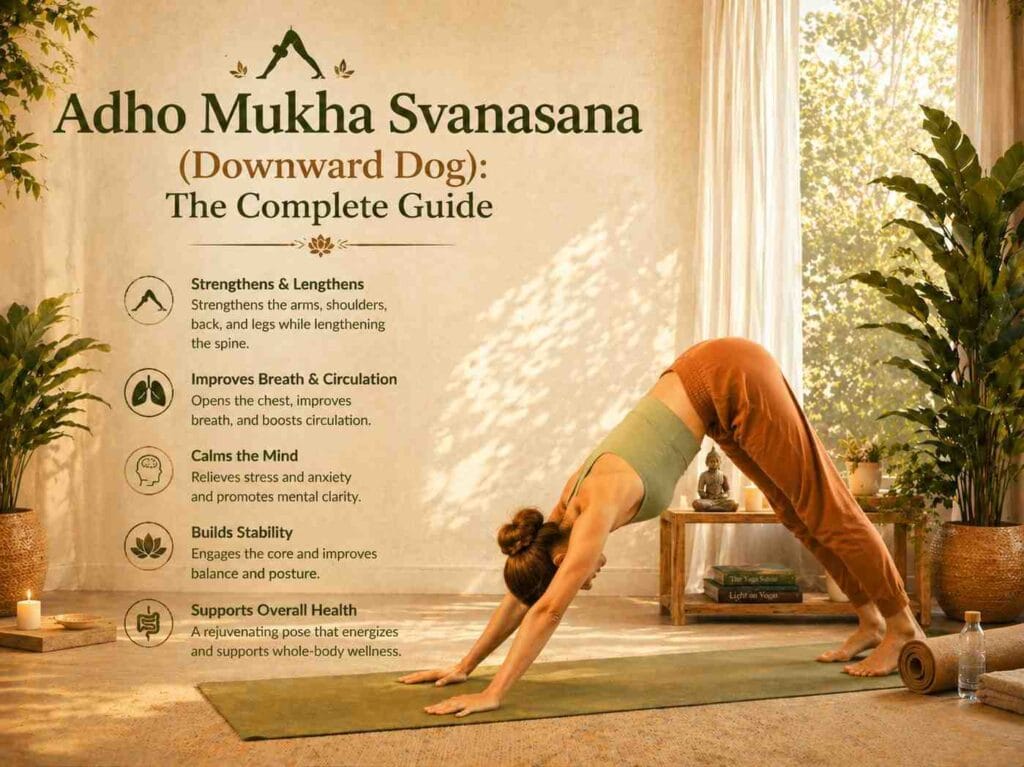
Learn Adho Mukha Svanasana (Downward Dog) with this complete guide covering benefits, alignment, structural mechanics, breathing, common mistakes, and yogic significance.
Introduction
Adho Mukha Śvānāsana, commonly known as Downward Dog, is one of the most recognized postures in modern yoga practice.
It appears in beginner classes, advanced sequences, therapeutic routines, and dynamic styles such as Vinyasa Yoga. Despite its widespread familiarity, the posture is often practiced mechanically without fully understanding its structural purpose, energetic qualities, or relationship to traditional yogic principles.
Unlike many postures commonly associated with classical Haṭha Yoga texts, Adho Mukha Śvānāsana is not explicitly described in the Hatha Yoga Pradipika. However, the principles underlying the posture, spinal elongation, steadiness, breath regulation, circulation, and nervous system balance, closely align with the broader aims of traditional yoga practice.
Modern yoga systems developed and expanded significantly during the late 19th and 20th centuries, incorporating influences from traditional āsana practice, physical culture, movement systems, and therapeutic anatomy. Adho Mukha Śvānāsana became central within these evolving systems because it integrates multiple functional qualities into a single posture.
The posture combines:
- spinal extension
- shoulder stability
- hamstring lengthening
- arm engagement
- breath awareness
- and nervous system regulation
At first glance, Downward Dog may appear simple.
In practice, however, it requires coordinated alignment, balanced muscular engagement, and mindful distribution of effort throughout the body. When practiced correctly, the posture develops both strength and release simultaneously. It energizes the body while calming mental agitation.
And because of its versatility, it functions both as an active strengthening posture and as a transitional resting position within flowing sequences.
Meaning of the Name
The Sanskrit term Adho Mukha Śvānāsana carries more depth than a simple descriptive label.
Each word reflects both the physical orientation of the posture and the observational approach through which many traditional yoga postures were understood.
The name can be divided into four parts:
- Adho – downward
- Mukha – face or facing
- Śvāna – dog
- Āsana – posture or seat
Together, the phrase translates approximately as:
“Downward-Facing Dog Posture.”
At first glance, the name appears straightforward because the body resembles the instinctive stretching movement commonly observed when a dog extends its spine and limbs after rest.
However, this comparison carries deeper significance within yogic understanding.
Traditional yoga often developed through close observation of efficient natural movement patterns rather than through rigid mechanical exercise systems. Many classical postures were inspired by qualities observed in nature, stability, adaptability, groundedness, alertness, extension, or relaxation.
The movement associated with a stretching dog is remarkably functional. The spine lengthens naturally. The limbs extend without excessive force. The body awakens gradually after stillness. There is both activation and release occurring simultaneously. This balance reflects an important principle within yoga practice itself.
Adho Mukha Śvānāsana is not intended to create aggressive muscular strain or forced flexibility. Instead, it develops coordinated extension throughout the body while maintaining steadiness and breath awareness.
The posture therefore embodies two qualities at the same time:
- elongation
- and release
The body actively engages, yet unnecessary tension gradually softens. This balance between effort and ease appears repeatedly throughout traditional yogic teachings and remains central to skillful āsana practice.
The Purpose of the Posture
In many modern yoga systems, Adho Mukha Śvānāsana functions as a foundational transitional posture connecting standing sequences, inversions, balances, and floor-based movements.
Because it appears frequently within flowing styles of yoga, many practitioners begin treating it merely as a “resting position” between more demanding postures. However, this interpretation can overlook the deeper structural and physiological value of the posture itself.
Adho Mukha Śvānāsana is not simply a transition. It is a highly integrated full-body posture that develops multiple qualities simultaneously.
Its functions include:
- spinal decompression
- upper body strengthening
- elongation of the posterior chain
- postural organization
- breath expansion
- circulatory support
- and nervous system regulation
One of the posture’s most important actions is the creation of axial extension through the spine.
Modern lifestyles often involve prolonged sitting, forward head posture, reduced spinal mobility, and compressive loading through the neck and lower back. Adho Mukha Śvānāsana counteracts many of these patterns by encouraging length through the entire spinal column.
The hips move upward and backward while the arms actively press into the ground, creating opposing directional forces that help decompress the spine.
At the same time, the posture develops structural support through the shoulders, upper back, wrists, arms, and core. This combination of strength and lengthening is one reason the posture is considered so foundational within modern yoga systems.
Importantly, the posture also influences breathing.
When the spine lengthens and the ribcage broadens appropriately, respiratory movement often becomes more spacious and efficient. The breath therefore becomes an integral part of the posture rather than something secondary to it.
The nervous system response is equally important.
Although physically active, Downward Dog often creates a stabilizing and regulating effect when practiced with smooth breathing and balanced effort. The mild inversion alters circulation and orientation within the body while encouraging attentional steadiness.
This reflects a broader yogic principle: The purpose of āsana is not simply external flexibility or physical performance. It is the cultivation of integrated balance between structure, breath, attention, and nervous system regulation. For this reason, the intention of Adho Mukha Śvānāsana is not maximum range of motion. The aim is sustainable alignment with coordinated muscular engagement and steady awareness.
When practiced skillfully, the posture develops what may be called structural intelligence, the body learns how to organize effort efficiently rather than relying on force alone.
How to Practice Adho Mukha Śvānāsana
Step-by-Step Method
Although Downward Dog appears visually simple, the posture requires careful coordination throughout the entire body.
The quality of the posture depends less on external appearance and more on how effectively the body distributes weight, lengthens the spine, and maintains stable breathing.
Begin in a tabletop position on the hands and knees.
The hands should be positioned approximately shoulder-width apart with the fingers spread comfortably. Pressing evenly through the palms and fingertips helps distribute load across the hands rather than collapsing excessive pressure into the wrists alone.
The knees remain approximately hip-width apart.
From this position: Press firmly through the hands and gently lift the knees from the floor. As the hips begin moving upward and backward, gradually straighten the legs without forcing them into rigid extension.
The movement of the pelvis is extremely important.
Rather than simply pushing downward toward the floor, the hips should lift diagonally upward and backward to create maximum length through the spine.
At the same time, the chest moves gently toward the thighs while the arms remain active and supportive.
The shoulders should not collapse toward the ears. Instead, the upper back broadens while the neck remains relaxed.
The head stays aligned naturally between the arms without excessive tension in the neck or jaw.
The heels may move toward the floor, but contact with the ground is not required.
For many practitioners, especially beginners or individuals with tight hamstrings, forcing the heels downward often creates compensatory spinal rounding and excessive tension.
This is why slightly bent knees are frequently beneficial.
Bent knees allow the pelvis to tilt more effectively and help maintain spinal elongation, which is the primary structural goal of the posture.
Breathing should remain smooth and continuous throughout.
If breathing becomes strained or restricted, it often indicates excessive muscular effort or overextension.
The posture should feel active and engaged, but not aggressive.
This distinction is essential.
Yoga postures are not meant to be forced mechanically into external shapes. Their purpose is integrated organization of movement, breath, awareness, and stability.
Understanding the Structural Mechanics
Adho Mukha Śvānāsana is frequently misunderstood as merely a hamstring stretch.
In reality, it is a complex integrated posture involving coordinated action throughout multiple systems simultaneously.
The posture includes:
- shoulder flexion and stabilization
- spinal extension and axial lengthening
- hip flexion
- posterior chain elongation
- core stabilization
- and upper-body weight-bearing mechanics
This combination explains why the posture develops both strength and mobility together.
One of the most important structural principles is that the spine remains the priority. Many practitioners become overly focused on external appearance, particularly straight legs or heels touching the floor. However, these goals become problematic if they compromise spinal organization.
If hamstring tightness causes the lower back to round excessively, the knees should bend slightly. This adjustment allows the pelvis to rotate more effectively and preserves length through the spine. Preserving spinal integrity is more important than achieving an externally “perfect” shape.
The posture is therefore not about forcing flexibility. It is about balanced integration. The arms actively press the floor away. The shoulders stabilize. The core supports the spine. The hips lift upward. The legs ground downward. These opposing actions create length and stability simultaneously.
Over time, consistent practice gradually improves both mobility and structural support together rather than emphasizing passive stretching alone. This distinction is important because healthy movement depends not simply on flexibility, but on coordinated stability within movement itself. Adho Mukha Śvānāsana develops this coordination exceptionally well when practiced with awareness and proper alignment.
Key Alignment Principles
Several alignment principles significantly improve both safety and effectiveness within the posture.
1. Lengthen the Spine First
The primary action is spinal elongation rather than pushing the heels aggressively downward. The hips lift upward and backward while the chest gently moves toward the thighs.
2. Distribute Weight Evenly
Many practitioners overload the wrists.
Weight should distribute through:
- palms
- fingertips
- shoulders
- hips
- and legs together
The posture is not a passive hanging position.
3. Maintain Shoulder Stability
The shoulders should remain active and externally supported rather than collapsing toward the ears. The upper back broadens while the neck stays relaxed.
4. Avoid Hyperextension
Locking the knees or elbows aggressively creates unnecessary joint stress. The posture should feel engaged but not rigid.
5. Breathe Continuously
Breath should remain smooth and stable. Holding the breath often indicates excessive tension or overexertion.
Benefits of Adho Mukha Śvānāsana
Spinal Decompression
The posture lengthens the spine and may help reduce compressive tension accumulated through prolonged sitting or poor posture.
Shoulder and Arm Strength
Because the upper body bears significant weight, the posture develops stability through the shoulders, arms, wrists, and upper back.
Hamstring and Calf Mobility
The posterior chain gradually lengthens through consistent practice without requiring aggressive stretching.
Improved Postural Awareness
The posture develops coordination between the pelvis, spine, shoulders, and limbs.
Breath Expansion
The position of the ribcage may support fuller breathing and increased awareness of respiratory movement.
Circulatory Support
As a mild inversion, the posture alters gravitational relationship within the body and may support circulation and mental refreshment.
Nervous System Regulation
Although physically active, the posture often creates a calming effect when combined with slow breathing and sustained attention.
The Relationship Between Strength and Flexibility
One of the reasons Adho Mukha Śvānāsana is so valuable is that it develops both strength and mobility simultaneously. Modern yoga culture sometimes separates these qualities unnecessarily. However, healthy movement depends on their integration.
The posture strengthens:
- shoulders
- arms
- wrists
- upper back
- and core stabilizers
while simultaneously improving mobility within:
- hamstrings
- calves
- hips
- and spinal tissues
This balance helps create functional rather than purely aesthetic flexibility.
Common Mistakes
Rounding the Spine
One of the most common errors occurs when tight hamstrings pull the pelvis backward excessively, causing the spine to round. Slight knee bending is preferable to spinal collapse.
Collapsing Into the Shoulders
Allowing the shoulders to sink heavily creates instability and excessive pressure in the upper body.
Overemphasizing Heel Contact
The heels do not need to touch the floor. Forcing them downward often distorts alignment elsewhere.
Excessive Wrist Pressure
Poor weight distribution can overload the wrists unnecessarily. The hands should actively press into the floor.
Holding Tension in the Neck
The neck should remain relaxed rather than rigidly lifted.
Modifications for Beginners
Many practitioners initially lack the mobility or strength to enter the posture comfortably. Modifications are therefore important.
Beginners may:
- bend the knees
- shorten stance length
- elevate the hands on blocks
- practice against a wall
- or reduce holding duration initially
These modifications are not “lesser” versions. They allow the posture to remain structurally intelligent while the body develops gradually.
Precautions
The posture may require modification or caution in cases involving:
- wrist injuries
- shoulder instability
- severe hamstring injury
- uncontrolled high blood pressure
- glaucoma
- or acute dizziness
Pregnant practitioners or individuals with medical conditions should seek guidance from qualified professionals where appropriate.
The Energetic Perspective
Within broader yogic understanding, postures influence not only muscular structures, but also energy, attention, and nervous system regulation.
Adho Mukha Śvānāsana combines grounding through the limbs with extension through the spine and breath. This creates a quality that is simultaneously stabilizing and energizing. The posture often helps reduce mental heaviness while improving alertness without excessive stimulation. This balance between effort and steadiness reflects an important yogic principle:
The posture should cultivate awareness rather than aggression.
Adho Mukha Śvānāsana in Modern Practice
Today, Downward Dog functions as one of the foundational postures within many modern yoga systems because it integrates multiple physical and psychological benefits efficiently.
It may function as:
- a strengthening posture
- a transitional movement
- a resting position within sequences
- a mobility exercise
- or a breath-centered awareness practice
Its adaptability explains why it remains central across styles ranging from therapeutic yoga to dynamic Vinyasa systems. Yet despite its popularity, the posture remains most effective when practiced mindfully rather than mechanically. Depth within yoga rarely depends on complexity alone. Often, it depends on how awareness is brought into foundational practices repeatedly.
Adho Mukha Śvānāsana is far more than a transitional posture within yoga sequences.
When practiced correctly, it develops integrated strength, spinal lengthening, breath awareness, structural balance, and nervous system regulation simultaneously.
Although not explicitly listed within classical Haṭha Yoga texts such as the Hatha Yoga Pradipika, the principles embodied within the posture align closely with traditional yogic aims: steadiness, balance, breath regulation, and mindful awareness.
Its value lies not in how advanced it appears externally, but in how effectively it organizes the body and attention internally. Like many meaningful yoga practices, its depth emerges gradually through consistency, alignment, breath, and awareness rather than force or performance alone.