Explore Yoga Sutras 1.30–1.32 in depth. Discover Patañjali’s nine obstacles to meditation, the connection between mind, body, and breath, and the yogic solution for inner steadiness and concentration.
Introduction
After describing meditation, surrender, Īśvara, and the contemplative significance of Om in the earlier sutras, Yoga Sutras of Patanjali now turns toward a deeply practical question:
Why is the mind so difficult to stabilize? This shift is extremely important.
Many spiritual teachings describe higher states of awareness, concentration, or liberation, but Patañjali also recognizes a fundamental psychological reality:
human beings repeatedly encounter inner resistance on the path of practice.
The mind does not become steady automatically.
Even sincere practitioners experience: doubt, fatigue, distraction, restlessness, loss of motivation, emotional instability, and inner conflict.
Rather than treating these struggles as personal failure, Patañjali analyzes them systematically. This is one reason the Yoga Sutras remain psychologically sophisticated even today.
Instead of presenting spiritual growth romantically, the text openly examines the actual obstacles that disturb concentration and destabilize awareness.
Sutras 1.30–1.32 therefore become some of the most psychologically practical teachings in the entire Yoga Sutras because they identify the major disturbances affecting meditation and inner steadiness while also offering a direct method for working with them.
Importantly, these obstacles are not limited to formal spiritual practice alone.
They also appear throughout ordinary life.
Modern individuals may experience the same disturbances through: constant distraction, mental exhaustion, overthinking, lack of consistency, digital overstimulation, emotional imbalance, or fragmented attention.
This makes the sutras surprisingly relevant in contemporary life.
Patañjali’s analysis reveals that the challenges of the human mind have remained remarkably consistent across centuries.
Sutra 1.30
व्याधिस्त्यानसंशयप्रमादालस्याविरतिभ्रान्तिदर्शनालब्धभूमिकत्वानवस्थितत्वानि चित्तविक्षेपास्तेऽन्तरायाः ॥
Transliteration
Vyādhi-styāna-saṁśaya-pramādālasya-avirati-bhrānti-darśana-alabdha-bhūmikatvānavasthitatvāni citta-vikṣepās te ’ntarāyāḥ
Translation
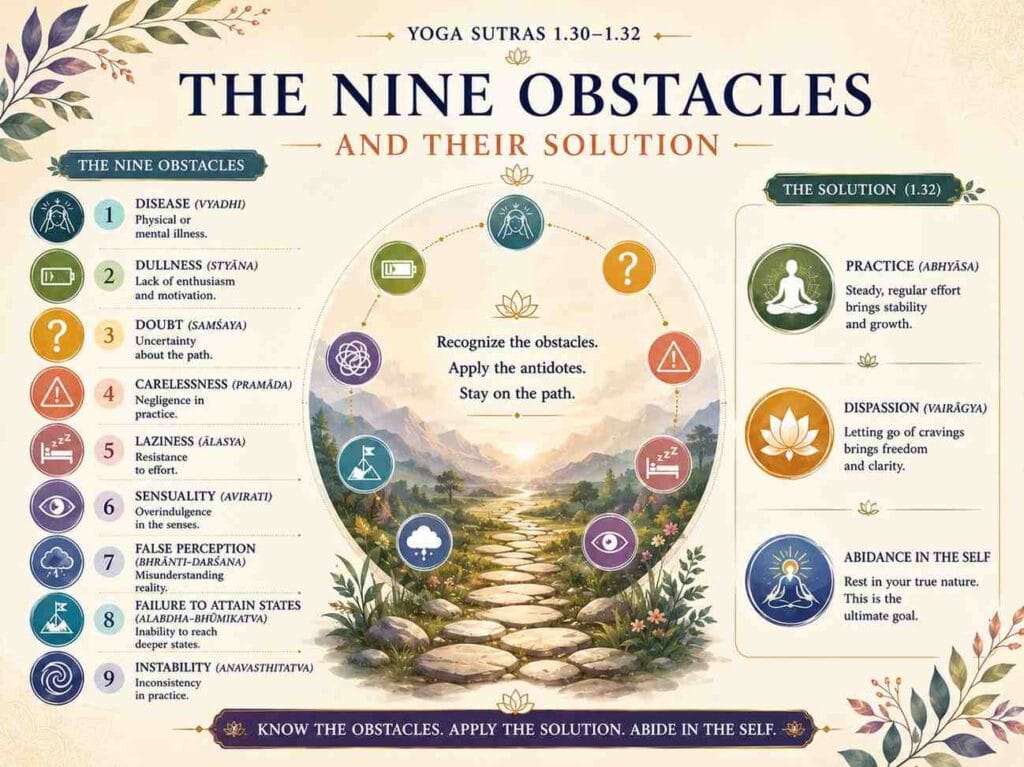
“Disease, dullness, doubt, carelessness, laziness, sensual attachment, false perception, failure to attain stages of practice, and instability in maintaining them are the distractions of the mind and obstacles.”
This sutra is one of the most psychologically detailed teachings in the entire Yoga Sutras of Patanjali because Patañjali openly analyzes why the mind repeatedly loses steadiness.
Many spiritual systems focus heavily on ideal states: peace, samādhi, clarity, liberation, or transcendence. Patañjali does something different here.
He studies the actual mechanics of inner disturbance.
Instead of pretending spiritual practice is always peaceful or inspiring, he acknowledges a difficult reality: the mind resists steadiness constantly. This makes the sutra deeply human.
Every practitioner eventually encounters phases of: confusion, loss of motivation, restlessness, distraction, fatigue, or discouragement.
Patañjali normalizes these experiences rather than treating them as proof of failure.
This is psychologically compassionate because people often become discouraged precisely when obstacles appear.
They assume: “My practice is not working.” “Something is wrong with me.” “I am incapable of meditation.”
Patañjali suggests the opposite. Obstacles are part of the structure of the mind itself. Recognizing them clearly becomes part of practice.
The term citta-vikṣepa is especially important. It refers to distraction, scattering, or fragmentation of consciousness. The mind loses its center and becomes pulled in multiple directions continuously.
This fragmentation prevents deeper concentration and inner steadiness from developing consistently.
The nine obstacles Patañjali lists are therefore not random problems. They are forces that destabilize awareness itself.
Vyādhi – Physical Illness
The first obstacle is vyādhi, illness, imbalance, or physical disorder. Patañjali begins with the body deliberately.
This is significant because yoga philosophy is often misunderstood as purely mental or spiritual.
In reality, classical yoga recognizes that the body strongly influences consciousness.
When the body experiences: pain, chronic fatigue, inflammation, hormonal imbalance, digestive disturbance, injury, or nervous system exhaustion, attention naturally becomes unstable.
Meditation becomes more difficult because awareness repeatedly gets pulled toward discomfort. This insight feels strikingly contemporary today.
Modern neuroscience and psychology increasingly recognize how deeply physical states affect mood, cognition, attention, and emotional regulation.
Poor sleep alone, for example, can dramatically affect: focus, emotional stability, memory, motivation, and mental clarity.
Patañjali recognized thousands of years ago that inner steadiness cannot be separated entirely from physical condition.
This does not mean yoga demands perfect health before practice begins.
Rather, it acknowledges that embodiment matters.
The condition of the nervous system, breath, posture, and physiology influences meditation directly.
This is one reason later yogic traditions developed practices involving: āsana, diet, breathing regulation, cleansing techniques, and lifestyle balance.
The body was understood as participating in consciousness rather than existing separately from it.
Styāna – Mental Dullness and Inner Inertia
The second obstacle, styāna, is much subtler. It refers to mental stagnation, heaviness, dullness, or lack of psychological vitality. This is not simple relaxation or calmness.
Instead, awareness loses sharpness and aliveness.
The practitioner may still intellectually value yoga or meditation, yet inwardly the mind feels: foggy, passive, uninspired, emotionally flat, or psychologically inactive.
Meditation then becomes mechanical rather than deeply attentive. A person may sit for practice physically while inwardly remaining disconnected and absent.
This obstacle is important because many people mistake dullness for peace. However, Patañjali distinguishes true steadiness from low-energy passivity.
Real meditative clarity contains alertness. Awareness becomes quiet but not unconscious. Styāna resembles a cloud settling over consciousness.
The mind loses its capacity for sustained depth. This condition may arise through: emotional exhaustion, overstimulation, lack of sleep, depression, burnout, poor lifestyle rhythm, or prolonged mental overload.
Modern life intensifies this obstacle significantly.
Many individuals remain continuously overstimulated while simultaneously mentally exhausted.
As a result, attention loses both steadiness and vitality.
Patañjali’s analysis remains remarkably relevant because he recognizes that consciousness does not only become restless.
It may also become psychologically heavy and inert. Both conditions disturb yoga.
Saṁśaya – Doubt and Fragmented Commitment
Among all obstacles, saṁśaya, doubt, may be one of the most destabilizing psychologically.
Doubt divides energy internally.
The practitioner cannot move fully in one direction because awareness remains split between trust and uncertainty.
The mind begins generating endless questions: “Does meditation actually work?” “Am I wasting my time?” “What if transformation is impossible?” “Why am I not progressing fast enough?” “Maybe another path would be better.”
Patañjali is not criticizing intelligent inquiry here. Healthy questioning can deepen understanding. The obstacle arises when doubt becomes chronic fragmentation.
Instead of supporting clarity, the mind endlessly destabilizes itself through hesitation and second-guessing.
This prevents continuity of practice. Consciousness keeps restarting itself repeatedly. The deeper psychological issue behind doubt is often fear. The ego fears sustained transformation because genuine practice gradually changes identity itself.
Meditation destabilizes familiar mental structures. Part of the mind resists this uncertainty.
Thus, doubt frequently becomes a defense mechanism protecting old conditioning.
Modern culture often intensifies saṁśaya because people are constantly exposed to competing opinions, endless information, and comparison.
Attention becomes scattered across countless possibilities without depth anywhere. Patañjali therefore emphasizes steadiness and continuity rather than endless mental fluctuation.
Pramāda – Carelessness and Loss of Awareness
Pramāda refers to negligence, carelessness, inattentiveness, or unconscious living.
This obstacle is subtle because the practitioner may technically continue practicing while losing genuine awareness internally.
Meditation becomes automatic. Practice loses sincerity. The person stops observing carefully and begins functioning mechanically. This often happens gradually.
At first, practice feels alive and intentional.
Over time, however, awareness becomes diluted through habit and distraction.
The practitioner knows what supports clarity but repeatedly ignores it unconsciously.
For example: ignoring rest, losing mindfulness during daily life, allowing distraction to dominate attention, or practicing without genuine presence.
Patañjali identifies this because yoga requires attentiveness rather than routine alone. Mechanical repetition without awareness does not transform consciousness deeply.
Pramāda is dangerous precisely because it appears ordinary. The practitioner may continue outward practice while inwardly losing wakefulness.
This insight feels psychologically sophisticated because human beings often function automatically without recognizing how unconscious their behavior has become.
Ālasya – Laziness and Resistance Toward Transformation
Ālasya is usually translated as laziness, but the meaning goes deeper than simple unwillingness to work.
It refers to resistance toward necessary effort and transformation.
Part of the mind wants growth. Another part resists the discomfort required for change. This creates inner conflict.
Human beings often remain attached to familiar suffering because the unknown feels threatening psychologically.
Old habits may create pain, yet they also create familiarity and identity. Meditative discipline gradually destabilizes these patterns. The ego resists this process naturally. Thus, laziness in yoga philosophy is not merely physical inactivity.
It is the inertia of conditioned consciousness itself.
The practitioner delays practice, avoids discipline, postpones inward observation, or continuously seeks comfort instead of depth.
This obstacle becomes extremely relevant today because modern environments encourage instant gratification constantly.
Attention becomes conditioned toward convenience, stimulation, and immediate reward. Deep practice, however, develops slowly through continuity. Patañjali therefore recognizes inertia as one of the major forces opposing inner transformation.
Avirati – Addiction to Stimulation
Avirati refers to inability to withdraw from sensory attachment and external engagement.
Attention continuously moves outward toward stimulation.
The mind becomes dependent upon: entertainment, novelty, pleasure, social validation, emotional drama, or constant engagement. This obstacle feels especially modern.
Digital environments now compete aggressively for human attention every moment.
People rarely experience silence or uninterrupted inwardness. Notifications, videos, advertisements, social media feeds, streaming platforms, and endless information continuously fragment awareness.
The nervous system becomes habituated to stimulation. As a result, stillness begins feeling uncomfortable.
Many individuals cannot remain quietly present even for a few minutes without seeking distraction. Patañjali recognized this psychological tendency long before technology existed.
The mind naturally chases stimulation because it fears emptiness and silence.
However, continuous outward engagement weakens the capacity for inward steadiness. This is why yoga repeatedly emphasizes withdrawal from compulsive sensory dependence.
Not because the world is evil, but because endless distraction prevents awareness from becoming stable and inwardly clear.
Bhrānti-Darśana – Illusion and Mistaken Understanding
One of the most sophisticated obstacles Patañjali describes is bhrānti-darśana, false perception, distorted understanding, or illusion.
This obstacle becomes especially important in spiritual life because the mind easily mistakes imagination for realization.
A practitioner may misinterpret emotional intensity as enlightenment. Or mistake fantasy, projection, or egoic excitement for genuine wisdom.
Human beings naturally interpret experiences through conditioning.
Desire shapes perception. Fear shapes perception. Expectation shapes perception. Thus, consciousness may create illusion while believing it possesses truth.
This insight is psychologically profound because the mind often sees what it wants to see.
Spiritual identity can become especially deceptive. A person may become attached to: being spiritually advanced, having mystical experiences, appearing awakened, or believing they possess special insight.
Patañjali therefore emphasizes discernment and steadiness over emotional intoxication or dramatic experience.
Real clarity develops gradually through sustained awareness, not through self-created fantasy.
Alabdha-Bhūmikatva – Failure to Reach Stability
This obstacle refers to difficulty attaining deeper stages of concentration despite sincere effort. The practitioner practices regularly yet feels unable to stabilize awareness fully.
This may create frustration and discouragement.
Patañjali openly acknowledges this stage because spiritual progress rarely unfolds according to personal expectation.
Modern culture conditions people toward immediate results. However, consciousness transforms slowly.
Meditation does not always produce dramatic experiences quickly. Often the deepest changes remain subtle and gradual.
This obstacle becomes psychologically difficult because the practitioner compares expectation with actual experience constantly.
Impatience then creates further disturbance. Patañjali normalizes this struggle. The inability to stabilize immediately does not mean practice is meaningless. It simply reflects the complexity of conditioning itself.
Anavasthitatva – Inability to Sustain Progress
Even after moments of clarity arise, maintaining them consistently becomes difficult.
The practitioner experiences temporary steadiness but repeatedly falls back into distraction, emotional reactivity, or instability.
This final obstacle is deeply realistic psychologically. Transformation is rarely permanent immediately. Old conditioning continues exerting influence even after genuine insight occurs. A person may experience profound meditation one day and intense restlessness the next.
This inconsistency often discourages practitioners because they assume progress should unfold smoothly.
Patañjali recognizes that stabilization takes time.
Temporary insight is not the same as irreversible transformation. Consciousness gradually learns steadiness through repeated practice and refinement. This insight remains extremely relevant because modern individuals often expect instant, permanent change.
The Yoga Sutras instead describe transformation as gradual stabilization of awareness over time.
Sutra 1.31
दुःखदौर्मनस्याङ्गमेजयत्वश्वासप्रश्वासा विक्षेपसहभुवः ॥
Transliteration
Duḥkha-daurmanasya-aṅgamejayatva-śvāsa-praśvāsā vikṣepa-saha-bhuvaḥ
Translation
“Pain, despair, bodily restlessness, and disturbed breathing accompany mental distraction.”
After listing the nine obstacles to yoga in the previous sutra, Patañjali now describes the symptoms that arise when consciousness becomes disturbed and fragmented.
This sutra is extraordinarily sophisticated because it recognizes something modern psychology and neuroscience continue exploring today: the mind, body, emotion, and breath constantly influence one another.
Mental disturbance does not remain confined to abstract thought alone. It affects emotional state. It changes bodily tension. It alters breathing rhythm. It influences the entire nervous system.
Patañjali therefore treats human experience as deeply interconnected.
When awareness loses steadiness internally, disturbance begins expressing itself across multiple levels simultaneously.
This insight is one reason the Yoga Sutras feel surprisingly modern despite their ancient origin.
Patañjali observed through direct contemplative experience that inner instability leaves visible psychological and physiological traces.
The body reveals the condition of the mind. The breath reveals the condition of the nervous system. Emotion reveals the condition of attention.
Thus, the obstacles described earlier are not theoretical problems. They become lived experience.
Duḥkha – Inner Suffering and Psychological Friction
The first symptom Patañjali mentions is duḥkha, suffering, discomfort, distress, or psychological unease.
Importantly, duḥkha here does not refer only to dramatic tragedy or external pain.
It points toward the inner friction created when consciousness becomes unstable and fragmented.
The mind naturally suffers when pulled continuously between: fear and desire, attachment and resistance, hope and disappointment, stimulation and exhaustion.
This suffering often appears subtly in daily life.
A person may outwardly function normally while inwardly experiencing: restlessness, chronic dissatisfaction, mental pressure, or inability to feel psychologically settled.
Patañjali’s insight is profound because he recognizes suffering not merely as something caused by external events, but as something intensified by the condition of consciousness itself.
Two people may face similar circumstances while experiencing them completely differently internally.
A fragmented mind experiences life differently from a steady mind. This is why yoga philosophy focuses so strongly on awareness itself. The goal is not merely changing outer conditions endlessly. It is transforming the relationship between consciousness and experience.
Why Mental Fragmentation Creates Suffering
Ordinarily, the mind seeks stability through unstable things continuously.
It depends upon: outcomes, validation, control, achievement, certainty, or stimulation. However, reality constantly changes. Nothing external remains perfectly stable permanently. As a result, awareness becomes vulnerable to continuous disturbance. The more scattered attention becomes, the more psychological friction increases internally.
Modern life intensifies this dramatically. People now process enormous amounts of information daily while receiving very little genuine stillness. The nervous system rarely gets an opportunity to reset fully.
Even during rest, the mind often remains active through: notifications, news, comparison, future planning, or digital engagement.
Patañjali’s analysis therefore feels deeply relevant because modern individuals often experience exactly the condition he describes: a consciousness unable to settle into inner steadiness.
Daurmanasya – Emotional Disturbance and Discouragement
The second symptom is daurmanasya, emotional distress, discouragement, heaviness, sadness, irritability, or low psychological morale.
This obstacle becomes important because Patañjali recognizes that disturbed attention affects emotional life directly.
When the mind becomes fragmented and unstable, emotional turbulence often increases simultaneously.
The practitioner may feel: frustrated, disheartened, emotionally reactive, hopeless, or internally drained. This emotional disturbance frequently appears during periods where practice feels inconsistent or inner clarity weakens.
The person begins feeling disconnected from purpose and steadiness.
What makes this psychologically sophisticated is that Patañjali does not separate emotional state from contemplative practice. Emotion and attention influence each other continuously.
When awareness becomes scattered, emotional instability often follows.
Similarly, emotional turbulence further destabilizes concentration.
This creates a cycle: disturbed attention intensifies emotional agitation, and emotional agitation further weakens attention. Patañjali’s teachings repeatedly attempt to interrupt this cycle through steadiness, observation, and inward unification.
Emotional Exhaustion in Modern Life
This part of the sutra feels particularly relevant today because many individuals experience chronic emotional fatigue even without dramatic external crisis.
Continuous stimulation, comparison, pressure, and cognitive overload gradually exhaust emotional resilience. The mind rarely experiences silence or recovery. As a result, people often feel emotionally heavy without fully understanding why.
Patañjali recognized long ago that consciousness cannot remain healthy while constantly fragmented. Inner steadiness is not merely spiritual. It is psychologically necessary.
Aṅgamejayatva – Bodily Agitation and Nervous System Restlessness
The third symptom Patañjali mentions is aṅgamejayatva, bodily instability, trembling, restlessness, or inability to remain physically settled.
This observation is extremely important because it shows how deeply yoga traditions understood the connection between mental state and physical expression.
When the mind becomes agitated, the body reflects it automatically.
A person may experience: muscular tightness, fidgeting, jaw tension, restless posture, shallow movement, or inability to remain still comfortably.
Modern individuals often experience this constantly without noticing consciously. Stress accumulates physically throughout the day.
The shoulders tighten. The breath shortens. The spine becomes rigid. The nervous system remains activated. Even when trying to rest, the body may continue carrying subtle tension. Patañjali recognizes that physical agitation is not separate from mental disturbance.
The body becomes a visible expression of inner fragmentation.
This insight later became foundational for many yogic practices involving posture, breath regulation, and relaxation.
The purpose was not merely flexibility. It was stabilization of consciousness through the body itself.
Why Stillness Feels Difficult
One of the deepest implications of this sutra is that many people struggle with stillness because the nervous system itself has become conditioned toward continuous activation.
Modern culture normalizes constant movement: checking devices, switching tasks, multitasking, scrolling, consuming information, and reacting continuously. As a result, simply sitting quietly may feel uncomfortable.
The body seeks stimulation because the mind has become habituated to movement. This is why meditation initially feels difficult for many practitioners.
The difficulty is not merely “lack of discipline.” The entire psycho-physical system may already be conditioned toward restlessness.
Patañjali recognized this deeply.
Śvāsa-Praśvāsa – Disturbed Breathing and the Mind
The final symptom described is śvāsa-praśvāsa, irregular or disturbed breathing.
This may be one of the most important observations in the entire sutra because it directly connects breath with mental state.
When consciousness becomes disturbed, breathing changes automatically.
The breath may become: rapid, shallow, uneven, strained, or restless. Similarly, when awareness becomes calm and steady, breathing naturally slows and softens. Ancient yoga traditions repeatedly observed this relationship through direct meditative experience.
Long before modern physiology existed, yogis recognized that breathing rhythm strongly affects mental condition.
This insight later became foundational for prāṇāyāma practices. Breath was understood not merely as a biological process, but as a bridge between body and mind.
Unlike many automatic bodily functions, breathing can function both unconsciously and consciously. This makes it uniquely important within yoga.
By regulating the breath consciously, practitioners gradually influence nervous system activity and mental steadiness simultaneously.
Why Breath Reveals Mental State
One of the reasons breathing became so central within yoga is because breath reflects consciousness almost instantly.
Fear changes breathing. Anger changes breathing. Excitement changes breathing. Anxiety changes breathing. Calmness changes breathing. This is why many meditation traditions begin with simple breath awareness.
Observing breathing allows practitioners to observe the condition of the mind indirectly. Patañjali’s insight here is remarkably advanced because he recognizes that mental disturbance is not abstract. It becomes embodied through physiology itself.
Sutra 1.32
तत्प्रतिषेधार्थमेकतत्त्वाभ्यासः ॥
Transliteration
Tat-pratiṣedhārtham eka-tattvābhyāsaḥ
Translation
“To remove these obstacles, practice one principle steadily.”
After presenting such a detailed analysis of distraction and instability, Patañjali now offers a solution that appears almost deceptively simple: steady practice upon one principle. This sutra contains one of the central psychological insights of yoga philosophy: fragmentation weakens consciousness, while continuity stabilizes it.
Ordinarily, the mind disperses itself endlessly.
Attention moves constantly between: thoughts, memories, desires, screens, worries, impulses, stimuli, and emotional reactions. The mind rarely remains with one thing deeply.
As a result, awareness loses stability. Patañjali’s remedy is eka-tattva, one-pointedness or sustained orientation toward a single stabilizing principle.
This principle may vary according to the practitioner. It could involve: breath awareness, Om, Īśvara, a mantra, inner witnessing, compassion, or another contemplative focus.
The essential point is not the object alone. The essential point is continuity of attention.
Why the Mind Needs Unification
Human attention becomes exhausted when scattered continuously.
Modern life intensifies this fragmentation dramatically.
People often consume multiple streams of stimulation simultaneously: messages, videos, music, notifications, news, conversation, and internal thinking. Attention rarely rests in one place completely.
This weakens concentration over time. Patañjali recognized that awareness becomes steadier when it stops dispersing itself endlessly across competing impulses.
One-pointed practice gradually reorganizes consciousness.
The nervous system becomes quieter because attention no longer keeps jumping constantly between countless mental objects.
Consistency Changes Consciousness
One of the deepest implications of this sutra is that transformation develops through sustained continuity rather than dramatic intensity.
Modern culture often values extreme motivation, rapid results, and intense experiences. However, Patañjali emphasizes steadiness instead.
The mind changes gradually through repeated orientation.
Small but consistent practice often transforms awareness more deeply than occasional dramatic effort.
This principle appears throughout yoga philosophy repeatedly. Consciousness becomes shaped by what attention returns to consistently. Thus, meditation is not merely about isolated experiences.
It is about training awareness toward increasing continuity and stability over time.
Why These Sutras Feel So Modern
Sutras 1.30–1.32 remain astonishingly relevant because they describe many psychological conditions intensified by contemporary life itself.
Today people commonly experience: mental exhaustion, difficulty concentrating, restlessness, emotional overload, physical tension, digital overstimulation, and inability to sustain inward attention.
Modern environments constantly compete for awareness. As a result, attention becomes fragmented almost automatically. Patañjali’s teachings therefore feel less like abstract ancient philosophy and more like a direct diagnosis of modern consciousness.
The Yoga Sutras recognize that human suffering is deeply connected to instability of awareness itself.
And they suggest that steadiness remains possible through sustained inner practice.
Final thoughts
In Sutras 1.31–1.32, Patañjali reveals that the disturbances of the mind affect the entire human system simultaneously: emotionally, physically, mentally, and physiologically.
Pain, discouragement, bodily agitation, and disturbed breathing all arise together when consciousness becomes fragmented. Rather than offering a complicated solution, Patañjali proposes something radically simple yet profound: steady practice upon one stabilizing principle.
Through continuity of awareness, the scattered mind gradually becomes more unified, steady, and inwardly clear. These teachings reveal yoga not merely as philosophy or exercise, but as a sophisticated science of human consciousness itself.