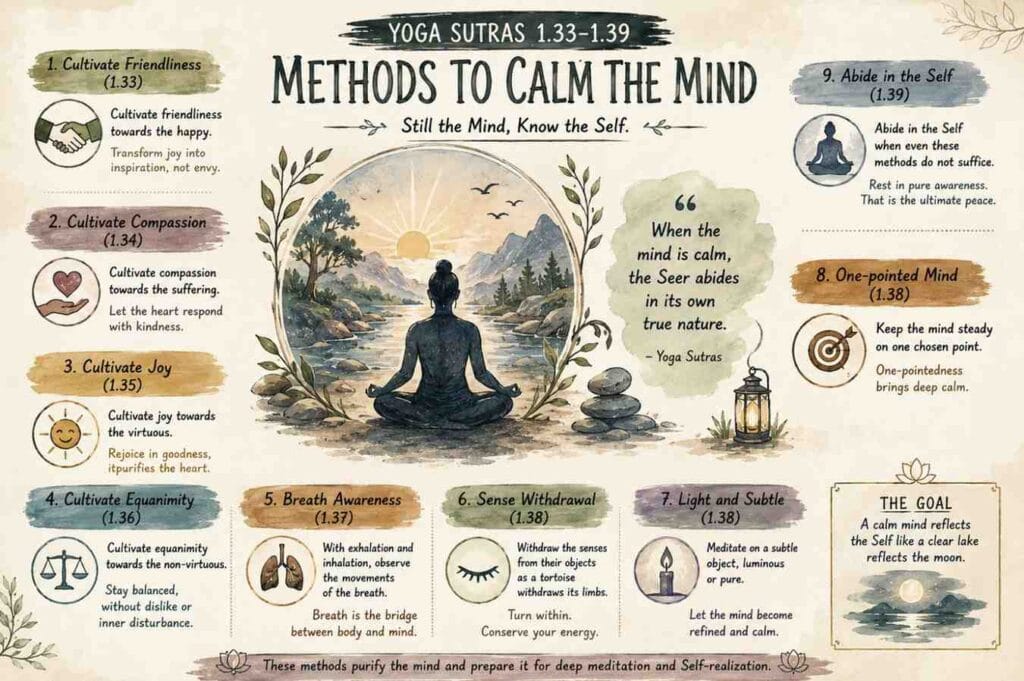
Explore Yoga Sutras 1.33–1.39 in depth. Learn how Patañjali explains emotional balance, breath regulation, meditation, dreams, Om, and concentration as methods to calm the mind and stabilize awareness.
Introduction
After identifying the major obstacles that disturb concentration in the previous sutras, Yoga Sutras of Patanjali now turns toward practical methods for stabilizing consciousness.
This transition is extremely important.
Patañjali does not merely diagnose the problems of the human mind.
He also provides direct methods for working with them. This reveals one of the defining characteristics of the Yoga Sutras: the text is not only philosophical, but deeply experiential and psychological.
The earlier sutras described how consciousness becomes fragmented through: doubt, restlessness, emotional instability, distraction, attachment, and mental disturbance. Now Patañjali explains how awareness may gradually regain steadiness.
Importantly, the methods described in Sutras 1.33–1.39 are remarkably diverse.
Rather than insisting upon a single rigid technique, Patañjali presents multiple pathways for calming the mind.
This flexibility is psychologically sophisticated because different practitioners respond to different approaches.
Some individuals stabilize awareness through emotional refinement. Others through breath. Others through concentration. Others through contemplative experience. The Yoga Sutras therefore avoid becoming mechanically dogmatic.
Instead, Patañjali recognizes that consciousness itself is multidimensional.
These sutras also remain surprisingly relevant today because modern life continuously intensifies mental agitation.
People now experience unprecedented levels of: digital stimulation, information overload, emotional exhaustion, comparison, attention fragmentation, and nervous system stress.
As a result, the ability to calm the mind intentionally has become increasingly difficult. Patañjali’s teachings therefore feel strikingly contemporary despite being ancient.
Sutra 1.33
मैत्रीकरुणामुदितोपेक्षाणां सुखदुःखपुण्यापुण्यविषयाणां भावनातश्चित्तप्रसादनम् ॥
Transliteration
Maitrī-karuṇā-muditā-upekṣāṇāṁ sukha-duḥkha-puṇyāpuṇya-viṣayāṇāṁ bhāvanātaś citta-prasādanam
Translation
“By cultivating friendliness toward the happy, compassion toward the suffering, joy toward the virtuous, and equanimity toward the non-virtuous, the mind becomes clarified and peaceful.”
This sutra is one of the most psychologically profound teachings in the Yoga Sutras because Patañjali directly connects emotional attitude with mental clarity.
Ordinarily, people assume meditation depends only upon concentration techniques.
Patañjali recognizes something deeper: the emotional patterns carried within the mind strongly influence inner steadiness.
The term citta-prasādanam means calming, clarifying, or purification of consciousness.
Patañjali suggests that the mind becomes disturbed not only through external distraction, but also through unhealthy emotional reactions toward other people.
Jealousy, resentment, anger, comparison, hostility, and emotional reactivity continuously agitate awareness internally. Thus, emotional refinement itself becomes part of yoga practice.
Maitrī – Friendliness Toward the Happy
Patañjali first recommends maitrī – friendliness or benevolence toward those who are happy. This may sound simple, yet psychologically it is extremely difficult. Ordinarily, human beings often react to others’ happiness through: comparison, envy, insecurity, competition, or subtle resentment.
The ego feels threatened when others succeed or flourish. Social comparison intensifies this tendency dramatically in modern culture.
People constantly measure themselves against others through: social media, status, achievement, appearance, or recognition. This creates chronic psychological agitation.
Patañjali offers another possibility. Instead of reacting with envy, the practitioner consciously cultivates goodwill toward others’ happiness.
This softens comparison and reduces inner conflict. The mind becomes lighter because it stops generating hostility toward others’ wellbeing.
Karuṇā – Compassion Toward Suffering
The second quality is karuṇā – compassion toward those experiencing suffering.
Without compassion, the mind often reacts to others’ pain through indifference, judgment, avoidance, or emotional defensiveness. Compassion changes this relationship.
Importantly, compassion in yoga philosophy does not mean emotional collapse or excessive sentimentality. It refers to sensitive awareness free from cruelty and emotional hardness.
The practitioner recognizes suffering without becoming consumed by hatred or indifference.
Psychologically, compassion stabilizes consciousness because hostility and emotional numbness fragment the mind internally. Compassion creates connection rather than separation.
Muditā – Joy Toward the Virtuous
Muditā refers to appreciative joy or genuine delight toward goodness and virtue in others.
This teaching is subtle. Human beings often struggle not only with envy toward happiness, but also with resentment toward virtue itself. People may become cynical toward goodness because it challenges their own egoic tendencies.
Patañjali instead encourages joyful appreciation of integrity, wisdom, kindness, and sincerity wherever they appear. This protects the mind from cynicism and bitterness. The practitioner learns to celebrate goodness rather than feeling threatened by it.
Upekṣā – Equanimity Toward the Non-Virtuous
The final attitude is upekṣā – equanimity toward harmful or non-virtuous behavior. This does not mean approving wrongdoing or becoming passive toward injustice.
Rather, it means avoiding emotional entanglement through hatred, obsession, or reactive hostility.
The mind becomes disturbed when it remains continuously consumed by anger toward others’ behavior. Equanimity creates psychological balance. The practitioner responds with clarity rather than compulsive emotional reaction. This is one of the deepest insights of the sutra:
inner peace depends greatly upon how consciousness relates emotionally to the world.
Why Emotional Refinement Calms the Mind
Patañjali’s teaching here is psychologically brilliant because emotional reactions strongly shape mental atmosphere.
The mind cannot become deeply peaceful while continuously feeding: envy, resentment, comparison, hostility, or emotional agitation. Meditation does not occur separately from emotional life.
The emotional tendencies carried daily directly influence concentration and awareness. Thus, yoga becomes not only technical meditation practice, but refinement of relational consciousness itself.
Sutra 1.34
प्रच्छर्दनविधारणाभ्यां वा प्राणस्य ॥
Transliteration
Pracchardana-vidhāraṇābhyāṁ vā prāṇasya
Translation
“Or by exhalation and retention of the breath.”
This sutra is extremely important because it marks one of the earliest direct references to breath regulation within the Yoga Sutras of Patanjali.
Although Patañjali does not yet present the full system of prāṇāyāma found later in yoga traditions, he clearly recognizes something profound: the breath and the mind mirror each other continuously. When the mind becomes disturbed, breathing changes automatically.
During fear, the breath may become shallow and rapid. During anger, it may become forceful and heated. During anxiety, breathing often becomes irregular or constricted. During calmness, however, the breath naturally slows and softens. Patañjali reverses this process intentionally.
Instead of allowing emotional states to unconsciously control breathing, the practitioner consciously works with the breath in order to influence consciousness itself.
This is psychologically and physiologically sophisticated. Ancient yogis discovered experientially that breathing is not merely mechanical respiration.
It is deeply connected to attention, emotional state, nervous system activity, and mental steadiness.
The terms pracchardana and vidhāraṇa are significant here. Pracchardana refers to exhalation or controlled release of the breath. Vidhāraṇa refers to retention, restraint, or holding.
Many commentators interpret the sutra as emphasizing especially the calming effect of prolonged exhalation and gentle breath retention. This is important because exhalation naturally relates to release and relaxation within the nervous system.
Even modern physiological research increasingly explores how slower exhalation patterns influence relaxation responses and autonomic regulation. Patañjali observed these relationships through contemplative experience long before scientific language existed.
Why Breath Became Central in Yoga
Breath occupies a unique position within human experience.
Most bodily processes occur automatically without conscious control: heartbeat, digestion, hormonal activity, and cellular function. Breathing, however, exists between the voluntary and involuntary systems.
A person can breathe unconsciously for hours. Yet the same breath can also be consciously slowed, deepened, paused, or regulated intentionally.
This makes breath extraordinarily powerful within yoga practice. The breath becomes a bridge between body and mind. By calming the breath, the practitioner indirectly calms the nervous system and mental activity.
This insight later became foundational in: prāṇāyāma, Haṭha Yoga, tantric systems, meditation traditions, and contemplative practices throughout Indian philosophy.
Ancient yogis repeatedly noticed that mental agitation and irregular breathing appear together. Similarly, when breathing becomes steady, awareness often becomes steadier as well. This does not mean breathing alone instantly produces enlightenment.
However, breath regulation helps reduce the turbulence that keeps consciousness scattered continuously.
The Psychological Significance of Exhalation
One subtle aspect of this sutra is its emphasis on exhalation rather than inhalation alone. Exhalation psychologically and physiologically relates to release.
The body softens during exhalation. Tension decreases. Holding patterns begin loosening. This is why many calming breathing practices across yoga traditions emphasize: longer exhalations, gentle slowing, and relaxed release of breath.
Modern individuals often breathe in chronically restricted ways because of stress and overstimulation. The chest remains tight. Breathing becomes shallow.
The nervous system stays subtly activated.
Many people are not fully aware of how strongly emotional tension affects breathing patterns until they consciously observe them. Patañjali recognized that conscious breathing can interrupt these unconscious stress patterns.
The practitioner gradually learns how to influence inner state through rhythm and awareness rather than remaining completely controlled by emotional reactivity.
Breath and Attention
Another reason breath became so central in meditation is because breathing occurs continuously in the present moment.
The mind constantly moves toward: memory, anticipation, worry, fantasy, or distraction. Breath brings awareness back toward immediate experience. Unlike abstract philosophical thought, breath is direct and experiential. It can be observed moment by moment. This makes it a stabilizing anchor for attention.
As awareness repeatedly returns to breathing, the mind gradually becomes less scattered.
Patañjali therefore presents breath not merely as a physical tool, but as a method for unifying consciousness itself.
Sutra 1.35
विषयवती वा प्रवृत्तिरुत्पन्ना मनसः स्थितिनिबन्धिनी ॥
Transliteration
Viṣayavatī vā pravṛttir utpannā manasaḥ sthiti-nibandhinī
Translation
“Or concentration arising from subtle sensory experience may stabilize the mind.”
This is one of the most mysterious sutras in this section because Patañjali speaks about refined experiences arising during meditation itself. The wording is difficult and has been interpreted differently across centuries.
However, the central idea appears to be this: as concentration deepens, awareness may begin perceiving subtler dimensions of experience that help stabilize attention further. Ordinarily, the mind operates through gross sensory engagement.
Attention moves constantly toward external stimulation: noise, objects, conversation, screens, movement, and sensory distraction.
However, when meditation deepens and mental noise decreases, perception itself becomes more refined.
The practitioner may become aware of subtle internal phenomena involving: sound, light, vibration, sensation, or delicate shifts in awareness.
Patañjali acknowledges that such experiences can temporarily support concentration because the mind becomes naturally absorbed in subtler perception.
Refinement of Perception in Meditation
One of the deeper implications of this sutra is that meditation changes not only attention, but perception itself. Ordinary awareness is usually noisy and externally scattered.
As mental fluctuation quiets, subtler dimensions of experience become noticeable. Ancient meditation traditions frequently described practitioners becoming aware of: inner sound currents, subtle luminosity, energetic movement, heightened sensitivity, or refined bodily awareness. Importantly, Patañjali does not sensationalize these experiences.
He does not present them as supernatural achievements or final realization. This distinction matters greatly. Many practitioners become distracted by unusual experiences during meditation and begin treating them as spiritual accomplishment.
Patañjali remains extremely careful psychologically. The experiences themselves are not the goal. They may simply function as temporary supports helping stabilize awareness.
The deeper aim of yoga remains steadiness and clarity of consciousness itself.
Why the Mind Becomes More Sensitive During Meditation
Ordinarily, the nervous system remains overloaded by continuous stimulation. Awareness keeps moving outward rapidly.
Subtle perception becomes drowned beneath mental noise. Meditation reduces this overload gradually. As distraction weakens, awareness becomes quieter and more receptive.
The practitioner may begin noticing experiences that were previously ignored because the mind was too agitated to perceive them. This is similar to how subtle sounds become noticeable only when external noise decreases.
Patañjali’s insight here is psychologically refined because he recognizes that consciousness has layers of subtlety not usually accessible during ordinary distraction.
The Danger of Attachment to Experience
One of the most important aspects of this sutra is what Patañjali does not say. He does not encourage obsession with mystical experience. This is extremely important because the ego can easily become fascinated with unusual meditative phenomena.
A practitioner may begin seeking: visions, lights, energetic sensations, or altered states instead of genuine inner steadiness. The Yoga Sutras consistently warn against attachment, even attachment to spiritual experiences.
Thus, subtle perception may help concentration temporarily, but it is not ultimate liberation itself. Patañjali repeatedly prioritizes clarity over fascination.
Sutra 1.36
विशोका वा ज्योतिष्मती ॥
Transliteration
Viśokā vā jyotiṣmatī
Translation
“Or through meditation upon inner luminosity free from sorrow.”
This sutra introduces one of the most contemplative and poetic teachings in the Yoga Sutras. Patañjali now speaks about meditation upon a luminous awareness untouched by sorrow. The term jyotiṣmatī refers to luminosity, radiance, or inner light.
Viśokā means free from grief, suffering, or emotional disturbance. Different traditions interpret this sutra differently. Some understand it symbolically as contemplation upon pure consciousness itself. Others interpret it more literally as subtle inner luminosity experienced during meditation.
However, the psychological meaning remains profound regardless of interpretation.
Patañjali suggests that beneath ordinary emotional turbulence there exists a deeper dimension of awareness not completely defined by suffering.
Ordinarily, people become fully identified with emotional fluctuation.
When sadness arises, the mind says: “I am sadness.” When fear arises: “I am afraid.” When anger arises: “I am angry.” Awareness becomes fused with temporary mental states continuously. Patañjali points toward another possibility: consciousness observing emotional movement without becoming completely imprisoned by it.
Inner Luminosity as Awareness Itself
Many commentators interpret the “inner light” symbolically rather than visually.
The luminosity represents awareness itself: clear, observing, present, and fundamentally different from the changing contents of the mind. Thoughts change. Emotions change. Sensations change. Yet awareness remains capable of observing all these changes continuously.
Meditation gradually reveals this distinction experientially. This is why the sutra describes the luminosity as “free from sorrow.”
Patañjali is not claiming human beings never experience emotional pain again. Rather, deeper awareness is no longer completely overwhelmed by every emotional fluctuation. A more stable witnessing consciousness begins emerging.
The Psychological Importance of This Sutra
This teaching remains deeply relevant because modern individuals often define themselves entirely through psychological states.
Identity becomes fused with: stress, fear, success, failure, mood, memory, or emotional turbulence. As a result, inner stability becomes fragile because everything psychological changes continuously. Patañjali suggests that awareness itself may be deeper than these fluctuations.
Meditation gradually reveals a quieter dimension of consciousness beneath constant mental movement. This insight became foundational across later yogic and Vedantic traditions.
The practitioner begins discovering that peace is not created merely by controlling external life perfectly. Rather, steadiness emerges when awareness becomes less identified with the endless movement of the mind itself.
Sutra 1.37
वीतरागविषयं वा चित्तम् ॥
Transliteration
Vīta-rāga-viṣayaṁ vā cittam
Translation
“Or by meditating upon the mind of one free from attachment.”
This sutra introduces a deeply human and psychologically powerful method for calming the mind: contemplation upon someone who embodies inner freedom.
The phrase vīta-rāga refers to a person free from compulsive attachment, craving, and emotional bondage. Patañjali suggests that the mind becomes influenced by whatever it repeatedly contemplates.
This insight is extremely important because human consciousness is naturally imitative.
People unconsciously absorb the psychological atmosphere surrounding them.
When attention remains constantly immersed in: conflict, greed, competition, aggression, comparison, or emotional chaos, the mind gradually begins reflecting similar patterns internally. Modern life intensifies this continuously.
People spend hours consuming emotionally charged information, overstimulating content, and reactive environments. Attention becomes conditioned by what it repeatedly encounters.
Patañjali offers another possibility.
Instead of filling awareness with agitation, the practitioner intentionally contemplates someone whose consciousness reflects steadiness, compassion, wisdom, or detachment. Over time, the mind begins orienting itself toward similar qualities.
Why Human Consciousness Learns Through Contemplation
One of the deepest psychological insights behind this sutra is that attention shapes identity.
What the mind repeatedly focuses upon gradually influences perception, emotion, and behavior. This is visible throughout ordinary life.
People unconsciously adopt: speech patterns, emotional tendencies, values, attitudes, and habits from the environments and individuals surrounding them.
Patañjali applies this principle spiritually. By contemplating someone deeply free from attachment, the practitioner begins developing an inner image of psychological steadiness itself.
This does not require blind worship or unhealthy idealization.
Rather, the mind uses higher qualities as a stabilizing reference point. The practitioner gradually learns what non-reactive awareness feels like internally.
The Meaning of “Freedom From Attachment”
The phrase vīta-rāga does not mean emotional coldness or indifference toward life. In yoga philosophy, attachment refers to compulsive psychological dependence.
Ordinarily, the mind continuously clings to: pleasure, recognition, identity, control, possession, approval, or emotional certainty. This creates instability because everything external changes constantly.
A person free from attachment still participates in life, but without becoming completely psychologically imprisoned by every gain and loss. Such a mind possesses a different quality of steadiness.
Patañjali suggests that contemplating this state helps awaken similar stability within the practitioner.
The Importance of the Guru Principle
This sutra later became foundational within many guru-disciple traditions throughout Indian spirituality. The guru was not originally viewed merely as a lecturer or authority figure.
Ideally, the guru represented living embodiment of inner steadiness and realization.
The student learned not only through intellectual teaching, but through contemplative attunement to a consciousness less dominated by egoic disturbance.
This principle also influenced: Bhakti Yoga, Vedanta, Tantric traditions, Zen Buddhism, and contemplative lineages across Asia. The deeper idea is universal: human beings transform partly through the consciousness they remain close to.
Psychological Modeling and Inner Transformation
Modern psychology also recognizes forms of observational learning and emotional influence.
Human nervous systems constantly respond to the emotional states of others. Calmness affects people. Anxiety affects people. Hostility affects people. Compassion affects people. Patañjali understood this experientially long before modern psychology emerged.
The mind gradually becomes shaped by what it repeatedly contemplates and emotionally absorbs. Thus, contemplation upon wisdom becomes a practical method for reorganizing consciousness itself.
Sutra 1.38
स्वप्ननिद्राज्ञानालम्बनं वा ॥
Transliteration
Svapna-nidrā-jñānālambanaṁ vā
Translation
“Or through knowledge arising from dreams and deep sleep.”
This sutra is one of the most mysterious and philosophically rich teachings in this section because Patañjali now turns toward the study of consciousness across different states of experience. Ordinarily, people identify almost completely with waking life.
They assume consciousness only exists in its everyday waking form. Yoga philosophy, however, investigates awareness much more deeply.
Ancient yogic traditions examined multiple states of consciousness: waking, dreaming, deep sleep, and transcendent awareness. Patañjali suggests that careful contemplation of dreams and deep sleep may reveal important insights about the nature of the mind itself.
This is psychologically sophisticated because dreams expose layers of mental activity often hidden during ordinary waking consciousness.
Desires, fears, memories, symbolic imagery, and unresolved impressions frequently emerge within dreams in unusual forms. Dreams reveal that the mind continues generating experience even when external sensory contact decreases.
Dreams as Windows Into the Mind
In yogic philosophy, dreams are not always treated merely as meaningless random imagery.
They may reveal the subtle activity of consciousness itself. The waking mind usually remains occupied with external engagement and sensory stimulation. During dreams, however, the deeper patterns of memory, emotion, conditioning, and imagination become more visible.
This is one reason many contemplative traditions observed dreams carefully. Not because every dream possesses mystical meaning, but because dreams demonstrate how the mind constructs experience internally.
Even without external objects, consciousness creates entire worlds during dreaming. This insight becomes philosophically important.
It raises deeper questions: What is perception? What is reality? How does consciousness construct experience? Patañjali is not encouraging obsession with dream interpretation. Rather, he suggests that observing different states of awareness may deepen understanding of consciousness itself.
The Importance of Deep Sleep
The reference to nidrā, deep sleep, is equally profound.
Deep sleep fascinated many Indian philosophical traditions because ordinary mental activity temporarily disappears there.
During waking life, consciousness constantly moves through: thought, memory, identity, emotion, desire, and sensory engagement. In deep sleep, however, these fluctuations dissolve temporarily.
Yet upon waking, people still say: “I slept well.” This raises an important philosophical question: who recognized the absence of ordinary mental activity?
Indian traditions repeatedly used deep sleep to investigate the relationship between consciousness and thought.
Patañjali appears to suggest that contemplating such states may help the practitioner understand that awareness is deeper than ordinary waking mental fluctuation alone.
States of Consciousness in Indian Philosophy
This sutra later became deeply connected with teachings found in texts like the Mandukya Upanishad, which analyzes: waking consciousness, dream consciousness, deep sleep, and transcendental awareness. The broader philosophical implication is profound: human consciousness contains dimensions beyond ordinary waking identity.
Meditation becomes not merely relaxation, but exploration of awareness itself.
Sutra 1.39
यथाभिमतध्यानाद्वा ॥
Transliteration
Yathābhimata-dhyānād vā
Translation
“Or through meditation upon any object of one’s choosing.”
This sutra concludes the section with extraordinary openness and flexibility. After describing multiple methods for calming the mind, Patañjali now essentially says: awareness may stabilize through any contemplative object genuinely capable of sustaining deep attention.
This is psychologically sophisticated because different minds respond differently.
Some individuals stabilize through: breath, others through mantra, others through devotion, others through philosophical contemplation, others through visual concentration, others through awareness itself.
Patañjali therefore avoids rigid dogmatism. The Yoga Sutras are not obsessed with forcing every practitioner into a single technique. The deeper principle is steadiness of attention.
Any object capable of genuinely unifying consciousness may function as a support for meditation.
Why Flexibility Matters in Yoga
This sutra reveals that yoga is ultimately experiential rather than ideological. Different temperaments require different doorways into concentration. A highly emotional person may stabilize through devotion. A contemplative thinker may stabilize through inquiry. Another practitioner may respond most deeply to breath awareness or sacred sound.
Patañjali recognizes this diversity. This flexibility is one reason yoga evolved into many later traditions while still retaining common philosophical foundations. The essential goal remains the same: stabilization and refinement of consciousness. The methods may vary.
The Real Meaning of Meditation in This Sutra
One of the deepest implications of Sutra 1.39 is that meditation is less about the object itself and more about the quality of awareness brought to it.
Ordinarily, the mind constantly jumps between countless impressions. Meditation reverses this fragmentation. Attention gradually becomes: continuous, stable, subtle, and inwardly unified.
The chosen object simply functions as a focal point helping consciousness gather itself together.
Thus, meditation is not merely thinking about something intensely. It is the gradual training of awareness away from compulsive scattering.
The Deeper Psychological Meaning of These Sutras
Together, Sutras 1.33–1.39 reveal something profound: the mind becomes calm through integration rather than force. Patañjali does not recommend violent suppression of thought.
Instead, he offers methods that gradually harmonize: emotion, breath, attention, perception, and awareness. Different individuals require different approaches because human consciousness is complex.
Some stabilize through compassion. Some through breath. Some through devotion. Some through concentration. Some through contemplative inquiry. The Yoga Sutras therefore present yoga as a flexible science of consciousness rather than rigid ideology.
Relevance in Modern Life
These teachings feel extraordinarily relevant today because modern life continuously fragments attention and destabilizes emotional balance.
People increasingly struggle with: overthinking, anxiety, restlessness, comparison, digital overload, emotional exhaustion, and inability to remain inwardly quiet. Patañjali’s methods offer practical ways to counter this fragmentation.
The sutras suggest that inner steadiness develops not merely through escaping the world, but through transforming one’s relationship with: emotion, attention, breath, perception, and consciousness itself.
Final thoughts
In Sutras 1.33–1.39, Patañjali presents multiple methods for calming and stabilizing the mind.
These include: emotional refinement, breath regulation, subtle concentration, contemplation, meditation upon wisdom, and one-pointed attention.
Together, these teachings reveal yoga as a sophisticated psychology of consciousness rather than mere physical exercise. The Yoga Sutras recognize that inner peace cannot be forced mechanically. It develops gradually through harmonization of awareness itself.
Ultimately, these sutras remind practitioners that steadiness is possible, not through suppression of the mind, but through understanding how consciousness naturally becomes calm, clear, and unified.
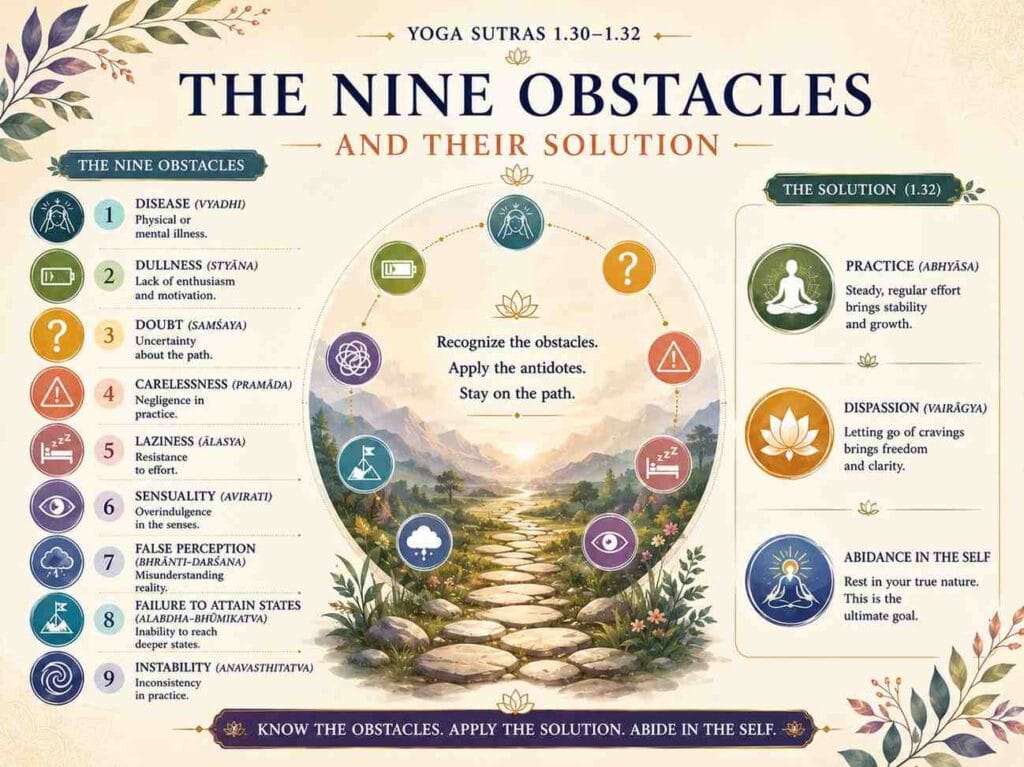
Also read: Sutras 1.30–1.32: The Nine Obstacles and Their Solution