
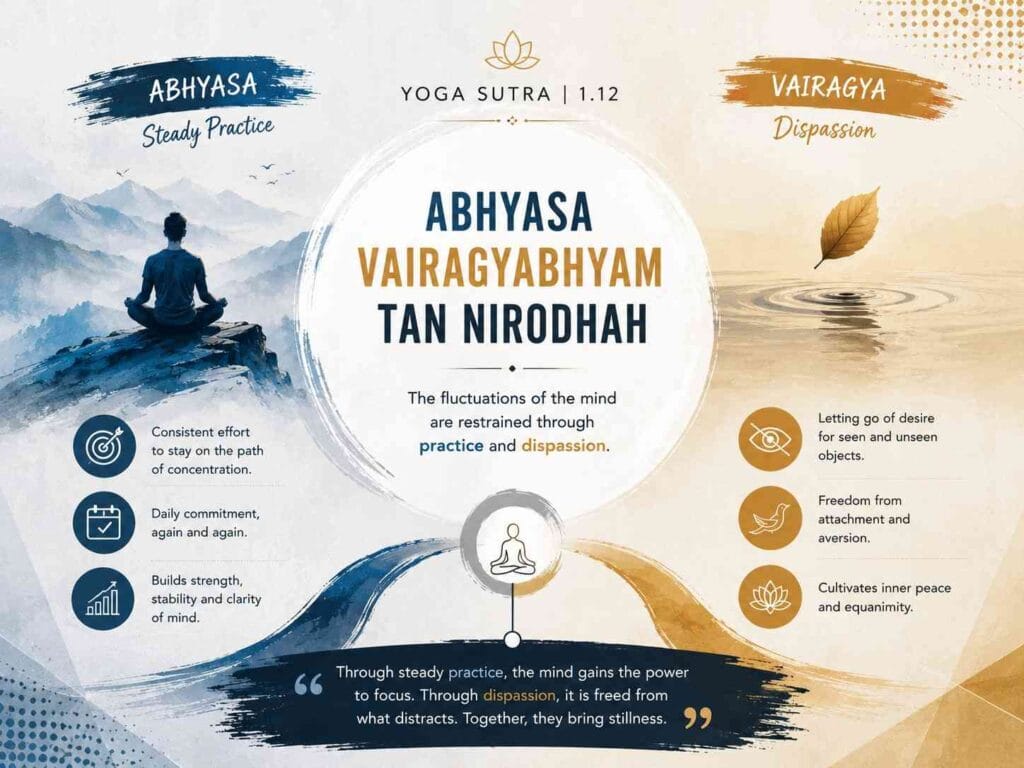
Explore Sutra 1.12 of the Yoga Sutras of Patanjali – Abhyasa Vairagyabhyam Tan Nirodhah – with deep explanation of practice, non-attachment, nirodha, meditation, and yogic psychology.
Sutra 1.12 – अभ्यासवैराग्याभ्यां तन्निरोधः
Abhyāsa-vairāgyābhyāṁ tan-nirodhaḥ
Translation
“The restraint of those mental modifications is achieved through practice and detachment.”
Literal Breakdown of the Sutra
- Abhyāsa – sustained practice, disciplined repetition, steady effort
- Vairāgyābhyām – through detachment, dispassion, non-attachment
- Tat – those (referring to the mental modifications or vṛttis described earlier)
- Nirodhaḥ – restraint, stilling, regulation, cessation
Together, the sutra explains that the calming and regulation of the mental modifications (vṛttis) occurs through two complementary principles: consistent practice and non-attachment.
Introduction
In the opening chapter of the Yoga Sutras of Patanjali, Patañjali first establishes one of the most foundational definitions in all of yoga philosophy:
योगश्चित्तवृत्तिनिरोधः
Yogaś citta-vṛtti-nirodhaḥ
“Yoga is the stilling of the fluctuations of the mind.”
This statement immediately shifts the understanding of yoga away from being merely physical exercise, ritual activity, or philosophical speculation.
For Patañjali, yoga is fundamentally concerned with consciousness itself. The central problem is not the external world alone, but the unstable and continuously fluctuating condition of the mind. Human consciousness ordinarily remains in constant movement. Thought follows thought endlessly. Emotion reacts to emotion. Attention moves continuously between memory, imagination, fear, desire, sensory stimulation, and internal narrative.
As a result, awareness rarely rests in clarity. Instead, it becomes identified with the movements occurring within the mind. After defining yoga in this way, Patañjali carefully analyzes the different categories of mental activity that shape ordinary experience.
He examines:
- pramāṇa – accurate cognition
- viparyaya – false perception
- vikalpa – conceptual construction
- nidrā – sleep
- smṛti – memory
This progression is psychologically profound because it demonstrates that the mind is not a single uniform process. Human consciousness is shaped through multiple forms of mental movement, each influencing perception differently. Some movements may produce accurate understanding.
Others create confusion, projection, conditioning, or unconsciousness. By systematically examining these vṛttis, Patañjali reveals that yoga begins with observation and understanding of the mind itself.
However, after identifying the nature of these mental fluctuations, an essential question naturally arises: How are these fluctuations actually regulated? How does the mind become steady rather than continuously reactive? How does awareness become free from compulsive movement?
Sutra 1.12 answers this directly. And the answer Patañjali gives is remarkably concise: Through abhyāsa (practice) and vairāgya (detachment). These two principles become the foundation of the entire yogic path. This is one of the reasons Sutra 1.12 is considered so important within yoga philosophy. It presents yoga not as abstract theory, but as a practical psychological discipline.
Patañjali does not describe transformation as accidental, emotional, or dependent merely upon intellectual belief. Nor does he suggest that freedom appears automatically through wishful thinking or temporary inspiration. Instead, he presents inner steadiness as the result of disciplined training.
The mind becomes stable gradually through consistent cultivation and release of attachment. This insight remains deeply relevant because human beings often attempt to calm the mind through extremes.
Some attempt forceful suppression: trying to eliminate thought aggressively, judging themselves for distraction, or fighting continuously against mental activity.
Others move toward passive escape: withdrawing from difficulty, avoiding responsibility, or seeking numbness rather than clarity.
Patañjali rejects both extremes. The mind does not become steady through violence toward oneself. Nor through unconscious avoidance of life. Instead, steadiness develops through balance: consistent practice combined with freedom from compulsive attachment. This balance forms the heart of yoga psychology.
Understanding “Nirodha”
The word nirodha is one of the most important and misunderstood terms within the Yoga Sutras.
It is often translated as:
- cessation
- restraint
- control
- regulation
- or stilling
Yet none of these translations fully capture the subtlety of what Patañjali means. Many people mistakenly interpret nirodha as suppression of thought. This misunderstanding creates significant confusion. Yoga does not seek destruction of the mind. Nor does it advocate forcing consciousness into emptiness through repression.
Patañjali is not describing psychological violence against mental activity. Rather, nirodha refers to the gradual calming and regulation of compulsive mental fluctuation. The distinction is extremely important.
Ordinarily, the mind moves automatically from one object to another without stability. Thought continuously generates further thought. Emotion triggers reaction. Memory activates association. Fear projects into the future. Desire pulls attention outward. The senses constantly seek stimulation. Awareness becomes fragmented because consciousness identifies with every movement arising within the mind. This produces inner restlessness. The individual becomes psychologically carried away continuously by mental activity.
In this condition, there is little stillness. Little clarity. Little freedom from reaction. Patañjali describes yoga as the process through which these fluctuations no longer dominate awareness completely. The movements of the mind may still arise, but awareness becomes less unconsciously entangled within them. This is nirodha.
The mind gradually becomes quieter, steadier, and less reactive. Importantly, this state is not dullness or unconsciousness. Patañjali carefully distinguishes yogic stillness from states such as sleep or mental inertia. True steadiness is deeply alert. Awareness becomes clearer, not weaker. More conscious, not less conscious. The mind develops the ability to rest without compulsive disturbance. This distinction is essential because many beginners confuse stillness with blankness or passivity.
But yogic stillness is intensely lucid. It is a condition in which awareness remains fully present without being constantly pulled into agitation and identification.
Why Two Principles Are Necessary
One of the deepest psychological insights within this sutra is that Patañjali does not prescribe a single method for calming the mind.
He introduces two complementary principles:
- abhyāsa – sustained practice
- vairāgya – non-attachment
This dual approach is profoundly important because human disturbance operates through both habit and attachment simultaneously. The mind becomes conditioned through repetition. Whatever is practiced repeatedly becomes strengthened. Thought patterns strengthen through repetition.
Emotional reactions strengthen through repetition. Behavioral habits strengthen through repetition.
At the same time, the mind also remains psychologically bound through attachment:
- craving
- fear
- aversion
- identification
- expectation
- emotional dependency
Thus, disturbance arises through two interwoven processes: habitual conditioning and emotional attachment. Because of this, transformation requires two corresponding disciplines. Practice retrains the conditioned movements of attention. Detachment weakens compulsive emotional entanglement. Without practice, the mind remains unstable because old habits continue dominating consciousness automatically. Without detachment, the mind remains psychologically burdened because attachment continuously generates agitation.
Patañjali therefore presents a balanced path. Practice alone is insufficient. A person may become extremely disciplined while still remaining deeply attached to achievement, identity, control, or spiritual success.
In such cases, practice itself may strengthen egoic striving rather than dissolve suffering. Likewise, detachment alone without disciplined practice may become passive withdrawal, avoidance, or stagnation. A person may intellectually reject attachment while remaining inwardly unstable and untrained. Together, however, practice and detachment create balance.
Practice stabilizes awareness. Detachment prevents psychological entanglement. Practice develops attentional strength. Detachment creates inner freedom. This balance forms the foundation of yogic discipline.
What Is Abhyāsa?
The term abhyāsa is often translated simply as “practice,” but within yoga philosophy the word carries far deeper meaning than occasional effort, temporary motivation, or sporadic enthusiasm. Abhyāsa refers to sustained and disciplined effort directed toward steadiness of mind. The emphasis is not on dramatic intensity. It is on continuity.
This is psychologically profound because the human mind itself becomes conditioned through repetition. Every repeated thought strengthens certain mental pathways. Every repeated emotional reaction becomes easier to repeat again. Attention develops habits. Behavior develops habits. Emotional patterns develop habits. Over time, unconscious repetition shapes the structure of consciousness itself.
Patañjali recognizes this clearly. Because conditioning develops through repetition, transformation must also develop through repetition. Abhyāsa gradually retrains the mind through consistent conscious effort.
This may include:
- repeatedly returning attention during meditation
- repeatedly observing emotional reaction without impulsive expression
- repeatedly cultivating steadiness amidst distraction
- repeatedly returning to awareness instead of unconscious habit
- repeatedly choosing clarity over compulsive reaction
At first, the mind may resist this process strongly. Attention wanders constantly. Distraction returns repeatedly. Emotional habits reappear automatically. But abhyāsa is not defeated by repetition of distraction. Abhyāsa itself is the repeated returning. This is one of the deepest insights within yoga practice.
Progress does not depend upon never becoming distracted. It depends upon continually returning to awareness.
Over time, these repeated efforts begin reshaping the structure of attention itself. The mind gradually becomes less impulsive, less fragmented, and more capable of remaining steady. This is why yoga emphasizes disciplined consistency more than dramatic spiritual experience. A single moment of insight may inspire transformation. But stable transformation develops through sustained practice carried into daily life repeatedly over time.
Abhyāsa Is Not Mechanical Repetition
One of the most important clarifications within Sutra 1.12 is that abhyāsa does not mean unconscious repetition of techniques. Patañjali’s understanding of practice is far more subtle and psychological.
A person may repeat postures, breathing exercises, rituals, or meditation techniques for years while remaining internally distracted, reactive, impatient, ego-driven, or emotionally unstable.
From the yogic perspective, repetition alone is not transformation. True abhyāsa is not measured merely by how often a technique is performed. It is measured by the quality of awareness brought into practice. This distinction is essential because the human mind has the ability to turn even spiritual discipline into habit without consciousness. A practitioner may mechanically perform practices while the mind remains consumed by comparison, ambition, frustration, or self-image. In such cases, repetition may actually strengthen conditioning rather than dissolve it.
For example, a person may meditate daily while secretly becoming attached to appearing “spiritual.” Another may practice yoga postures while internally driven by competition, insecurity, or validation.
Externally, practice exists. Internally, however, the mind may still remain deeply disturbed. Patañjali therefore presents abhyāsa as conscious participation in inner refinement rather than external performance alone. Authentic practice requires continuous reorientation of awareness toward steadiness, clarity, and observation.
This is why practice must include:
- sincerity
- attentiveness
- patience
- consistency
- humility
- and psychological self-observation
Without awareness, discipline easily becomes mechanical. And mechanical repetition cannot produce deep transformation because unconsciousness continues operating beneath the surface. Abhyāsa therefore is not simply “doing yoga.” It is the disciplined training of consciousness itself. The practitioner repeatedly notices distraction and returns. Repeatedly notices emotional reaction and observes it. Repeatedly notices unconscious habit and redirects awareness. This gradual returning is the essence of practice.
Over time, the quality of consciousness itself begins changing. Attention becomes steadier. Reaction becomes less compulsive. Awareness becomes less fragmented. Thus, abhyāsa is fundamentally an inner process of refinement rather than mere external repetition.
What Is Vairāgya?
If abhyāsa represents disciplined cultivation, vairāgya represents release from psychological dependence.
The term is often translated as:
- detachment
- non-attachment
- dispassion
- or freedom from craving
Yet these translations can sometimes create misunderstanding if interpreted superficially. Vairāgya does not mean emotional deadness, indifference, repression, or rejection of life. Patañjali is not advocating withdrawal from human experience or suppression of feeling. Rather, vairāgya refers to freedom from compulsive attachment to experience.
Ordinarily, the mind is continuously pulled outward through attraction and resistance. It seeks pleasure constantly. It fears discomfort. It clings to praise. It resists criticism. It becomes attached to identity, outcome, validation, control, memory, and expectation. As long as awareness remains psychologically dependent upon these movements, the mind cannot become steady. Why? Because attachment itself produces disturbance. The mind becomes unstable whenever its emotional security depends entirely upon changing external conditions.
For example:
- attachment to success creates fear of failure
- attachment to praise creates sensitivity to criticism
- attachment to pleasure creates fear of loss
- attachment to identity creates defensiveness
The mind becomes trapped within constant emotional fluctuation because its stability depends upon conditions that continuously change. Vairāgya weakens this dependency. Experiences may still occur. Pleasure and pain may still arise naturally. Human emotion does not disappear. But awareness gradually becomes less psychologically entangled within these experiences.
The practitioner begins relating to experience with greater spaciousness and less compulsive grasping. This creates increasing inner freedom. The mind becomes capable of remaining more balanced amidst changing circumstances because it becomes less dependent upon controlling them.
The Relationship Between Practice and Detachment
Abhyāsa and vairāgya are inseparable because each corrects the imbalance of the other. Practice without detachment can easily become another form of egoic striving. A practitioner may become obsessed with progress, achievement, spiritual identity, or attaining particular experiences. Meditation then becomes performance. Discipline becomes self-image. The mind remains attached even while practicing intensely. This often creates frustration because the practitioner begins demanding results from practice rather than allowing gradual transformation to unfold naturally.
On the other hand, detachment without practice may remain intellectual and passive. A person may speak about “letting go” philosophically while remaining inwardly untrained and unstable. Without disciplined cultivation of awareness, the mind continues following old habits automatically.
Patañjali therefore presents these principles together deliberately. Practice creates stability. Detachment prevents fixation. Practice strengthens attentional clarity. Detachment weakens compulsive emotional dependence. Practice develops discipline. Detachment reduces psychological burden. Together, they create balanced transformation. This balance is one of the deepest psychological insights within yoga philosophy because human beings often move toward extremes. Some become excessively forceful and controlling. Others become passive and avoidant.
Yoga seeks neither rigid control nor unconscious drifting. It seeks steady awareness combined with inner freedom. Transformation requires effort. But eventually, even effort itself must become less egoically attached.
The Psychological Meaning of Vairāgya
Vairāgya is deeply psychological rather than merely behavioral. This distinction is extremely important. A person may externally renounce possessions, relationships, or activity while remaining internally consumed by craving, fear, resentment, or attachment. Externally detached behavior alone does not necessarily produce inner freedom.
Similarly, another individual may remain fully active within ordinary life while inwardly becoming less psychologically dependent upon outcomes and emotional fixation. True vairāgya therefore concerns the inner relationship between awareness and experience.
The practitioner gradually learns:
- not to cling compulsively
- not to resist obsessively
- and not to derive identity entirely from changing thoughts, emotions, or conditions
This process does not eliminate human feeling. Pleasure may still be experienced. Pain may still arise. Love, grief, joy, disappointment, and emotion remain part of life. However, awareness becomes less consumed by them. The individual develops greater capacity to experience life without becoming completely psychologically dominated by every fluctuation. This creates steadiness. The mind becomes less reactive because it becomes less dependent. Inner balance no longer depends entirely upon external circumstances remaining favorable.
This is one reason vairāgya is considered essential within yoga. Without some degree of non-attachment, awareness remains continuously pulled outward through emotional dependence and compulsive identification.
Abhyāsa and Vairāgya in Meditation
Meditation itself becomes one of the clearest demonstrations of why both practice and detachment are necessary simultaneously. During meditation, attention naturally wanders repeatedly. Thoughts arise continuously. Memories appear. Emotions surface. The mind becomes distracted. Abhyāsa is the repeated returning of awareness. The practitioner notices distraction and gently returns attention again and again. This repeated returning is practice itself.
However, meditation also requires vairāgya because the mind becomes attached not only to ordinary thoughts, but even to meditation experiences themselves.
The practitioner may become attached to:
- peaceful states
- spiritual expectations
- frustration about distraction
- desire for progress
- judgments about performance
- pleasant sensations
- or imagined ideas of “successful meditation”
Without detachment, awareness becomes absorbed into these reactions automatically. Meditation then becomes another cycle of craving and resistance. Vairāgya allows the practitioner to observe these movements without becoming completely identified with them. Each moment of returning is abhyāsa. Each moment of releasing attachment is vairāgya. Together, they gradually stabilize consciousness. Meditation therefore becomes a direct lived expression of Sutra 1.12 rather than merely a theoretical idea.
Relevance in Modern Life
Sutra 1.12 remains extraordinarily relevant today because contemporary life intensifies both distraction and attachment continuously.
Modern attention is fragmented through:
- constant notifications
- social media stimulation
- information overload
- emotional polarization
- comparison culture
- productivity pressure
- and endless sensory engagement
The nervous system rarely rests. Attention becomes conditioned toward rapid movement and continuous stimulation. At the same time, psychological attachment becomes stronger through modern systems built around identity, performance, visibility, consumption, and external validation.
People increasingly derive emotional stability from:
- approval
- achievement
- online identity
- productivity
- status
- or constant stimulation
As a result, inner steadiness becomes more difficult. Patañjali’s solution therefore remains profoundly contemporary. The mind requires disciplined attentional training because distraction has become normalized. And it requires detachment because emotional dependence upon external conditions continuously intensifies disturbance. Without practice, awareness becomes unstable. Without detachment, awareness remains psychologically entangled.
Together, abhyāsa and vairāgya create the possibility of inner balance even amidst modern overstimulation.
The Deeper Philosophical Significance
At a deeper philosophical level, Sutra 1.12 reveals that yoga is neither passive escape from life nor aggressive domination of the mind. It is a gradual refinement of consciousness.
The mind is patiently trained through repeated practice while simultaneously becoming freer from compulsive attachment.
This reflects one of the central principles of yoga philosophy: clarity cannot emerge fully within a consciousness continuously pulled by unconscious habit and emotional fixation.
Abhyāsa and vairāgya therefore function together as complementary forces guiding awareness toward steadiness. One creates direction and discipline. The other creates spaciousness and freedom. Together, they gradually reduce the compulsive fluctuations that obscure deeper clarity within consciousness. This process is not instantaneous. It unfolds gradually through observation, repetition, patience, and inner refinement.
Yoga therefore becomes less about achieving dramatic experiences and more about transforming the relationship between awareness and mental activity itself.
Conclusion
In Sutra 1.12 of the Yoga Sutras of Patanjali, Patañjali explains that the regulation of mental fluctuations (vṛttis) is achieved through two essential disciplines:
abhyāsa – sustained practice
and
vairāgya – non-attachment.
This teaching forms one of the central psychological foundations of yoga. The mind does not become steady through suppression, avoidance, or forceful control. It becomes steady gradually through disciplined cultivation of awareness combined with freedom from compulsive attachment.
Practice stabilizes attention. Detachment loosens psychological entanglement. Together, they reduce the restless movements that continuously disturb consciousness. Sutra 1.12 therefore presents yoga not merely as philosophy or belief, but as a deeply practical method of inner training.
Through sustained practice and growing non-attachment, awareness gradually becomes clearer, steadier, and less dominated by unconscious conditioning and emotional reactivity.