
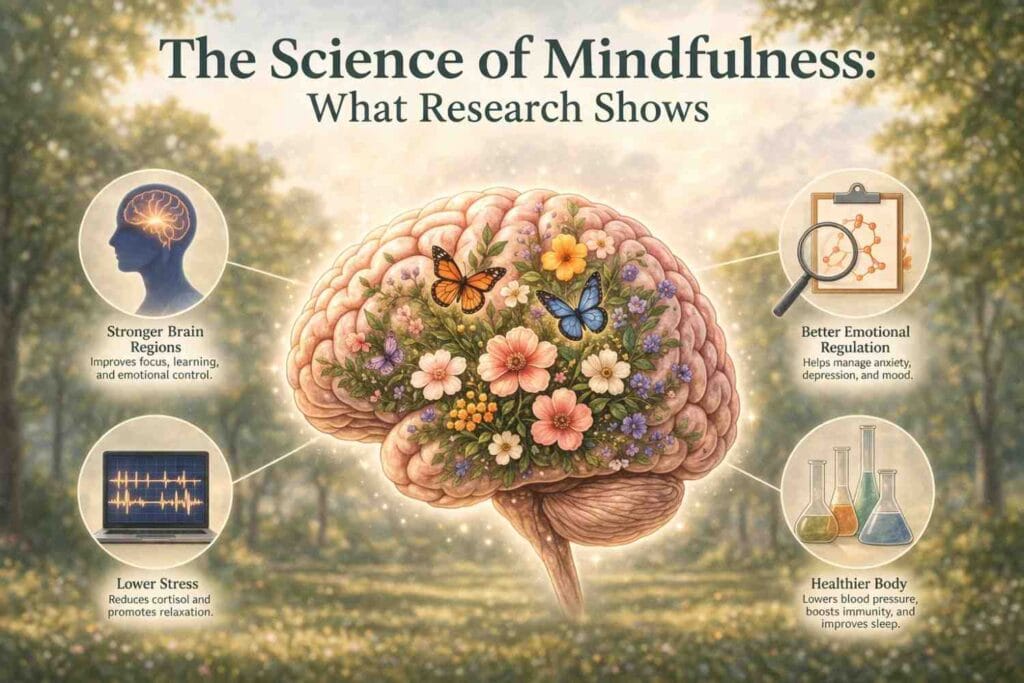
What does research really say about mindfulness? This article explores how mindfulness affects attention, stress, and emotional response based on modern scientific studies.
Why Mindfulness Is Being Studied So Widely
Over the past two decades, mindfulness has moved from being a relatively niche concept into a subject of widespread scientific interest. It is now studied in psychology, neuroscience, medicine, and even education. Researchers are trying to understand not only whether mindfulness works, but how it works, and under what conditions it is most effective.
This rise in interest is not accidental. It reflects a growing recognition of a specific problem that defines modern life, continuous mental activity without sufficient recovery. People are not just physically tired; they are mentally overloaded. Attention is fragmented, and rest does not always feel like rest.
Mindfulness, in this context, is not treated as a philosophical idea, but as a practical intervention.
What Researchers Mean by Mindfulness
In scientific research, mindfulness is generally defined as the ability to maintain awareness of present-moment experience without immediate reaction or judgment. This includes observing thoughts, sensations, and emotions as they arise, rather than being automatically carried by them.
This definition may sound simple, but it points to something specific, the ability to create a gap between experience and reaction.
Most of the time, this gap is absent. Thoughts lead directly to responses, emotions lead directly to behavior. Mindfulness introduces a pause, even if it is brief.
This pause is central to many of the outcomes observed in research.
The Brain and Attention
One of the primary areas of study is attention. Research shows that the human mind tends to wander frequently, even when engaged in tasks. This wandering is not always productive. It often moves toward repetitive thinking, worry, or anticipation.
Mindfulness practices train attention to return to a chosen point, such as the breath or bodily sensation. Over time, this repeated return appears to strengthen the brain’s ability to sustain attention.
Studies using brain imaging have shown changes in areas related to attention control. While these changes are gradual, they suggest that attention is not fixed, it can be developed.
Emotional Regulation and Response
Another area where mindfulness has been studied extensively is emotional regulation.
Normally, emotional responses are immediate. A situation triggers a reaction, and the reaction unfolds without much awareness. This can lead to patterns such as overreaction, suppression, or prolonged stress.
Mindfulness changes this pattern by increasing awareness of the early stages of emotional response. Instead of being fully absorbed in the reaction, there is a degree of observation.
This does not remove the emotion, but it reduces automatic escalation.
Research has shown that individuals who practice mindfulness regularly tend to experience less reactivity and recover more quickly from emotional disturbances.
Stress and the Nervous System
Stress is one of the most common reasons people turn to mindfulness, and it is also one of the most studied areas.
When the body is under stress, the nervous system becomes activated in a way that prepares for action. This is useful in short-term situations, but when it becomes continuous, it leads to fatigue and imbalance.
Mindfulness appears to influence this system by promoting a shift toward a more regulated state. Breathing becomes slower, heart rate stabilizes, and the body moves away from constant activation.
This is not achieved by forcing relaxation, but by reducing unnecessary mental engagement.
The Role of Repetition
One important finding in research is that mindfulness is not effective as a one-time practice. Its effects develop over time through repetition.
Short, consistent practice tends to be more effective than occasional long sessions. This aligns with the idea that mindfulness is not a technique to be applied occasionally, but a skill that develops gradually.
The brain adapts through repeated exposure. Just as habits form through repetition, so does awareness.
Changes in Brain Structure
Some studies have examined long-term practitioners and found structural changes in certain areas of the brain. These include regions associated with memory, learning, and emotional regulation.
While these findings are still being explored, they suggest that consistent mindfulness practice may influence not just how the brain functions, but how it is organized.
However, it is important not to overstate these results. The changes are gradual and depend on sustained practice.
Mindfulness and Mental Health
Mindfulness-based approaches are now used in clinical settings, particularly for conditions such as anxiety, depression, and stress-related disorders.
Programs like Mindfulness-Based Stress Reduction (MBSR) and Mindfulness-Based Cognitive Therapy (MBCT) have shown measurable benefits in reducing symptoms and preventing relapse.
The effectiveness of these approaches appears to come from increasing awareness of thought patterns. Instead of being fully identified with negative thinking, individuals learn to observe it.
This reduces the intensity and persistence of such patterns.
Limitations of Research
While research on mindfulness is extensive, it is not without limitations.
Results vary depending on:
- The type of practice
- Duration of practice
- Individual differences
Some studies show strong effects, while others show more modest outcomes.
Additionally, mindfulness is sometimes simplified in research settings, focusing only on specific techniques rather than the broader context in which it was originally practiced.
This can create a gap between traditional understanding and modern application.
A Connection to Traditional Understanding
Although scientific research approaches mindfulness differently, there are parallels with classical perspectives.
In traditional frameworks, the emphasis is also on observing mental activity and reducing unnecessary engagement.
The difference lies in context. Traditional systems present mindfulness as part of a larger process, while modern research often studies it in isolation.
Both approaches, however, recognize the importance of awareness.
Why Mindfulness Feels Difficult
One common experience is that mindfulness feels difficult, especially in the beginning.
This is not because the practice is complex, but because it reveals the current state of the mind.
When attention is brought to the present moment, the usual distractions are reduced. This makes underlying activity more visible.
Thoughts appear more frequent, not because they have increased, but because they are being noticed.
Understanding this prevents unnecessary frustration.
Practical Implications
For someone interested in mindfulness, research suggests a few practical points.
Consistency matters more than duration. Short, regular practice is effective.
The aim is not to eliminate thoughts, but to observe them.
Progress is gradual and may not always be obvious.
These points align with both scientific findings and traditional approaches.
The scientific study of mindfulness has provided valuable insights into how attention, emotion, and stress are influenced by awareness.
Research shows that mindfulness can improve attention, reduce reactivity, and support overall mental well-being.
At the same time, it highlights that mindfulness is not a quick solution. Its effects develop through consistent practice and realistic expectations.
When understood clearly, mindfulness becomes less about achieving a specific state and more about changing the way experience is related to. And in that change, both research and lived experience begin to align.