
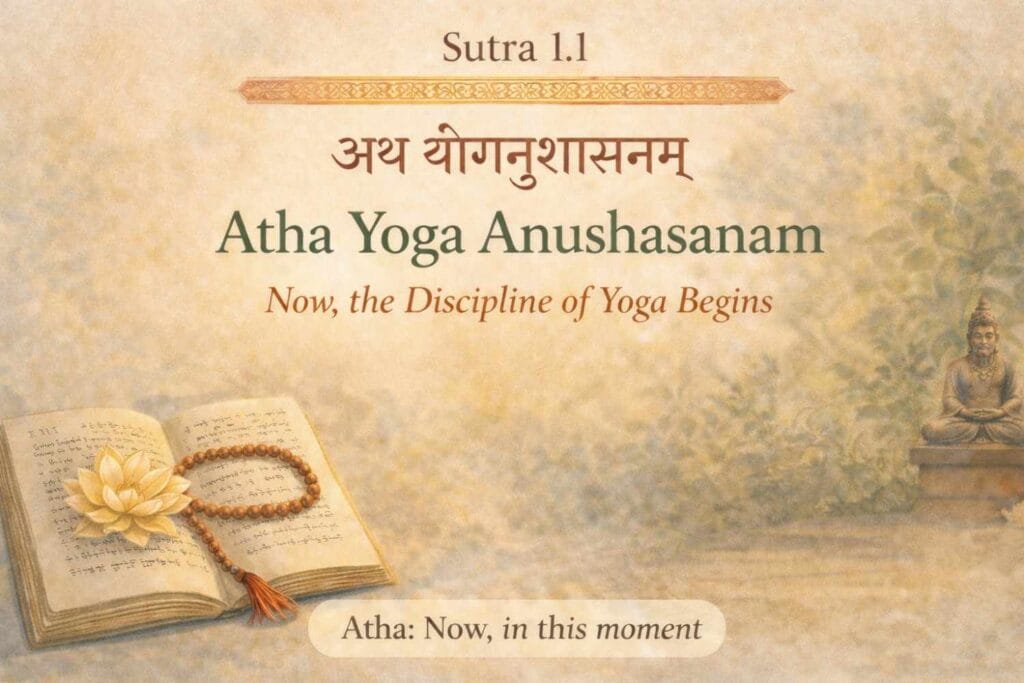
What does Atha Yoga Anushasanam mean? Understand the first Yoga Sutra with accurate translation and deeper insight into its true significance.
Sanskrit
अथ योगानुशासनम्
Atha Yoga Anushasanam
English Translation
“Now, the disciplined instruction of Yoga begins.”
The Sutra That Does Not Explain – Yet Defines the Entire Approach
At first reading, this sutra appears almost too simple. It does not define Yoga. It does not describe techniques, practices, or goals. It only announces a beginning.
But in classical texts like the Yoga Sutras of Patanjali, nothing is casual. Every word is intentional, and every placement carries meaning.
This sutra is not meant to inform. It is meant to prepare.
Before the text explains what Yoga is, it establishes how it must be approached. Without this, everything that follows can be misunderstood.
The Depth of “Atha” – More Than Just “Now”
The word “Atha” is often translated simply as “now,” but this translation is incomplete if taken casually.
In traditional Sanskrit usage, “Atha” is used to indicate an auspicious and prepared beginning. It is not the beginning of a book. It is the beginning of a state.
It implies that something has already been completed or cultivated before this moment:
- A certain level of maturity
- A readiness to listen, not just read
- A willingness to observe, not just understand intellectually
This means Yoga does not begin randomly.
It begins when the individual is ready to engage with it in the right way.
Without this readiness, the text may still be read, but it will not be understood in its intended sense.
Yoga Is Not Introduced – It Is Entered
One of the most important aspects of this sutra is what it does not do.
It does not define Yoga.
It does not describe its purpose.
It does not justify its importance.
Instead, it simply says:
“Now, the instruction begins.”
This indicates that Yoga is not something that needs introduction. It is something that needs entry.
This changes the entire orientation of the reader.
You are not here to learn about Yoga.
You are here to enter a process.
The Meaning of “Anushasanam”
The word “Anushasanam” is central to this sutra and often misunderstood.
It is commonly translated as “teaching” or “instruction,” but its meaning is more precise.
It refers to:
- A systematic and disciplined transmission
- A structure that must be followed, not improvised
- Guidance that is rooted in experience, not opinion
This immediately removes several modern assumptions:
Yoga is not:
- A flexible lifestyle choice
- A collection of techniques to pick from
- A casual or occasional practice
Yoga is presented here as a disciplined system, one that requires consistency, attention, and continuity.
Why This Sutra Comes Before the Definition of Yoga
Logically, one might expect the text to begin by defining Yoga. But that comes in Sutra 1.2.
Before defining Yoga, Patanjali establishes the right state of approach.
This is crucial.
Because without the correct approach:
- Definitions become intellectual concepts
- Practices become mechanical routines
- Results become misunderstood or exaggerated
This sutra ensures that the reader does not approach Yoga casually or superficially.
It sets the tone for everything that follows.
The Shift from Curiosity to Commitment
This sutra marks a transition that is subtle but significant.
It shifts the reader from:
- Curiosity → to commitment
- Information → to transformation
- Reading → to observation
In modern contexts, Yoga is often approached out of interest or convenience. This sutra challenges that approach.
It suggests that Yoga requires a different kind of engagement, one that is steady and intentional.
Relation to the Broader Yogic Framework
Although this sutra stands alone, its meaning aligns with insights from other classical texts.
The Bhagavad Gita emphasizes discipline, moderation, and consistency in action. It does not support extremes or casual effort.
Similarly, the Hatha Yoga Pradipika presents practice as something that must be sustained and structured, not random or occasional.
Sutra 1.1 reflects the same foundation.
It establishes that Yoga is not an idea to explore briefly. It is a path that requires continuity.
What This Means for a Modern Practitioner
For someone starting Yoga today, this sutra has direct relevance.
It suggests that Yoga does not begin when you:
- Learn postures
- Follow routines
- Watch or imitate
It begins when:
- Attention becomes intentional
- There is willingness to observe the mind
- There is acceptance of discipline
Without this shift, Yoga remains external.
With it, Yoga begins internally.
The Subtle Discipline It Implies
This sutra does not command discipline explicitly, but it implies it completely.
“Anushasanam” suggests that:
- Practice must be regular
- Effort must be steady
- Understanding must develop gradually
This discipline is not rigid or forceful. It is consistent.
It aligns with the idea presented later in the Yoga Sutras:
that sustained effort over time leads to stability.
A Sutra That Prepares Rather Than Teaches
This sutra is unique because it does not provide knowledge.
It prepares the ground for knowledge.
It ensures that what follows is not taken casually or misunderstood as theory.
Without this preparation, the deeper sutras lose their impact.
With it, even simple statements gain depth.
Expanded Understanding
If expressed in a slightly more descriptive way (without distorting meaning):
“Now, with readiness and attention, begins the disciplined and systematic path of Yoga.”
Conclusion
Sutra 1.1 is not about explaining Yoga. It is about establishing the right beginning.
It marks a moment where:
- The reader becomes a practitioner
- Curiosity becomes commitment
- Knowledge becomes a process
It reminds us that Yoga does not begin with action.
It begins with readiness to observe and follow a disciplined path.
And only after this readiness is established does the teaching truly begin.