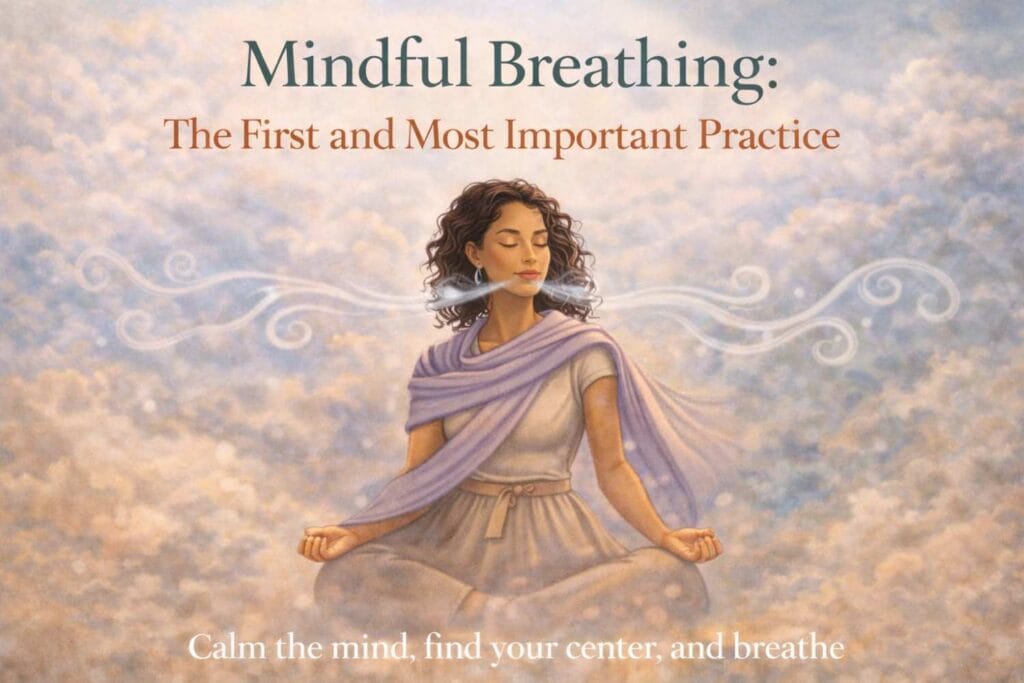
Mindful breathing is the simplest and most powerful practice to build awareness. Learn how breath influences the mind and how to begin today.
Before Anything Else, There Is Breath
There is something so constant in our experience that it almost disappears from attention. It does not need effort, instruction, or reminder. It continues whether we notice it or not. That is breath.
And yet, in most cases, it is the last thing we become aware of when we begin practices like Yoga or meditation. People search for techniques, methods, routines, but the simplest and most immediate aspect of experience is already present.
Breath does not need to be introduced. It needs to be noticed.
This is why, in traditional understanding, breath is not treated as a secondary tool. It is the first doorway.
Why Breath Comes Before Technique
In the Hatha Yoga Pradipika, breath is not described as just a physiological process. It is directly connected to the movement of the mind. When the breath is unsettled, the mind reflects that disturbance. When the breath becomes steady, something in the mind begins to slow down.
This relationship is not symbolic. It is observable.
If you pause for a moment and notice your breath during stress, it is often shallow or irregular. In moments of ease, it becomes slower and more even. The body and mind are not operating separately. They are continuously influencing each other.
Because of this, working with breath becomes a direct way of approaching the mind without forcing it.
The Mistake of Trying to Control Too Early
When people first hear about mindful breathing, the immediate tendency is to control it. To breathe slowly, deeply, or in a specific pattern.
But control is not the starting point.
If you try to change the breath without first understanding it, the process becomes artificial. The breath loses its natural rhythm, and attention shifts toward performance rather than observation.
In Yogic understanding, awareness precedes regulation.
Before the breath is adjusted, it must be seen as it is.
What It Means to Observe the Breath
Observation sounds simple, but it is often misunderstood.
To observe the breath is not to analyze it or label it. It is to remain with it as it moves: inhale, exhale, without interference.
At first, this seems easy. But within a few seconds, attention moves. Thoughts appear, distractions arise, and the breath is forgotten.
This is not a failure of practice. It is the first clear insight into how attention behaves.
The Yoga Sutras of Patanjali describes the mind as naturally active, constantly moving. Observing the breath simply makes this movement visible.
Breath as a Point of Return
Because the mind does not remain steady initially, the breath becomes a point to return to.
Each time attention moves away, it is brought back, not forcefully, but gently.
This repetition is not a distraction from practice. It is the practice itself.
Over time, this returning becomes smoother. The gap between distraction and noticing becomes shorter.
This is how stability begins, not by eliminating movement, but by recognizing it more quickly.
The Subtle Change That Begins to Happen
With consistent observation, something begins to shift.
The breath, without being forced, becomes more even. The body relaxes slightly. The mind, though still active, becomes less chaotic.
These changes are not dramatic. They are gradual and often subtle.
But they indicate something important, the system is beginning to regulate itself.
This is why breath is considered foundational. It does not impose change. It allows it.
The Link Between Breath and Attention
Attention and breath move together more closely than we realize.
When attention is scattered, the breath reflects it. When attention settles, the breath follows.
Working with the breath gives attention a place to rest. Not permanently, but repeatedly.
This repeated placement of attention creates familiarity. And familiarity reduces resistance.
Why Breath Is Considered the First Practice
Many practices in Yoga require some level of stability, postures require balance, meditation requires attention.
Breath, however, is always available. It does not depend on flexibility, knowledge, or preparation.
This makes it the most accessible starting point.
The Bhagavad Gita emphasizes balance and moderation in action. Breath observation naturally supports this balance. It does not push the system toward extremes. It brings it toward steadiness.
The Role of Consistency
Mindful breathing does not require long sessions. What it requires is consistency.
Even a few minutes of daily observation begins to create a pattern.
The body becomes familiar with stillness. The mind becomes slightly less reactive.
These changes are small, but they accumulate.
In the Yoga Sutras, sustained practice over time is emphasized. Breath awareness fits naturally into this principle.
Breath Beyond Sitting Practice
While mindful breathing is often practiced while sitting, it is not limited to that.
During daily activities, walking, waiting, even speaking, the breath continues.
Bringing attention to it in these moments extends the practice into life.
This does not require additional time. It requires occasional remembering.
When the Practice Feels Difficult
There will be times when observing the breath feels frustrating. The mind moves constantly, and attention does not stay.
This is not a sign that the practice is ineffective. It is a sign that awareness is becoming sharper.
What was previously unnoticed is now visible.
Instead of trying to fix this, it is more useful to continue observing without judgment.
The Relationship Between Breath and Stillness
Stillness in Yoga is not created by forcing the body or suppressing thoughts. It emerges when unnecessary movement reduces.
Breath plays a central role in this.
As the breath becomes steady, the need for constant adjustment reduces. The body becomes quieter. The mind follows.
This is not a sudden transformation. It is a gradual settling.
Why This Practice Remains Relevant
In a time where attention is constantly fragmented, mindful breathing offers something simple and direct.
It does not require external tools or complex methods. It only requires noticing what is already present.
This simplicity makes it easy to overlook. But it is also what makes it effective.
A Practical Way to Begin
Sit in a stable position.
Allow the body to settle without forcing it.
Bring attention to the breath.
Observe it as it moves in and out.
When attention moves away, bring it back gently.
This is enough.
There is no need to extend or complicate it.
Mindful breathing is not just a technique. It is an entry point.
It connects the body and mind in a way that is immediate and observable. It allows attention to develop without force.
Through the understanding found in the Yoga Sutras, the Bhagavad Gita, and the Hatha Yoga Pradipika, breath becomes more than a physical process. It becomes a bridge.
And in returning to it, again and again, practice begins to deepen, not through effort, but through continuity.