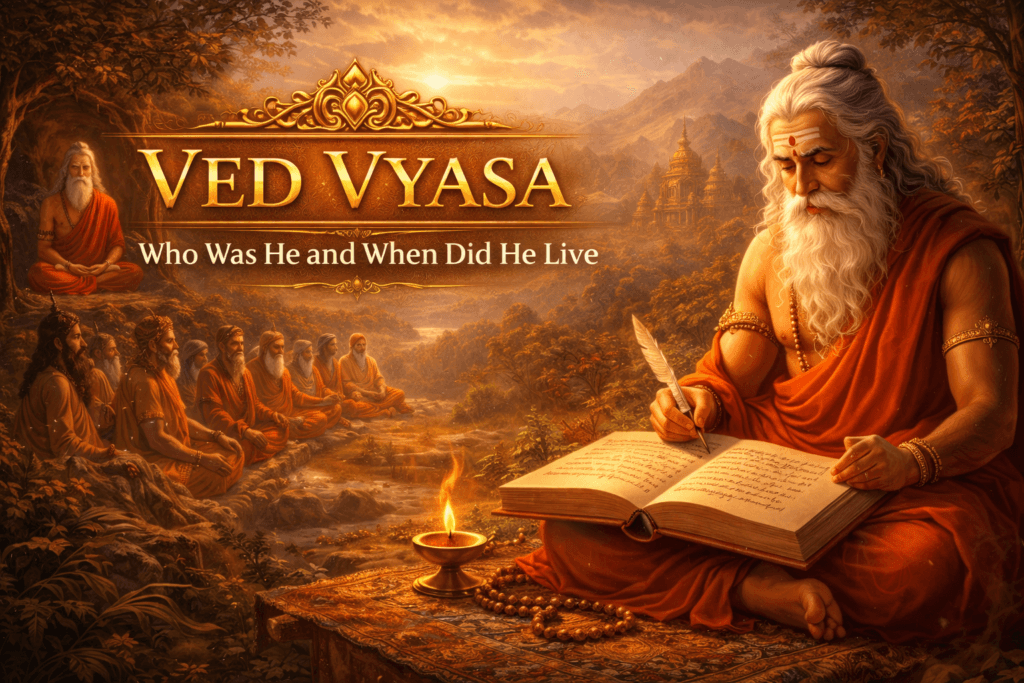
Explore the life and contributions of Ved Vyasa and understand his importance in the transmission of the Bhagavad Gita.
A Figure Who Does Not Stand in Front, Yet Shapes Everything
In most traditions, the author stands visibly at the center of the work. Their voice is direct, their presence unmistakable. But in the case of Ved Vyasa, the relationship is different.
He does not present himself as the central voice. He does not dominate the narrative. And yet, without him, some of the most important texts in the Indian tradition, including the Bhagavad Gita, would not exist in the form we know today.
His role is not of expression alone. It is of preservation, arrangement, and transmission.
To understand Ved Vyasa is to understand how knowledge moves across generations, not loudly, but with continuity and structure.
The Meaning Behind the Name “Vyasa”
The name “Vyasa” is not just an identity; it is a function.
It means “one who arranges, compiles, or divides”. This is important because it reflects the nature of his work.
He is traditionally known as Krishna Dvaipayana Vyasa:
- Krishna → referring to his complexion
- Dvaipayana → born on an island
- Vyasa → the one who organized knowledge
This already indicates that his contribution was not limited to writing. It was about making knowledge accessible and structured.
The Context in Which Vyasa Appears
To understand his role, it is important to see the context.
The knowledge contained in the Vedas was originally transmitted orally. It was vast, complex, and required immense memory and discipline to preserve accurately.
Over time, this knowledge needed to be organized so that it could be maintained without distortion.
This is where Vyasa’s role becomes central.
He is traditionally credited with dividing the Vedas into four parts, making them easier to study and transmit. This act was not just intellectual, it was essential for preserving continuity.
Vyasa as a Compiler, Not Just an Author
Unlike modern authors who create original narratives, Vyasa’s role is often described as that of a compiler and arranger of existing knowledge.
He gathers, structures, and presents.
This distinction is important. It shows that his contribution lies in clarity and continuity, not personal expression.
This same approach is reflected in the way the Bhagavad Gita appears within a larger narrative.
The Mahabharata and the Emergence of the Bhagavad Gita
The Bhagavad Gita is not a standalone text in its original form. It appears within the Mahabharata, traditionally attributed to Ved Vyasa.
The Mahabharata is not merely a story. It is a complex narrative that includes history, philosophy, ethics, and human conflict.
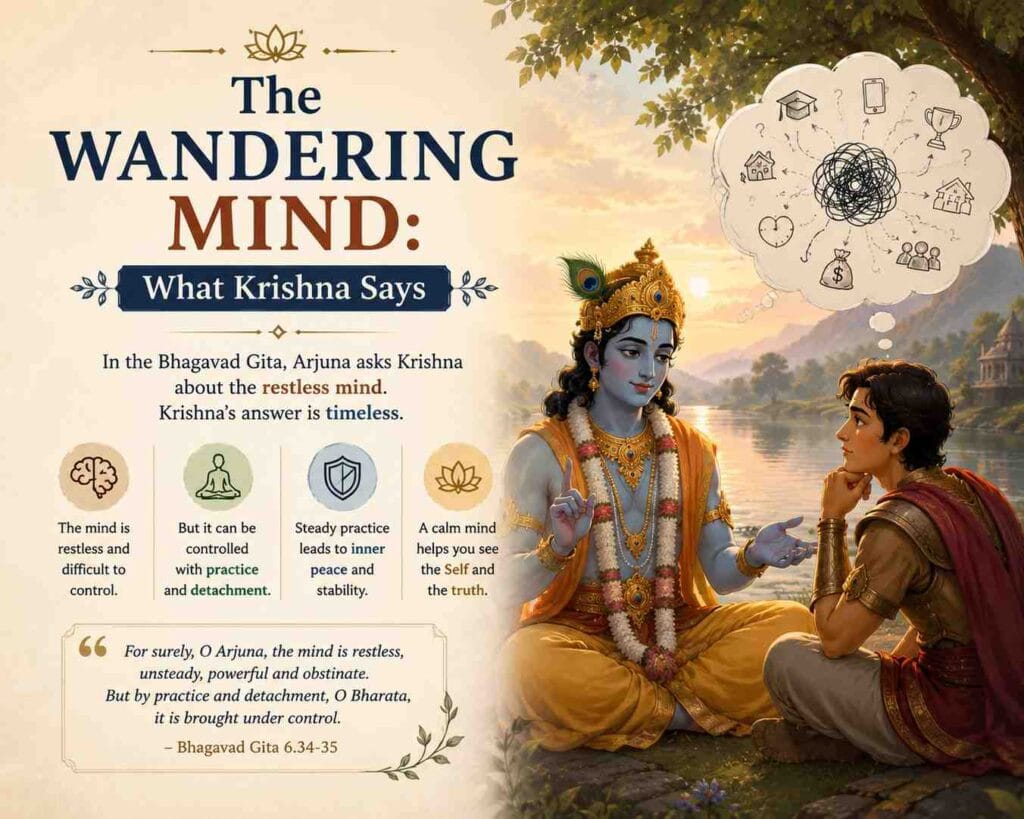
Within this vast framework, the Bhagavad Gita emerges as a dialogue, between Arjuna and Krishna, at a moment of intense conflict.
Vyasa’s role here is not as a speaker in the dialogue, but as the one who presents the dialogue within a structured narrative context.
His Role in the Bhagavad Gita
Vyasa does not speak the teachings of the Gita. That role belongs to Krishna within the dialogue.
But Vyasa’s contribution lies in:
- Preserving the dialogue
- Placing it within a meaningful context
- Ensuring its transmission
Without this structure, the dialogue would not reach us in the same way.
This is a different kind of authorship, one that values accuracy over expression, continuity over individuality.
The Layered Transmission of Knowledge
The Bhagavad Gita is presented as a dialogue between Krishna and Arjuna, but it is also narrated through layers:
- Krishna speaks to Arjuna
- Sanjaya narrates the dialogue
- Vyasa structures the entire narrative
This layered transmission shows how knowledge is preserved not through a single voice, but through a chain of observation and narration.
Vyasa stands at the foundation of this chain.
Vyasa and the Idea of Observation
In Yogic understanding, observation plays a central role.
The Yoga Sutras of Patanjali emphasizes the importance of seeing clearly, without distortion.
Vyasa’s method reflects a similar principle.
He does not interfere with the dialogue. He does not modify it for personal interpretation. He presents it as it is, within a structured framework.
This reflects a discipline of non-distortion, a key aspect of preserving knowledge.
The Relationship Between Knowledge and Structure
Knowledge, when left unstructured, can become fragmented.
Vyasa’s work shows that preservation requires organization.
By dividing the Vedas and compiling texts like the Mahabharata, he ensures that knowledge is not lost, scattered, or misinterpreted over time.
This is not a creative act in the modern sense. It is a protective act, maintaining clarity across generations.
Vyasa’s Influence Beyond the Bhagavad Gita
While his role in the Bhagavad Gita is significant, it is part of a larger contribution.
He is associated with:
- Compilation of the Vedas
- Composition of the Mahabharata
- Contribution to Puranic literature
These works collectively form a major part of the Indian knowledge tradition.
His influence is not limited to one text. It extends across multiple layers of tradition.
The Nature of His Contribution
What makes Vyasa unique is not the volume of his work, but the nature of his contribution.
He does not seek visibility.
He does not present personal philosophy.
He does not position himself as central.
Instead, he creates a structure through which knowledge can move forward.
This is a different kind of role, one that is often overlooked, but essential.
A Quiet Presence in a Vast Tradition
In many ways, Vyasa represents a principle rather than a personality.
The principle of:
- Organizing knowledge
- Preserving accuracy
- Ensuring continuity
This principle is what allows traditions to survive beyond individual lifetimes.
The Connection to Practice
For someone engaging with Yoga or philosophy, Vyasa’s role offers a subtle insight.
Understanding does not always come from creating new ideas. Sometimes it comes from engaging deeply with what already exists.
The texts preserved by Vyasa are not meant to be consumed quickly. They are meant to be observed, revisited, and understood gradually.
Why His Role Still Matters Today
In a time where information is abundant but often fragmented, Vyasa’s approach remains relevant.
He shows that knowledge requires:
- Structure
- Clarity
- Continuity
Without these, information loses its depth.
Ved Vyasa does not stand at the forefront of the teachings found in the Bhagavad Gita, yet his presence runs through every line of it. Without his effort to organize and preserve, the dialogue between Krishna and Arjuna would remain confined to its moment, rather than becoming a text that continues to be studied and reflected upon.
His contribution reminds us that knowledge is not only about expression, but also about responsibility, the responsibility to maintain clarity, to transmit without distortion, and to ensure that what is meaningful does not disappear with time.
And perhaps that is why his role feels quiet, yet foundational. Not because it demands attention, but because it supports everything that follows.