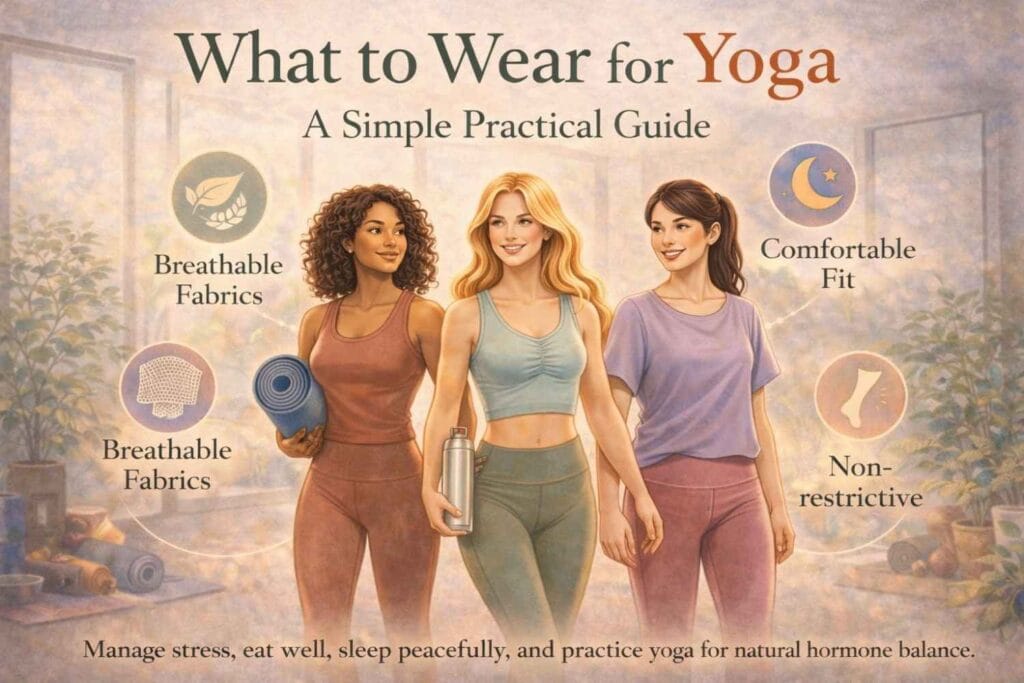
Not sure what to wear for yoga? This guide explains how to choose comfortable, practical clothing that supports movement, breath, and focus.
Why Clothing Matters More Than It Seems
Clothing is usually treated as a minor detail in Yoga. People focus on postures, breathing, or routines, assuming that what they wear does not make much difference. But once practice begins, this assumption quickly changes.
Tight or uncomfortable clothing restricts movement. Loose but unstable clothing shifts constantly. Synthetic fabrics may trap heat. Heavy clothing distracts attention.
Yoga requires a certain ease, not only in the body, but in how the body is supported. Clothing becomes part of that support.
This is not about appearance. It is about allowing the body to move and settle without unnecessary interference.
The Purpose of Clothing in Yoga
Before choosing what to wear, it helps to understand what clothing is meant to do during practice.
In Yoga, clothing should:
- Allow free and natural movement
- Stay in place without constant adjustment
- Support breath and expansion
- Keep the body at a comfortable temperature
Anything beyond this is secondary.
Clothing that draws attention to itself, through discomfort, restriction, or constant adjustment, interrupts the practice.
Comfort vs Function: Finding the Balance
Many people choose clothing based only on comfort. Others focus only on fit or appearance.
But Yoga requires a balance between comfort and function.
Clothing that is too loose may feel comfortable while standing, but during movement, it can shift or interfere. Clothing that is too tight may look stable but can restrict breathing or circulation.
The right choice sits between these extremes.
It should feel natural when still and remain stable when moving.
Fabric: The First Thing to Consider
Fabric plays a major role in how clothing behaves during practice.
Natural fabrics like cotton are breathable and gentle on the skin. They allow air to pass through, reducing overheating. However, they may absorb sweat and feel heavy during longer sessions.
Stretchable fabrics provide flexibility and adapt to movement. They allow the body to move without resistance. But if they are not breathable, they can trap heat.
The ideal choice often combines both qualities, breathability and flexibility.
The aim is not to find a perfect material, but to avoid extremes that create discomfort.
Fit: Neither Too Tight Nor Too Loose
Fit directly affects movement.
Clothing that is too tight can restrict joints and breathing. It may look supportive, but it reduces natural range of motion.
Clothing that is too loose can shift during practice. It may bunch up, slide, or require constant adjustment.
A balanced fit:
- Moves with the body
- Stays in place during transitions
- Does not compress or restrict
This balance allows attention to remain on practice rather than clothing.
Upper Body Clothing
For the upper body, the main requirement is freedom of breath and movement.
The chest and shoulders expand during breathing. Clothing should not restrict this expansion.
For some, a fitted top provides stability and prevents shifting. For others, a slightly relaxed fit feels more natural.
The key is that the clothing should:
- Stay in place during movement
- Allow full range of motion
- Not feel tight around the chest or shoulders
Lower Body Clothing
The lower body is more involved in movement, bending, stretching, and balancing.
Clothing here must:
- Allow flexibility
- Stay secure without slipping
- Not restrict the hips or knees
Pants or leggings that stretch and hold their position tend to work well.
If the clothing shifts during practice, it becomes a distraction.
The Role of Temperature
Yoga is not always practiced in the same environment. Temperature affects clothing choice.
In warmer conditions, lighter and breathable fabrics help prevent overheating.
In cooler conditions, slightly layered clothing helps maintain comfort without restricting movement.
The goal is to maintain a neutral body temperature, not too warm, not too cold.
Why Simplicity Works Best
There is a tendency to overcomplicate clothing choices, different outfits for different styles, matching sets, or specialized gear.
But in practice, simplicity works best.
Clothing that is:
- Comfortable
- Functional
- Easy to wear
is more effective than anything designed for appearance.
The simpler the clothing, the less it interferes.
Avoiding Common Mistakes
Some common mistakes become noticeable only after practice begins:
- Wearing clothing that needs constant adjustment
- Choosing fabric that traps heat
- Wearing items that restrict movement
- Prioritizing appearance over comfort
These mistakes do not prevent practice, but they reduce its ease.
Clothing and Attention
The Yoga Sutras of Patanjali emphasizes the role of attention.
When applied to Yoga, attention should move toward the body, breath, and movement, not toward external discomfort.
Clothing that requires attention shifts focus away from practice.
Clothing that supports the body allows attention to remain where it is needed.
Do You Need Special Yoga Clothing?
A common question is whether specialized Yoga clothing is necessary.
The answer is simple: not always.
If regular clothing meets the requirements, comfort, flexibility, stability, it can be used.
Specialized clothing may make things easier, but it is not essential.
The practice does not depend on what you wear. It depends on how freely you can move and breathe.
Practicing at Home vs Studio
Clothing choices may vary slightly depending on where you practice.
At home, comfort and ease may be the priority.
In a studio, stability and coverage may become more important due to shared space.
But the core principles remain the same.
Minimalism in Practice
Yoga, at its core, moves toward simplicity.
Clothing reflects this as well.
The less you have to think about what you are wearing, the more naturally the practice unfolds.
This does not mean neglect. It means choosing what is sufficient.
A Practical Checklist
Before starting practice, you can ask:
- Can I move freely in this?
- Does it stay in place without adjustment?
- Does it feel comfortable over time?
If the answer is yes, the clothing is suitable.
What you wear for Yoga does not define your practice, but it influences how the practice feels.
Clothing that supports movement, breath, and comfort allows the body to function without interference.
Through a simple and practical approach, clothing becomes part of the environment that supports Yoga, not something that distracts from it.
And when that support is present, attention naturally shifts where it belongs, toward the practice itself.