
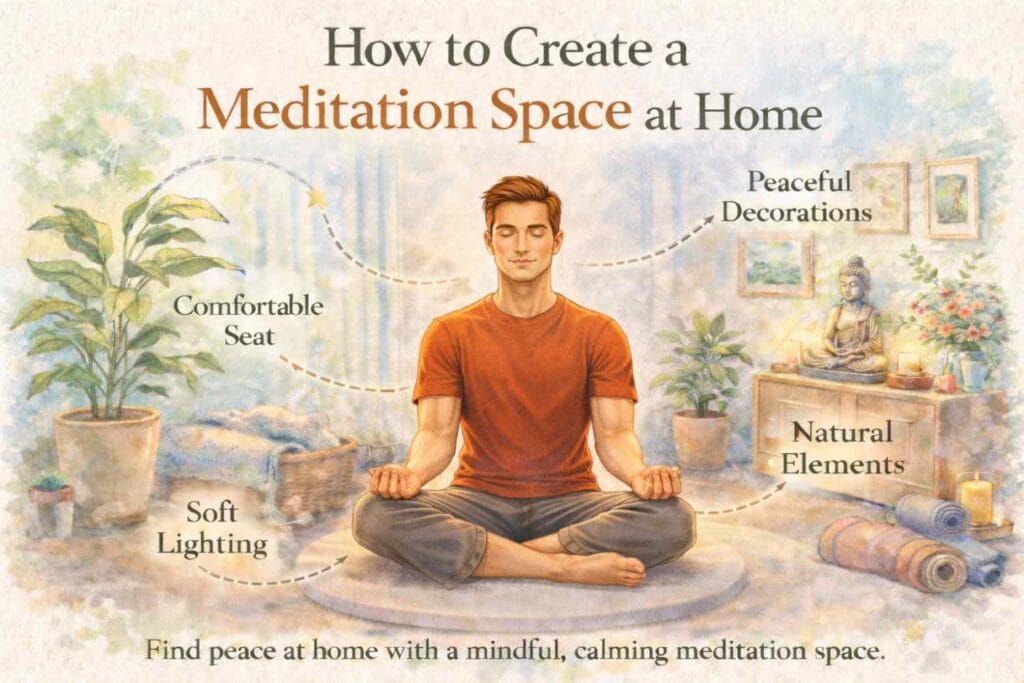
Discover how to design a peaceful meditation space at home that supports focus, relaxation, and consistency in your practice.
A Space Is Not Decoration – It Is Preparation
Meditation is often described as something internal. You close your eyes, observe your breath, and turn inward. Because of this, many assume that the external environment does not matter.
But if you observe carefully, the mind does not exist independently of its surroundings. Noise, clutter, light, and even subtle discomfort continuously influence attention.
This is why, in traditional Yogic understanding, preparation is never ignored. The environment is not the goal, but it is a support system for the goal.
The classical teachings reflected in Hatha Yoga Pradipika emphasize that practice should begin in a place free from disturbance and distraction, where the body and mind can settle naturally.
A meditation space, therefore, is not about aesthetics. It is about creating conditions where attention can stabilize without resistance.
Why a Dedicated Space Changes Your Practice
When you sit in the same place repeatedly, something subtle begins to happen. The body recognizes the posture. The mind recognizes the intention.
Over time, the space itself becomes associated with stillness.
A dedicated meditation space helps:
- Reduce decision fatigue (where to sit, how to begin)
- Signal the mind to shift inward
- Create continuity in practice
Even modern guidance reflects this: a consistent space helps the mind “move inward more quickly” due to association and habit.
This is not psychological conditioning alone, it is practical training of attention.
Choosing the Right Place: Simplicity Over Perfection
The first mistake people make is searching for the “perfect” meditation room.
In reality, you do not need a separate room. You need a consistent corner.
The space should:
- Be relatively quiet
- Have minimal interruption
- Feel neutral or calming
Traditional meditation practices often recommend a secluded and stable place, away from constant activity.
This does not mean isolation from life. It simply means reducing unnecessary stimulation.
Even a small corner in your room can become effective if used consistently.
Cleanliness and Order: More Important Than Decoration
A cluttered space creates subtle tension. Objects compete for attention. The mind remains slightly alert instead of settling.
A clean space, on the other hand, reduces sensory input.
Modern guidance aligns with this: a clean environment helps the mind relax more easily during meditation.
In Yogic understanding, this reflects sattva, clarity and balance.
Cleanliness is not about perfection. It is about removing what is unnecessary.
The Role of Light and Air
The body responds continuously to its environment.
- Fresh air supports alertness
- Natural light reduces heaviness
- Dim lighting can support inward focus
Spaces with natural light and ventilation are considered more supportive because they enhance comfort and clarity.
From an Ayurvedic perspective, this relates to prana (life force).
A space that feels fresh allows the breath to flow more naturally, which directly affects the mind.
Orientation and Direction (Subtle but Powerful)
Traditional systems like Vastu suggest that certain directions support calmness and clarity.
For example:
- Northeast direction is considered शांत (calm, sattvic)
- East-facing spaces are associated with new energy (sunrise)
These principles are not rigid rules, but observations of natural patterns.
Even modern guidance suggests that natural light direction influences the experience of meditation.
If possible, choose a space that feels naturally calm, not forced or artificial.
The Seat: Foundation of Stillness
In meditation, posture matters.
The classical texts emphasize establishing a stable seat (asana) before beginning practice.
This does not require complexity.
You can use:
- A folded blanket
- A cushion
- A mat
- A chair (if needed)
Research and traditional practice both confirm that stable seating supports better stillness and reduces physical disturbance.
The purpose is simple:
The body should not become the main distraction
Keep It Minimal: Less Is More
There is a tendency to decorate meditation spaces excessively: candles, statues, lights, objects.
While these can be meaningful, they can also become distractions.
A meditation space should feel:
- Open
- Uncluttered
- Simple
Modern recommendations clearly state that minimalism improves focus and reduces distraction.
The goal is not to impress the eye. It is to quiet the mind.
Creating a Subtle Focal Point (Optional)
A small focal point can help anchor attention.
Traditionally, this could be:
- A simple altar
- A candle flame
- A symbol
- A natural object
Such elements are not required, but they can provide direction to attention.
An altar, even in simple form, serves as a reminder of purpose and intention.
But it should remain simple. The moment it becomes decorative, it loses its purpose.
Sound: Silence or Soft Support
Silence is ideal, but not always possible.
If external noise is unavoidable, you can:
- Use soft background sound
- Choose consistent ambient noise
- Avoid sudden, sharp disturbances
The aim is not perfect silence, but predictable sound.
When sound is stable, the mind adapts more easily.
Fragrance and Sensory Input
Smell has a direct effect on the nervous system.
Natural fragrances like:
- Incense
- Essential oils
- Fresh air
can support relaxation when used gently.
However, strong or artificial scents can become distracting.
The principle remains the same:
Support the system, do not overstimulate it
Technology: The Silent Disturbance
One of the biggest disruptions in modern practice is the presence of devices.
Notifications, vibrations, and even the expectation of interruption keep the mind alert.
Even modern meditation guidelines recommend keeping phones away during practice.
A meditation space should be free from digital interference.
The Psychological Effect of Repetition
When you return to the same space daily, it begins to carry meaning.
- Sitting becomes easier
- Settling becomes faster
- Resistance reduces
This is not mystical. It is conditioning through repetition.
Just like a bed signals sleep, a meditation space signals stillness.
You Do Not Need Perfection
A common barrier is thinking:
“I will start when my space is perfect.”
This delays practice unnecessarily.
Meditation does not require ideal conditions. It requires consistent effort.
The space supports the practice, but it does not replace it.
A Simple Practical Setup
If you want a clear starting point:
- Choose a quiet corner
- Keep it clean
- Place a mat or cushion
- Ensure comfortable light and air
- Remove distractions
This is enough.
Everything else is optional.
The Deeper Meaning of a Meditation Space
From a Yogic perspective, the external space reflects an internal intention.
You are creating:
- A boundary from distraction
- A place for awareness
- A moment of stillness in daily life
The ancient texts consistently point toward this idea:
Meditation is about stilling the fluctuations of the mind.
The space does not create stillness. It supports it.
When the Space Becomes Secondary
Over time, something changes.
You no longer depend completely on the space. You can sit anywhere, home, travel, even in noise, and still observe.
But in the beginning, the space plays an important role.
It acts as training wheels for attention.
Creating a meditation space at home is not about designing a perfect room. It is about removing what interferes and supporting what helps.
Through principles found in traditional Yoga texts and practical observation, the essentials remain simple:
- Quiet
- Clean
- Stable
- Minimal
- Consistent
When these conditions are present, the practice becomes easier, not because the mind stops immediately, but because it faces fewer obstacles.
And gradually, as attention strengthens, the need for external support reduces.
But in the beginning, this small, intentional space becomes the place where the practice truly begins.