
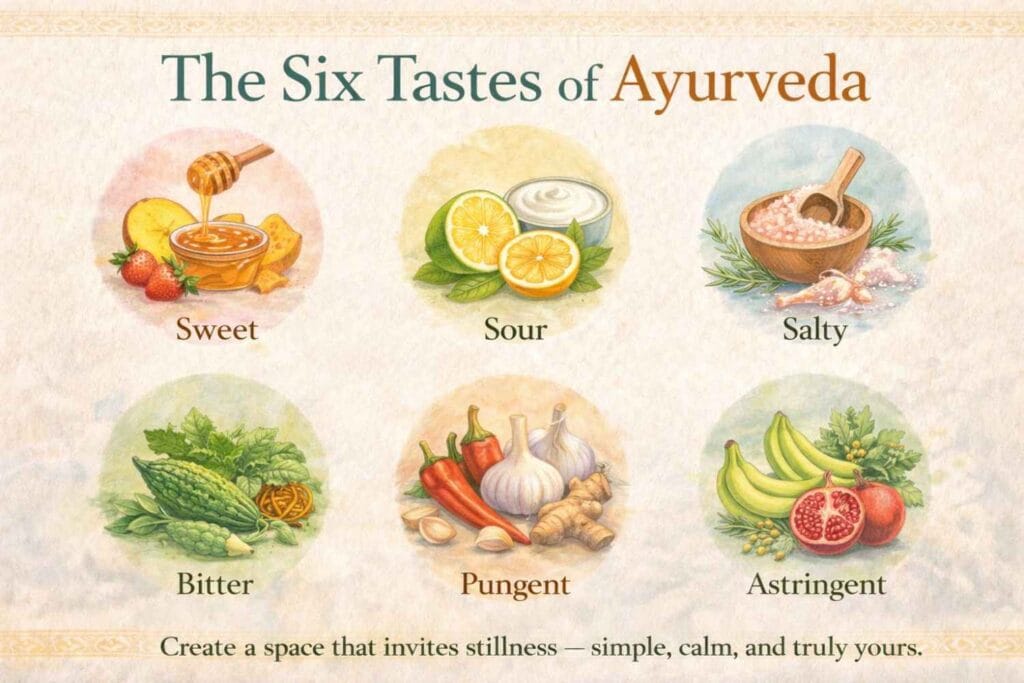
Discover the six tastes of Ayurveda and how sweet, sour, salty, bitter, pungent, and astringent foods influence digestion, energy, and balance.
The Moment Food Stops Being Just Food
There comes a point where eating is no longer just about hunger. You begin to notice patterns, some meals leave you steady and clear, while others make you feel heavy, restless, or strangely unsatisfied even after eating enough.
This difference is subtle at first, but once seen, it cannot be ignored. Food is not acting the same way every time. Something about it is interacting differently with the body.
Traditional knowledge never treated this as a mystery. It approached food not as a collection of nutrients, but as a set of qualities that actively shape the system.
The idea of the six tastes emerges from this observation. Not as a culinary classification, but as a way to understand how food behaves once it enters the body.
Taste as Experience Beyond the Tongue
When we say something tastes sweet or bitter, we usually refer to the moment it touches the tongue. But that is only the beginning of its journey.
In the Ayurvedic view, taste continues to act even after swallowing. It influences digestion, energy, and even the subtle state of the mind.
A sweet food may initially feel comforting, but in excess, it can slow the system down. A pungent food may feel sharp, but it can awaken digestion and circulation.
Taste, therefore, is not a surface sensation. It is a functional language of the body.
This understanding connects with the broader insight seen in the Bhagavad Gita, where food is described not just in terms of its physical nature but by the effect it creates, clarity, agitation, or inertia.
Why the Body Responds Differently to Different Foods
If food were only fuel, the body would respond uniformly. But it does not.
Some foods energize without burden. Others create fullness without nourishment. Some stimulate, while others calm.
This difference arises because each food carries a combination of qualities, heaviness, lightness, heat, dryness, stability. The six tastes are a direct expression of these qualities.
Understanding taste is essentially understanding how these qualities influence you.
Sweet Taste – The Pull Toward Comfort and Stability
Sweetness is the most instinctively preferred taste. From early life, it is associated with nourishment and satisfaction.
It builds, restores, and supports the body. After physical exertion or depletion, sweet taste brings a sense of grounding.
But this same quality, when extended beyond need, becomes stagnation.
You can observe this clearly:
- After a balanced amount of sweetness, the body feels stable
- After excess, it feels heavy and slow
This is not a contradiction. It is the same quality expressing itself differently depending on quantity.
Sweet taste also affects the mind. It soothes and comforts, which is why emotional eating often leans toward sweetness. But this comfort is temporary. When overused, it leads to dullness rather than clarity.
Sour Taste – The Sharp Edge of Activation
Sourness immediately awakens the senses. It stimulates salivation, increases appetite, and brings a certain sharpness to the experience of eating.
In the body, this translates into activation. Digestion becomes more responsive. There is a sense of readiness.
But this sharpness has a threshold.
Beyond a certain point, sourness begins to irritate rather than stimulate. It increases internal heat and can make the system reactive.
You can notice this when overly sour food leaves a lingering intensity that does not feel balanced.
Sour taste represents the line between stimulation and irritation.
Salty Taste – The Subtle Force of Retention
Salt does more than enhance flavor. It influences how the body holds and distributes fluids.
A small amount brings cohesion. It makes food more satisfying and helps the body retain what it needs.
But excess salt shifts the system toward holding too much. The body begins to retain rather than release.
This is not only physical. It reflects a tendency toward accumulation, holding onto more than necessary.
Salt teaches an important principle: what supports balance in moderation can create imbalance when overused.
Bitter Taste – The Taste That Reduces Excess
Bitter is rarely craved, yet it plays a crucial role.
It clears. It reduces. It creates space where there is excess.
In a system overloaded with heaviness or stimulation, bitter taste acts as a reset. It does not add, it removes.
This is why bitter foods often feel cleansing rather than comforting.
From a mental perspective, bitter taste reduces indulgence. It does not excite the senses; it quiets them.
This aligns with the direction suggested in the Yoga Sutras of Patanjali, where reducing unnecessary engagement leads toward steadiness.
Bitter does not please the senses, it balances them.
Pungent Taste – Movement, Heat, and Sharpness
Pungent taste is active. It is not subtle.
It creates heat, increases circulation, and stimulates metabolism. When the system feels sluggish, pungent taste brings movement.
You can feel this immediately, warmth spreads, breath changes, the body becomes alert.
But this activation is not always beneficial.
Excess pungency dries the system. It creates restlessness and irritation.
The same force that removes stagnation can, when overapplied, disturb stability.
Pungent taste represents controlled fire. Without control, it becomes excess heat.
Astringent Taste – The Quiet Force of Containment
Astringent taste is often the least recognized. It does not stand out strongly, but its effect is distinct.
It tightens, absorbs, and contracts.
You feel it in foods that leave a dry or slightly rough sensation in the mouth. Internally, it works by reducing excess fluidity and bringing containment.
This is important in balancing excess softness or heaviness in the system.
But too much astringency leads to dryness and restriction. Movement becomes limited.
Astringent taste shows that balance is not always about adding, it is sometimes about holding back.
When the Six Tastes Come Together
Each taste has a direction:
- Sweet → builds
- Sour → activates
- Salty → retains
- Bitter → clears
- Pungent → stimulates
- Astringent → contracts
A meal that includes all six does not overwhelm the system in one direction. It creates a more complete response.
This is why traditional meals often feel more satisfying without excess. They are not relying on one dominant taste.
The Relationship Between Taste and Awareness
Eating is usually driven by preference. You choose what you like, avoid what you do not.
But preference does not always reflect what the body needs.
Awareness begins when you observe how you feel after eating.
- Does the meal create clarity or heaviness?
- Does it leave you steady or restless?
This observation gradually shifts your relationship with food.
The Yoga Sutras of Patanjali emphasizes observation as a path toward understanding. Applied to eating, this becomes a direct practice.
Why Balance Feels Different From Satisfaction
There is a difference between feeling full and feeling balanced.
Fullness can come from excess. Balance comes from proportion.
A meal dominated by one taste may feel satisfying in the moment, but later create discomfort or dullness.
A balanced meal may feel simpler, but it sustains energy more consistently.
This difference becomes clearer with attention.
Taste and the State of the Mind
Food does not stop at the body. It influences the mind.
- Excess stimulation → restlessness
- Excess heaviness → dullness
- Balance → steadiness
This connection is not abstract. It is observable.
The Bhagavad Gita describes food in terms of how it affects mental clarity and stability. This insight becomes practical when you begin to notice how different foods influence your state of awareness.
Moving From Habit to Understanding
Most eating patterns are habitual. You repeat what feels familiar.
Understanding the six tastes introduces a different approach.
Instead of asking, “What do I feel like eating?”
you begin to ask, “What does the system need right now?”
This shift does not require strict control. It requires attention.
A Practical Way to Begin
You do not need to calculate every meal.
Start simply:
- Include variety in taste
- Avoid extremes
- Observe how you feel after eating
This gradually builds understanding.
The six tastes of Ayurveda are not simply about flavor, they are a way of understanding how food influences the body and mind at a deeper level. Each taste carries a direction, and when these directions are balanced, the system functions with greater ease and stability.
When one taste begins to dominate, imbalance quietly develops, sometimes physically, sometimes mentally. But when awareness is brought into how we eat, this imbalance can be gradually corrected without force or strict control.
Through the perspective reflected in
- Bhagavad Gita
- Yoga Sutras of Patanjali
- Hatha Yoga Pradipika
it becomes clear that food is not separate from overall well-being. It directly shapes how the body functions and how the mind responds.
Understanding the six tastes does not require complexity, it begins with simple observation and gradual adjustment.
And with that, eating becomes less about habit and more about awareness, where balance is not imposed, but naturally supported through daily choices.