Explore Yoga Sutras 2.10–2.21 and understand how suffering, karma, attachment, conditioning, and meditation shape human consciousness according to Patañjali’s ancient yoga philosophy.
Yoga Sutras 2.10–2.21 Explained
One of the most remarkable aspects of the Yoga Sutras of Patanjali is that Patañjali does not discuss suffering superficially. He does not simply say that life contains pain and difficulty. Instead, he investigates why suffering repeats itself, how attachment forms, why the mind becomes psychologically trapped, and how consciousness mistakes temporary experience for lasting identity.
In Sutras 2.10–2.21, Patañjali deepens the earlier discussion of the kleśas and begins exploring the relationship between suffering, conditioning, perception, and reality itself. These sutras become increasingly philosophical, but they are also deeply psychological. They explain how unconscious identification creates bondage and why awareness becomes entangled in external experience continuously.
Most importantly, Patañjali suggests that suffering is not created only by external events. Suffering persists because consciousness misunderstands its relationship with experience.
Sutra 2.10
ते प्रतिप्रसवहेयाः सूक्ष्माः ॥
Transliteration
Te pratiprasava-heyāḥ sūkṣmāḥ
Translation
“The subtle kleśas are removed through dissolution into their source.”
The Hidden Layers of the Mind
Patañjali now begins discussing something extremely important: not all suffering operates consciously.
Many psychological disturbances exist beneath ordinary awareness in subtle form. A person may appear calm, disciplined, emotionally stable, or spiritually mature externally while internally carrying unresolved fear, attachment, insecurity, egoic sensitivity, or emotional conditioning that has not yet fully surfaced.
This is why human behavior often feels unpredictable even to people themselves.
Someone may believe they are free from anger until criticism suddenly triggers intense emotional reaction. Another person may believe they have overcome attachment until fear and dependency appear inside relationships. A person may appear spiritually detached externally while still secretly seeking validation, control, or recognition internally.
Patañjali recognizes that the mind contains layers operating beneath conscious awareness continuously.
These subtle tendencies are called: sūkṣma kleśas – subtle afflictions. They are not always visible immediately because they often remain dormant until particular situations activate them.
Why Conditioning Stays Hidden
One reason unconscious conditioning becomes difficult to recognize is because human beings usually identify more with surface personality than with deeper psychological patterns.
People often know: how they want to appear, but not necessarily what operates underneath that appearance.
Modern life also encourages constant distraction. The mind rarely becomes quiet enough to observe itself deeply. Continuous stimulation through screens, work, entertainment, social interaction, and information overload keeps attention externally occupied most of the time.
As a result, deeper fears and attachments often remain unnoticed until life creates pressure strong enough to expose them.
This is why difficult situations frequently reveal hidden conditioning more clearly than comfortable situations. Stress, loss, conflict, failure, rejection, or uncertainty, often expose parts of the mind that normally remain concealed.
Patañjali therefore approaches suffering at its root rather than only at its surface.
What Does “Pratiprasava” Mean?
Patañjali says these subtle kleśas are removed through: pratiprasava. This is a highly sophisticated concept.
The word literally suggests: reversal, returning backward, or dissolution into the original source.
Psychologically, this means the practitioner does not merely suppress emotional reactions temporarily. Instead, awareness traces suffering back toward the deeper identification and conditioning from which it emerges.
For example: anger may arise from wounded ego, fear may arise from attachment, attachment may arise from insecurity, and insecurity may arise from mistaken identification with unstable aspects of life.
Yoga therefore investigates the root structure beneath psychological suffering rather than merely controlling symptoms externally. This makes Patañjali’s approach profoundly different from surface-level emotional management.
Why Suppression Is Not Transformation
One of the deepest insights in this sutra is the distinction between: suppression, and genuine transformation.
Modern culture often teaches people how to appear emotionally controlled without truly understanding themselves internally. People learn to: hide anxiety, control emotional expression, avoid vulnerability, maintain social image, or distract themselves from discomfort.
But hidden conditioning does not disappear simply because it becomes temporarily covered.
Suppressed fear still influences behavior. Suppressed anger still shapes relationships. Suppressed insecurity still seeks validation unconsciously. The mind may appear calm externally while remaining internally fragmented. Patañjali therefore does not emphasize repression. He emphasizes awareness.
Awareness Dissolves What Suppression Hides
According to the Yoga Sutras, unconscious patterns gradually weaken when awareness begins observing them clearly without denial or unconscious identification. This process takes time.
A person may initially recognize only surface emotional reactions. But through meditation and self-observation, deeper patterns slowly become visible: attachment, egoic defensiveness, fear of rejection, need for control, or emotional dependency.
As awareness deepens, the practitioner stops reacting mechanically to every internal movement.The pattern loses strength because consciousness is no longer completely trapped inside it automatically. This is why meditation in yoga is not merely relaxation. Meditation becomes a process of psychological illumination. The mind begins seeing itself more honestly.
The Difference Between Reaction and Observation
Ordinarily, human beings react unconsciously before awareness fully observes what is happening internally. A difficult comment creates anger instantly. Fear produces avoidance instantly. Attachment creates anxiety instantly.
The mind becomes identified with the reaction immediately. Patañjali’s method gradually interrupts this automatic process. Instead of becoming completely absorbed in emotional movement, awareness begins witnessing the movement itself.
That witnessing changes the entire structure of experience.
The practitioner slowly realizes:
“I am observing fear” rather than “I am fear.”
“I am witnessing anger” rather than “I am anger.”
This separation between awareness and conditioning becomes one of the foundations of inner freedom in yoga philosophy.
Sutra 2.11
ध्यानहेयास्तद्वृत्तयः ॥
Transliteration
Dhyāna-heyās tad-vṛttayaḥ
Translation
“Their active fluctuations are removed through meditation.”
Meditation as Direct Inner Observation
After explaining that subtle kleśas dissolve through returning to their source, Patañjali now explains how their active expressions weaken: through meditation. This sutra is extremely important because it reveals the real purpose of meditation within the Yoga Sutras.
Meditation is not presented merely as: relaxation, escapism, or temporary stress reduction. Patañjali treats meditation as a process of directly observing the movements of consciousness itself.
Ordinarily, human beings remain psychologically absorbed in thought continuously. The mind reacts automatically to memory, emotion, fear, craving, insecurity, desire, and mental narrative without recognizing these movements clearly.
People do not simply experience anger. They become anger. They do not simply observe fear. They become psychologically trapped inside fear. Meditation gradually changes this relationship.
Instead of remaining completely identified with every thought and emotional reaction, awareness slowly begins witnessing mental activity directly. This creates space between: awareness, and conditioning. That space becomes transformative.
Why the Mind Feels So Difficult to Control
One reason meditation initially feels difficult is because most people discover for the first time how restless the mind actually is.
The moment external stimulation decreases, consciousness begins producing: thought, memory, planning, fantasy, worry, comparison, and emotional reaction continuously. Ancient yogis observed this carefully.
They realized that suffering persists partly because awareness remains compulsively entangled with mental fluctuation. The mind keeps moving automatically from one object to another without stability. Meditation interrupts this unconscious momentum.
Not by violently suppressing thought, but by allowing awareness to observe thought without immediately following it. This distinction is essential.
Observation Changes the Structure of Experience
One of the deepest psychological insights in yoga philosophy is that unconscious patterns gain strength through automatic identification.
Fear becomes powerful when awareness unconsciously merges with it. Attachment becomes powerful when awareness completely believes it. Anger becomes powerful when consciousness reacts mechanically without observation. The moment awareness clearly sees a pattern directly, something begins changing internally.
The practitioner starts recognizing: “This is fear arising.” “This is attachment arising.” “This is egoic reaction arising.” Instead of unconsciously becoming the pattern, awareness witnesses the pattern. That witnessing weakens its control gradually. This is why meditation becomes transformative in yoga psychology.
Not because thoughts disappear instantly, but because consciousness becomes less mechanically trapped by them.
Meditation Is Not Suppression
A major misunderstanding about meditation is the belief that successful meditation means forcing the mind into silence. Patañjali’s approach is more subtle. The goal is not aggressive suppression of thought. Force often creates more inner conflict.
A person may temporarily repress mental activity externally while internally remaining tense, resistant, and psychologically disturbed. True meditation gradually develops: clarity, steadiness, and non-reactive awareness. Thoughts may still arise, but consciousness becomes less compulsively identified with them.
Over time, the mind naturally becomes quieter because awareness stops feeding every mental movement continuously. This is very different from forced control.
The Difference Between Awareness and Mental Activity
This sutra also deepens one of the central teachings of yoga philosophy: awareness itself is different from the movements appearing within awareness. Thoughts change constantly. Emotions change constantly. Mental states continuously arise and disappear. Yet awareness remains capable of observing all these movements.
Ordinarily, people become so absorbed in mental content that they never recognize the witnessing dimension beneath it. Meditation slowly reveals this distinction experientially.
The practitioner begins realizing: thoughts are being observed, emotions are being observed, fear is being observed. This realization gradually loosens psychological identification with mental fluctuation.
Why Meditation Feels Emotionally Difficult Sometimes
As awareness deepens, meditation may initially expose uncomfortable patterns people normally avoid through distraction.
Suppressed fear, unresolved emotion, attachment, loneliness, or insecurity may suddenly become visible. This is not failure. It is part of becoming conscious.
Modern life keeps people externally occupied almost constantly through: phones, work, conversation, media, and stimulation. Meditation removes many of these distractions temporarily. As a result, the actual condition of the mind becomes more visible. Patañjali therefore views meditation not merely as calming technique, but as a form of inner revelation.
Meditation and Modern Life
This sutra feels extraordinarily relevant today because modern attention has become increasingly fragmented.
People now live within continuous stimulation: notifications, short-form content, constant information, multitasking, and digital distraction. Sustained inward observation has become rare. As a result, many individuals feel mentally exhausted while remaining disconnected from their own psychological condition internally.
Meditation directly opposes this fragmentation. It trains awareness to remain: steady, observant, and less compulsively reactive. This is one reason meditation continues attracting global interest even outside traditional spiritual systems. Human beings are increasingly recognizing the psychological cost of continuous distraction.
Sutra 2.12
क्लेशमूलः कर्माशयो दृष्टादृष्टजन्मवेदनीयः ॥
Transliteration
Kleśa-mūlaḥ karmāśayo dṛṣṭa-adṛṣṭa-janma-vedanīyaḥ
Translation
“The storehouse of karma has the kleśas as its root and produces experiences in present and future life.”
Karma and the Psychology of Conditioning
Patañjali now connects the kleśas directly with karma.
This sutra is often misunderstood because karma is commonly reduced to simplistic ideas of cosmic reward and punishment. But in the Yoga Sutras, karma is also deeply psychological.
The term karmāśaya refers to the accumulated storehouse of impressions created through actions shaped by conditioning.
Human behavior does not emerge randomly. Thoughts, decisions, emotional reactions, habits, and actions are continuously influenced by: attachment, fear, egoic identification, aversion, and unconscious conditioning.
These conditioned actions then create further impressions within the mind itself. Thus, suffering becomes cyclical. Conditioning shapes action. Action strengthens conditioning. The same patterns repeat again and again.
The Mind Shapes Itself Through Repetition
One of the deepest insights in this sutra is that every repeated psychological pattern strengthens itself internally.
Repeated anger conditions the mind toward anger.
Repeated fear conditions the mind toward fear.
Repeated attachment deepens dependency.
Repeated insecurity strengthens emotional instability.
Over time, the mind becomes shaped by its own repeated reactions. This is why habits become difficult to break psychologically. The nervous system and mind gradually become familiar with particular emotional patterns and continue reproducing them automatically. Patañjali recognized this long before modern psychology or neuroscience existed.
Karma as Psychological Momentum
Karma here can also be understood as psychological momentum.
Every action leaves an impression.
Every impression influences future reaction.
Future reactions then create new impressions.
The cycle becomes self-reinforcing. For example: a person repeatedly reacting with defensiveness gradually conditions the mind toward chronic defensiveness. Someone repeatedly seeking validation externally may slowly become emotionally dependent upon approval. A person constantly escaping discomfort through distraction may weaken their ability to remain present with difficult emotion.
These patterns eventually feel automatic because they have been reinforced repeatedly over time. This is karma operating psychologically.
Why the Kleśas Become the Root of Karma
Patañjali specifically says karma has the kleśas as its root. This means unconscious suffering drives much human behavior. Attachment drives craving. Fear drives avoidance. Ego drives defensiveness. Insecurity drives comparison and control. When actions emerge from these afflictions, they continue strengthening the same psychological structures internally.
Without awareness, the cycle keeps repeating mechanically. This is why yoga focuses not only on behavior, but on the state of consciousness behind behavior. Transformation requires addressing the root patterns themselves.
Present and Future Experience
Patañjali also says these karmic impressions influence present and future experience. Philosophically, different traditions interpret this in different ways. Some interpret it through rebirth across lifetimes, while others emphasize psychological continuity within present life itself.
Even psychologically, however, the insight remains powerful. Past conditioning shapes present perception continuously. Childhood experience, habit, emotional memory, trauma, attachment, and repeated reaction all influence how the mind experiences reality today.
Thus, people do not encounter life neutrally. They perceive reality through layers of conditioning accumulated over time.
Breaking the Cycle of Conditioning
One of the most hopeful aspects of yoga philosophy is that conditioning is not considered permanently fixed. The same mind that developed unconscious patterns can gradually become conscious of them.
Through: meditation, self-observation, discipline, and awareness, the cycle slowly weakens. The practitioner becomes less mechanically controlled by old patterns and increasingly capable of conscious response rather than automatic reaction.
This is one of the central goals of yoga: freedom from unconscious conditioning. Not by escaping life,
but by becoming deeply aware within it.
Sutra 2.13
सति मूले तद्विपाको जात्यायुर्भोगाः ॥
Transliteration
Sati mūle tad-vipāko jāti-āyur-bhogāḥ
Translation
“As long as the root exists, its results manifest as birth, lifespan, and experience.”
Why Psychological Patterns Keep Repeating
Patañjali now explains an extremely important principle: as long as the root of suffering remains internally active, its consequences continue unfolding.
This sutra continues the earlier discussion about karma and conditioning. The “root” here refers to the kleśas, ignorance, egoic identification, attachment, aversion, and fear. As long as these remain psychologically active, they continue shaping human experience repeatedly. This insight feels deeply relevant because many people attempt changing external circumstances while carrying the same unconscious tendencies internally.
A person may leave one relationship only to repeat the same attachment patterns in another. Someone may achieve success externally while remaining inwardly insecure.
Another person may change career, environment, or lifestyle repeatedly while still experiencing the same emotional struggles internally.
The outer form changes.
The inner conditioning remains.
Patañjali therefore suggests that suffering repeats because the root producing suffering has not yet dissolved.
The Difference Between External Change and Inner Transformation
One of the deepest insights in this sutra is the distinction between: changing circumstances, and transforming consciousness.
Modern culture often teaches people to solve suffering primarily through external modification: new goals, new environments, new achievements, new relationships, or new identities.
While external change can sometimes help temporarily, Patañjali argues that unconscious conditioning continues recreating similar patterns unless deeper awareness develops internally. For example, a person strongly driven by insecurity may continue seeking validation regardless of external success. Someone deeply attached to control may recreate conflict repeatedly even in different situations. Yoga therefore focuses on transformation at the root rather than endless rearrangement of external life alone.
How Conditioning Shapes Experience
Patañjali suggests that human beings do not experience reality neutrally.
Perception itself becomes shaped by: memory, conditioning, attachment, fear, and unconscious habit. Two people may encounter similar situations while experiencing them completely differently because their internal conditioning differs.
Someone conditioned by fear may perceive danger constantly. Someone conditioned by insecurity may interpret events through rejection or comparison. Someone strongly attached to approval may become emotionally dependent upon recognition.
Thus, experience becomes filtered through accumulated conditioning continuously. This is why the Yoga Sutras place such enormous importance upon self-awareness. Without awareness, unconscious patterns keep shaping experience automatically.
The Meaning of “Birth, Lifespan, and Experience”
Traditional commentators often interpret this sutra cosmologically through rebirth across lifetimes. However, even psychologically, the teaching remains deeply meaningful. Every conditioned pattern creates consequences that influence how life is experienced.
A fearful mind experiences reality differently from a peaceful mind. An attached mind experiences instability differently from a steady mind. Thus, consciousness itself influences the quality of human experience continuously. Patañjali’s deeper point is that suffering does not emerge randomly. The condition of the mind shapes the condition of experience.
Sutra 2.14
ते ह्लादपरितापफलाः पुण्यापुण्यहेतुत्वात् ॥
Transliteration
Te hlāda-paritāpa-phalāḥ puṇya-apuṇya-hetutvāt
Translation
“They produce pleasure and pain according to virtue and non-virtue.”
The Instability of Human Experience
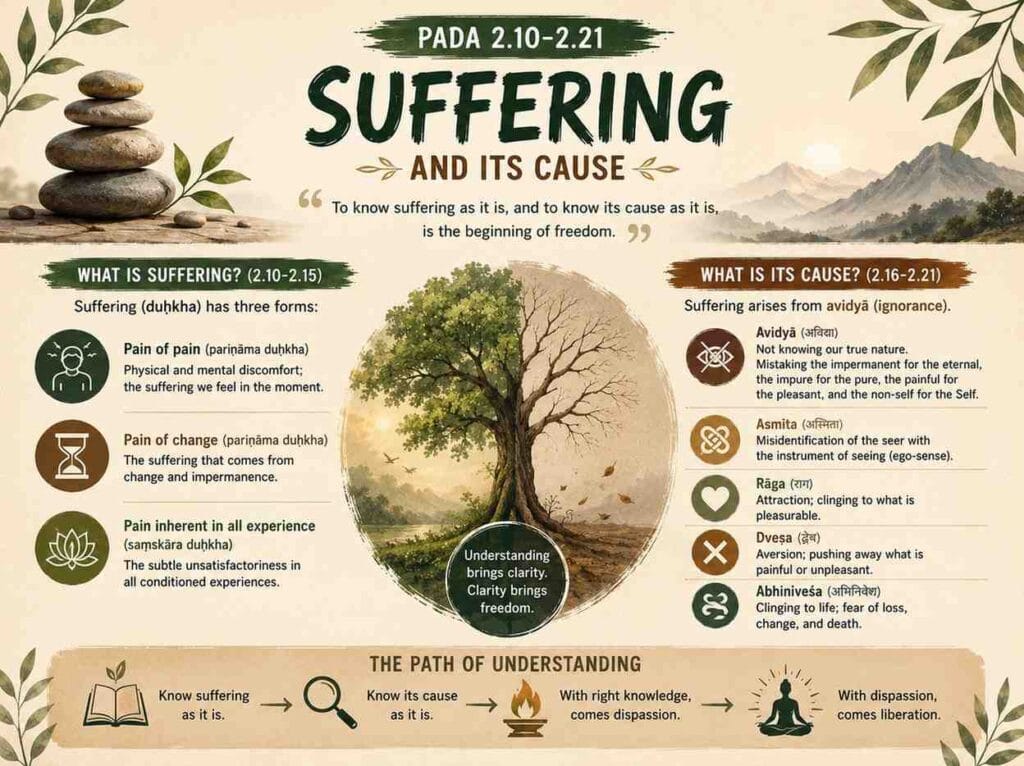
Patañjali now turns toward one of the most universal aspects of human existence: the constant fluctuation between pleasure and pain. Human life continuously moves through: comfort and discomfort, gain and loss, satisfaction and disappointment, success and failure. Nothing within ordinary experience remains permanently fixed.
Pleasurable experiences eventually change. Painful experiences also eventually change. This instability becomes psychologically difficult because the mind constantly seeks lasting security through conditions that are inherently temporary.
Why Pleasure Often Carries Hidden Anxiety
One of the deepest insights in this sutra is that even pleasurable experiences frequently contain subtle psychological tension beneath them.
The mind becomes attached to pleasure and then fears losing it.
For example: success creates fear of failure, love may create fear of loss, recognition may create anxiety about maintaining status, and comfort may create resistance toward uncertainty. Thus, pleasure itself can quietly generate insecurity when consciousness becomes psychologically dependent upon it.
Patañjali is not condemning joy or happiness. Rather, he is explaining why conditioned experience alone cannot provide complete stability permanently. Everything remains vulnerable to change.
The Mind’s Search for Permanent Fulfillment
Human beings naturally seek: security, continuity, meaning, and lasting happiness. The problem arises when the mind expects temporary experiences to provide permanent fulfillment. Modern society intensifies this tendency constantly.
People are repeatedly taught that fulfillment exists in: achievement, consumption, recognition, appearance, or external success. Yet even after obtaining desired experiences, dissatisfaction often returns. The mind continues searching because conditioned pleasure itself remains unstable. Patañjali therefore shifts attention away from compulsive external dependence toward deeper awareness.
Understanding “Virtue” and “Non-Virtue”
The terms puṇya and apuṇya are often translated as virtue and non-virtue, but their meaning here extends beyond simple morality. Actions arising from clarity, awareness, steadiness, and compassion tend to produce greater harmony internally.
Actions arising from fear, attachment, greed, hatred, or unconscious reaction tend to increase disturbance and suffering. Thus, karma in the Yoga Sutras reflects not merely punishment or reward, but the natural psychological consequences of different states of consciousness. The condition of the mind shapes the quality of experience continuously.
Sutra 2.15
परिणामतापसंस्कारदुःखैर्गुणवृत्तिविरोधाच्च दुःखमेव सर्वं विवेकिनः ॥
Transliteration
Pariṇāma-tāpa-saṁskāra-duḥkhair guṇa-vṛtti-virodhāc ca duḥkham eva sarvaṁ vivekinaḥ
Translation
“To the discerning, all conditioned experience is ultimately touched by suffering because of change, anxiety, latent impressions, and conflict between the guṇas.”
Patañjali’s Deepest Analysis of Suffering
This sutra is one of the most profound philosophical teachings in the Yoga Sutras. At first glance, it may sound pessimistic. But Patañjali is not claiming that life contains no beauty, joy, love, or meaningful experience. Instead, he explains why conditioned existence cannot provide absolute and permanent stability.
Everything within ordinary experience remains vulnerable to: change, loss, uncertainty, aging, and fluctuation. Even moments of happiness remain temporary. The discerning person eventually recognizes this instability clearly.
Why Change Creates Suffering
The first source of suffering Patañjali identifies is: pariṇāma – change. Everything changes continuously: the body changes, relationships change, circumstances change, emotions change, and social identity changes. The mind suffers because it seeks permanence within what is inherently impermanent.
Attachment therefore creates hidden instability from the very beginning. The stronger the attachment,
the stronger the fear of change becomes.
Tāpa – The Anxiety Hidden Inside Attachment
The second source is: tāpa – mental disturbance, pressure, or anxiety. Even pleasurable experiences often contain subtle tension because the mind fears their ending. A person may achieve success yet become anxious about losing it. Someone deeply attached to relationships may fear abandonment. Recognition may create pressure to maintain identity continuously.
Thus, attachment silently produces psychological strain beneath ordinary happiness itself. Patañjali recognizes that suffering is not created only by painful experiences, but also by the instability hidden inside pleasurable ones.
Saṁskāra – The Weight of Conditioning
The third source is: saṁskāra – latent impressions and conditioning. Human beings rarely experience reality freshly. Perception becomes filtered through: memory, habit, fear, attachment, past experience, and emotional conditioning. Old patterns continue shaping present experience automatically.
This is why the same emotional reactions often repeat repeatedly across different situations. Without awareness, conditioning keeps reproducing suffering mechanically.
Conflict Between the Guṇas
Finally, Patañjali mentions conflict between the guṇas – the constantly shifting qualities of nature. In classical yoga philosophy, all of nature moves through continuous fluctuation and imbalance. Nothing within conditioned existence remains perfectly stable permanently. Life continuously changes rhythm, movement, emotion, energy, and circumstance. The mind suffers when it demands fixed permanence from a reality built upon change itself.
The Meaning of “To the Discerning”
An important phrase in this sutra is: vivekinaḥ – “to the discerning.” Patañjali is describing the person who has begun observing life deeply rather than superficially. Such a person gradually recognizes: why attachment creates fear, why pleasure becomes unstable, why identity feels fragile, and why external conditions alone cannot create lasting peace.
This insight does not create hopelessness. It creates clarity. The practitioner slowly stops expecting permanent fulfillment from temporary conditions and begins turning inward toward deeper steadiness instead.
Sutra 2.16
हेयं दुःखमनागतम् ॥
Transliteration
Heyaṁ duḥkham anāgatam
Translation
“Future suffering can be avoided.”
One of the Most Hopeful Teachings in the Yoga Sutras
After offering such a deep analysis of suffering, attachment, conditioning, and psychological instability, Patañjali now introduces something extremely important: hope. This sutra is remarkably short, yet philosophically profound. Patañjali declares that future suffering can be reduced and prevented.
This is important because the Yoga Sutras are not pessimistic philosophy. Patañjali is not saying human beings are permanently trapped in suffering forever. Instead, he suggests that much suffering continues because people remain unconsciously identified with the very mental patterns creating it.
When awareness becomes clearer, suffering begins weakening at its source.
The Difference Between Pain and Psychological Suffering
One of the deepest implications of this sutra is that yoga distinguishes between unavoidable pain and unnecessary psychological suffering.
Certain aspects of life cannot be avoided completely: change, loss, uncertainty, aging, disappointment, and emotional difficulty, are natural parts of human existence.
But much psychological suffering becomes intensified through: attachment, resistance, fear, egoic identification, and unconscious reaction. For example, physical pain may arise naturally, but the mind often adds: fear, resentment, anxiety, mental replay, or emotional resistance, on top of the original experience.
Patañjali suggests that awareness can gradually reduce this secondary layer of suffering. This changes the entire purpose of yoga. Yoga is not about escaping life. It is about transforming the way consciousness relates to experience.
How Future Suffering Gets Created
Most suffering does not emerge suddenly from nowhere. It develops gradually through repeated unconscious patterns. Fear repeatedly reinforced becomes chronic anxiety. Attachment repeatedly reinforced becomes dependency. Anger repeatedly reinforced becomes emotional instability. Constant comparison creates insecurity. Continuous distraction weakens inner clarity.
Over time, these patterns shape perception, reaction, and behavior automatically. Patañjali therefore treats yoga as preventive rather than merely reactive. Instead of waiting for suffering to become overwhelming, the practitioner begins observing the inner mechanisms creating suffering while they are still subtle.
This is psychologically sophisticated because unconscious patterns are easier to transform before they fully solidify.
Awareness Interrupts the Cycle of Conditioning
The Yoga Sutras repeatedly emphasize one central insight: awareness changes unconscious patterns.
The moment a person begins observing attachment clearly, attachment loses some of its unconscious power.
The moment fear becomes fully visible, mechanical identification with fear begins weakening.
The moment emotional habits become conscious, the possibility of transformation appears.
This does not happen instantly. Patañjali is not promising immediate perfection or permanent bliss overnight. Transformation in yoga is gradual.
The practitioner slowly becomes: less reactive, less compulsive, less psychologically fragmented, and less dependent upon unstable external conditions for inner stability. Future suffering decreases because awareness no longer strengthens the same unconscious patterns continuously.
Sutra 2.17
द्रष्टृदृश्ययोः संयोगो हेयहेतुः ॥
Transliteration
Draṣṭṛ-dṛśyayōḥ saṁyōgō hēya-hētuḥ
Translation
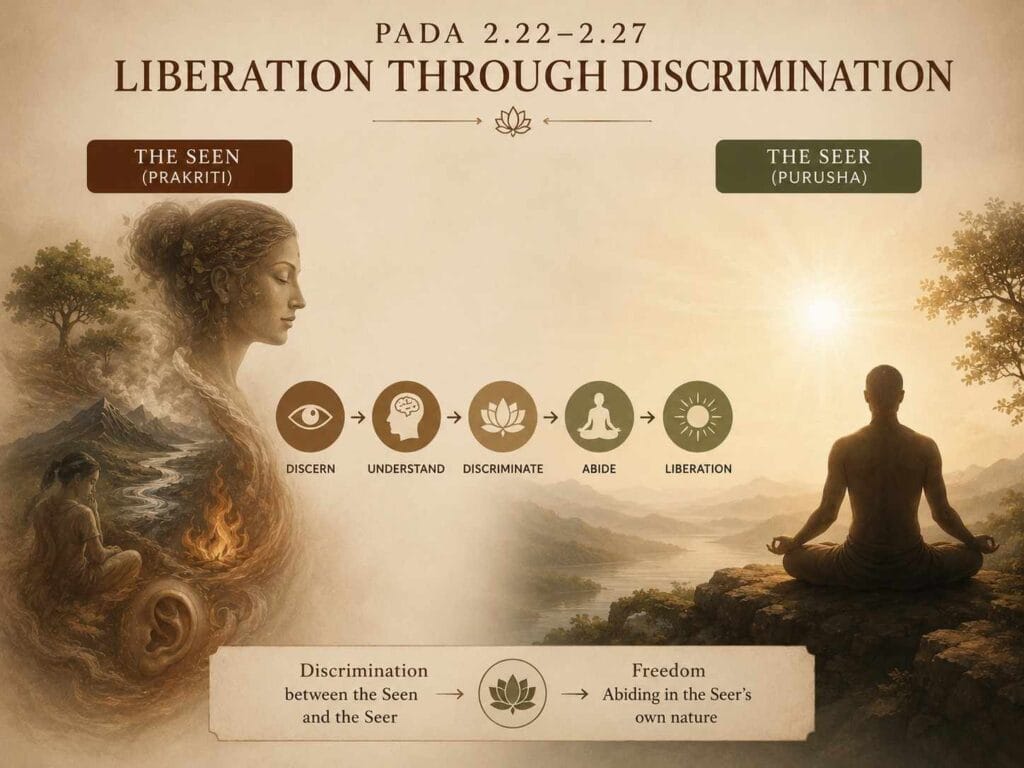
“The cause of suffering is the identification of the Seer with the seen.”
The Central Teaching of Classical Yoga
This sutra is one of the most important statements in the entire Yoga Sutras because it directly identifies the root of human suffering. Up until this point, Patañjali has explained the Kleshas, karma, attachment, and the unstable nature of worldly experience. Now he arrives at the deeper source beneath all of them: the confusion between consciousness itself and the objects experienced by consciousness.
According to Patañjali, suffering does not arise merely because painful events occur in life. Suffering arises because the individual mistakenly identifies the Self with things that are temporary, changing, and external.
This confusion is called saṁyoga-false union or misidentification.
The Seer (Draṣṭā) becomes entangled with the seen (Dṛśya), and from this entanglement, psychological bondage begins.
Who Is the “Seer” in Yoga Philosophy?
The Draṣṭā, or the Seer, is pure consciousness- the witnessing awareness that observes all experiences.
It is not the body.
It is not the personality.
It is not memory.
It is not emotion.
It is not social identity.
The Seer is the silent awareness through which all experiences become known.
Throughout life, thoughts constantly change, emotions rise and fall, desires appear and disappear, and the body continuously transforms. Yet something within remains aware of all these changes. That witnessing presence is what Patañjali calls the Draṣṭā.
In yogic philosophy, this witnessing consciousness is stable, untouched, and eternal. It does not suffer by nature. It simply observes. However, human beings rarely experience themselves as this witnessing awareness. Instead, they become completely identified with the movements of the mind.
What Is the “Seen”?
The Dṛśya, or the seen, refers to everything that can be experienced or perceived.
This includes:
- the physical body
- thoughts
- emotions
- desires
- fears
- memories
- social roles
- relationships
- achievements
- failures
- sensory experiences
- external possessions
Essentially, everything that changes belongs to the realm of the seen. Patañjali’s insight is extremely subtle here. The problem is not that these experiences exist. The problem begins when consciousness mistakes these temporary experiences for its true identity.
The mind says:
“I am successful.”
“I am anxious.”
“I am rejected.”
“I am my career.”
“I am my appearance.”
“I am my pain.”
According to yoga philosophy, this is the fundamental illusion.
Success is an experience.
Fear is an experience.
Pain is an experience.
Thoughts are experiences.
But awareness itself is deeper than all of them.
How Misidentification Creates Suffering
Human beings suffer because they build identity upon unstable things.
When identity depends upon beauty, aging creates suffering.
When identity depends upon success, failure creates suffering.
When identity depends upon relationships, separation creates suffering.
When identity depends upon praise, criticism becomes unbearable.
The mind continuously attaches itself to changing conditions and then feels psychologically threatened whenever those conditions shift. This is why Patañjali calls misidentification the root of suffering itself.
The external event is often not the deepest problem. The real suffering comes from the ego’s attachment to the event. For example, two people may experience the same criticism. One becomes emotionally shattered while the other remains calm. The difference lies in identification. The first person experiences criticism as an attack on identity, while the second sees it simply as an experience passing through awareness.
This sutra therefore reveals an important yogic principle: The more tightly identity attaches itself to temporary phenomena, the more fragile inner peace becomes.
The Difference Between Awareness and the Mind
One of the greatest contributions of yoga philosophy is its distinction between awareness and mental activity.
Modern life conditions people to believe they are their thoughts. If the mind says “I am not good enough,” the individual immediately believes it. If anxiety arises, the person becomes completely consumed by anxiety. Thoughts and emotions begin defining reality.
Patañjali challenges this assumption entirely. He teaches that thoughts are objects appearing within consciousness. They are movements within the mind, not the essence of the Self. This distinction transforms meditation from a relaxation technique into a process of liberation. As meditation deepens, the practitioner gradually begins observing thoughts rather than becoming trapped inside them. Emotional reactions still arise, but awareness no longer loses itself completely within them. This creates psychological freedom.
The practitioner begins realizing:
“I can observe fear without becoming fear.”
“I can witness sadness without losing myself within sadness.”
“I can experience anger without defining myself through anger.”
This shift weakens suffering at its root.
Meditation as the Reversal of Misidentification
According to Patañjali, meditation gradually reverses the false union between the Seer and the seen. Ordinarily, consciousness flows outward continuously toward thoughts, emotions, desires, and sensory experiences. Meditation redirects awareness inward.
The practitioner slowly begins recognizing:
- thoughts are changing
- emotions are changing
- bodily sensations are changing
- mental states are changing
But the witnessing awareness observing these changes remains constant. This realization is not merely intellectual. It becomes experiential through sustained practice. Over time, emotional suffering begins losing its intensity because awareness no longer treats every passing mental state as absolute truth.
Fear weakens.
Attachment softens.
Emotional reactivity decreases.
Inner clarity increases.
This is the beginning of freedom in classical yoga.
The Beginning of Liberation
Patañjali considers this recognition the foundation of liberation. As long as consciousness remains identified with the changing movements of nature, suffering continues. But when awareness begins recognizing its distinction from mental fluctuations, a new relationship with life emerges. The practitioner still experiences the world, but no longer becomes psychologically imprisoned by every experience.
Pleasure comes and goes.
Pain comes and goes.
Success comes and goes.
Thoughts come and go.
But awareness itself remains unchanged beneath them all. This realization is the doorway to Viveka, true discriminative wisdom. And according to Patañjali, that wisdom is what ultimately dissolves suffering.
Sutra 2.18
प्रकाशक्रियास्थितिशीलं भूतेन्द्रियात्मकं भोगापवर्गार्थं दृश्यम् ॥
Transliteration
Prakāśa-kriyā-sthiti-śīlaṁ bhūtēndriyātmakaṁ bhōgāpavargārthaṁ dṛśyam
Translation
“The seen world, composed of the elements and the senses, exists for experience and liberation.”
The Purpose of the External World
After explaining that suffering arises from the false identification between the Seer and the seen, Patañjali now addresses an equally important question:
If attachment to the world creates suffering, then what is the purpose of the world itself?
This sutra answers that question with remarkable depth.
Patañjali does not describe the world as evil, sinful, or meaningless. Nor does he teach that liberation requires hatred toward life or rejection of existence. Instead, he presents the world as a field of experience through which consciousness gradually evolves toward wisdom.
This is one of the most balanced aspects of yoga philosophy.
The world is not the enemy. Ignorance is.
Understanding the Meaning of “Dṛśyam”
The word dṛśyam means “the seen.” It refers to everything that can be experienced through the senses and the mind.
This includes:
- physical objects
- the body
- emotions
- thoughts
- desires
- memories
- relationships
- sensory experiences
- psychological states
Everything observable belongs to the realm of the seen.
Patañjali explains that this seen world possesses three essential characteristics:
1. Prakāśa – Illumination
Nature reveals experience. Through life, consciousness becomes aware of pleasure, pain, attachment, beauty, suffering, desire, and impermanence. The world acts as a mirror through which the mind gradually sees itself.
2. Kriyā – Activity
Nature is constantly moving and changing. Thoughts change. Emotions change. Circumstances change. Life itself is dynamic and restless. This constant movement exposes the instability of all temporary phenomena.
3. Sthiti – Stability or Structure
Although nature changes continuously, it still operates according to patterns and laws. There is order within existence. This balance between movement and structure allows experience itself to unfold.
The Two Purposes of Life According to Patañjali
Patañjali explains that the world exists for two purposes:
- Bhoga – experience
- Apavarga – liberation
These two ideas are central to understanding yoga philosophy.
Bhoga – The Purpose of Experience
Human beings engage with life through relationships, ambition, pleasure, pain, achievement, attachment, loss, joy, and struggle. These experiences shape consciousness.
At first, people seek fulfillment externally. They chase pleasure, validation, recognition, security, and emotional satisfaction. But eventually, repeated experience reveals a deeper truth: external things cannot provide permanent fulfillment.
Pleasure fades.
Success becomes temporary.
Attachment creates fear.
Possessions fail to remove inner restlessness.
Patañjali suggests that experience itself becomes a teacher. The world gradually exposes the limitations of external dependency. This is why suffering often becomes a catalyst for spiritual inquiry. Pain forces the individual to question assumptions that pleasure rarely challenges.
Apavarga – The Purpose of Liberation
The second purpose of existence is liberation.
Through repeated experience, consciousness slowly begins seeking something deeper than temporary satisfaction. The individual realizes that lasting peace cannot depend entirely upon unstable external conditions.
This realization marks the beginning of spiritual maturity.
Patañjali’s philosophy is incredibly profound here because he does not reject worldly experience entirely. Instead, he sees life itself as part of the evolutionary process of awareness. Every disappointment, attachment, fear, desire, and struggle contains the possibility of awakening. Even suffering becomes transformative when understood correctly.
A Mature Vision of Spirituality
Many spiritual approaches fall into extremes. Some become completely absorbed in material pleasure, while others reject the world entirely and attempt escape from human experience. Patañjali offers a far more mature perspective. The world is neither something to worship blindly nor something to hate.
It is something to understand. The practitioner gradually learns how to engage with life consciously without becoming psychologically trapped within it. One continues loving, working, creating, and participating in existence, but with greater awareness and less attachment. This balance is one of the defining qualities of authentic yoga philosophy.
Sutra 2.19
विशेषाविशेषलिङ्गमात्रालिङ्गानि गुणपर्वाणि ॥
Transliteration
Viśēṣāviśēṣa-liṅga-mātrāliṅgāni guṇa-parvāṇi
Translation
“The stages of manifestation of the Gunas are the specific, non-specific, subtle, and unmanifest.”
Understanding the Philosophical Depth of This Sutra
At first glance, this sutra appears highly abstract and philosophical, especially for readers unfamiliar with Sāṅkhya and classical yoga metaphysics. However, this sutra plays a crucial role in Patañjali’s explanation of reality, consciousness, and suffering. Here, he begins explaining the structure of nature itself, the mechanism through which the external world and the human mind are formed.
To understand suffering fully, Patañjali believes one must understand the nature of the world with which consciousness becomes identified.
This sutra explains that everything within existence evolves through different layers or stages of manifestation, all governed by the interaction of the three Gunas.
The Three Gunas: The Forces Governing Nature
According to classical yoga and Sāṅkhya philosophy, all of material and psychological existence operates through three fundamental energies known as the Gunas.
These Gunas are not merely symbolic ideas. They are the underlying tendencies shaping all mental states, behaviors, emotions, perceptions, and natural processes.
1. Sattva – Clarity and Harmony
Sattva represents purity, balance, wisdom, lightness, and inner clarity.
When Sattva dominates the mind:
- thoughts become calm
- awareness becomes sharp
- emotions become balanced
- perception becomes clearer
- compassion and understanding increase
States of peace, wisdom, discipline, and spiritual insight arise primarily through Sattva. However, even Sattva belongs to nature and therefore remains temporary.
2. Rajas – Activity and Restlessness
Rajas represents movement, ambition, stimulation, desire, passion, and constant activity.
When Rajas dominates:
- the mind becomes restless
- desires intensify
- emotional reactivity increases
- attachment strengthens
- constant mental movement arises
Modern society is heavily Rajasic. Endless productivity, stimulation, comparison, competition, and emotional overstimulation continuously agitate the mind. Rajas creates momentum and activity, but without balance it also produces anxiety and exhaustion.
3. Tamas – Inertia and Heaviness
Tamas represents darkness, resistance, ignorance, lethargy, confusion, and psychological heaviness.
When Tamas dominates:
- motivation weakens
- awareness becomes clouded
- denial increases
- emotional numbness appears
- clarity disappears
Tamas is necessary for rest and stability, but excessive Tamas leads to stagnation and unconscious living.
How the Gunas Shape Human Experience
Patañjali explains that all mental and emotional states arise through the changing interaction of these three Gunas.
Sometimes the mind feels peaceful and clear-Sattva becomes dominant.
Sometimes it becomes overstimulated and restless-Rajas takes over.
At other times it feels dull, exhausted, or emotionally heavy-Tamas predominates.
The important insight here is that these states are constantly changing. No mental condition remains permanent. Yet human beings continuously build identity around these temporary fluctuations. A person experiences sadness and concludes, “This is who I am.” Another experiences success and believes their worth has permanently increased. Patañjali wants the practitioner to recognize that all psychological states belong to nature, not to the eternal Self.
The Four Levels of Manifestation
Patañjali now explains the different stages through which nature manifests itself. These stages move from gross visible reality toward subtler and more unmanifest dimensions of existence.
1. Viśēṣa – The Gross and Specific World
Viśēṣa refers to the visible, differentiated world experienced through the senses.
This includes:
- the physical body
- objects
- relationships
- sensory experiences
- emotions
- thoughts
- external reality
This is the most obvious level of existence because it is directly perceivable.
Most human beings remain completely absorbed at this level. Their attention rarely moves beyond appearances, sensory pleasure, social identity, and external conditions.
2. Aviśēṣa – The Subtle Undifferentiated State
Aviśēṣa refers to subtler aspects of nature that are not yet fully differentiated into gross forms.
This includes the subtle tendencies and energetic foundations underlying visible reality.
In yogic psychology, many unconscious tendencies exist at this level before becoming fully expressed as thoughts, emotions, or actions.
This is why meditation becomes essential. Surface awareness alone cannot perceive these deeper layers of conditioning.
3. Liṅga-Mātra – The Subtle Principle of Intelligence
Liṅga-mātra refers to the subtle principle underlying manifestation itself, the deeper intelligence through which nature organizes experience.
This level is associated with cosmic intelligence or the subtle organizing principle behind mental and material existence.
Patañjali gradually moves the practitioner inward from gross matter toward increasingly subtle realities.
4. Aliṅga – The Unmanifest State
Finally, Aliṅga refers to the unmanifest condition of nature before differentiation occurs.
It is the causal state from which all forms eventually emerge.
At this level, existence remains in potential form rather than visible manifestation.
This concept reflects the extraordinary philosophical sophistication of classical yoga. Reality is understood not merely as physical matter, but as a continuum extending from gross experience into subtle and unmanifest dimensions.
Sutra 2.20
द्रष्टा दृशिमात्रः शुद्धोऽपि प्रत्ययानुपश्यः ॥
Transliteration
Draṣṭā dṛśi-mātraḥ śuddhō’pi pratyayānupaśyaḥ
Translation
“The Seer is pure consciousness, yet appears to perceive through the modifications of the mind.”
Patañjali’s Definition of Consciousness
After explaining the constantly changing nature of the external world, Patañjali now returns to the nature of the Seer itself. This sutra contains one of the clearest and most profound definitions of consciousness in yogic philosophy.
The Draṣṭā, the Seer, is pure awareness.
It is not the mind.
It is not thought.
It is not memory.
It is not emotion.
It is not personality.
It is not social identity.
The Seer is the witnessing presence through which all experiences become known. This awareness remains constant while every experience continuously changes.
The Difference Between Consciousness and the Mind
One of the most important distinctions in yoga philosophy is the difference between consciousness and mental activity.
Most people live as though the mind and the Self are the same thing. Every thought feels personal. Every emotional reaction feels absolute. If fear appears, the individual becomes fear. If sadness arises, identity merges with sadness completely.
Patañjali challenges this confusion directly.
He explains that consciousness itself remains pure and untouched, while the mind is simply an instrument through which experiences appear.
Thoughts fluctuate constantly.
Emotions rise and fall.
Desires appear and disappear.
Memories change continuously.
Yet the awareness observing these movements remains unchanged.
This awareness is the true Seer.
Why Consciousness Appears Disturbed
Patañjali says that although consciousness is pure, it appears to perceive reality through the movements of the mind. This creates the illusion that awareness itself is disturbed. A powerful analogy often used in yogic traditions compares consciousness to the moon reflected in water. When the water becomes agitated, the reflection appears distorted. Yet the moon itself remains untouched.
Similarly:
- consciousness remains stable
- the mind fluctuates
- identification creates confusion
Human beings mistake the movements of the mind for the nature of the Self. This misunderstanding creates suffering.
Meditation and Witness Consciousness
Meditation becomes essential because it trains awareness to observe the mind without complete identification. At first, the mind remains restless. Thoughts continuously pull attention outward. Emotional reactions dominate awareness automatically. But through sustained practice, a subtle separation begins emerging between the observer and the observed.
The practitioner begins noticing:
“There is anger, but I am observing it.”
“There is fear, but awareness itself remains present.”
“There is sadness, but it is moving through consciousness.”
This does not suppress emotion. Instead, it prevents total psychological entanglement.
As a result:
- emotional intensity weakens
- compulsive reactions reduce
- clarity increases
- inner stability deepens
This is the beginning of true meditative awareness.
Freedom in Classical Yoga
Patañjali’s idea of freedom is extremely sophisticated.
Freedom does not mean destroying the mind completely.
Freedom does not mean escaping human experience.
Freedom does not mean emotional numbness.
Freedom means consciousness no longer mistakes itself for the movements of the mind. The practitioner continues thinking, feeling, acting, and participating in life, but with greater awareness and less unconscious identification. This shift fundamentally changes the experience of suffering.
Sutra 2.21
तदर्थ एव दृश्यस्यात्मा ॥
Transliteration
Tad-artha ēva dṛśyasyātmā
Translation
“The very nature of the seen exists solely for the sake of the Seer.”
The Purpose of Existence in Yoga Philosophy
Patañjali concludes this profound sequence of sutras by explaining the ultimate purpose of the manifest world. Everything that is experienced through life exists for the evolution and awakening of consciousness. This statement completely transforms the yogic understanding of existence. The world is no longer viewed as meaningless chaos or random suffering. Instead, life becomes a vast field of experience through which awareness gradually comes to recognize its own true nature.
Life as a Teacher
According to Patañjali, every experience contributes to awakening.
Pleasure reveals the temporary nature of sensory fulfillment.
Pain exposes attachment.
Fear reveals dependency and insecurity.
Success reveals the instability of external identity.
Loss forces deeper introspection.
Relationships expose both attachment and compassion.
Life itself becomes a teacher. The purpose of existence is not endless accumulation of experiences, possessions, achievements, or stimulation. The deeper purpose is wisdom. Through repeated experience, consciousness gradually recognizes that lasting peace cannot emerge from constantly changing phenomena.
Why Suffering Can Become Transformative
This sutra also explains why suffering often becomes spiritually transformative.
Pleasure rarely forces deep inquiry because it temporarily distracts the mind. But suffering exposes the instability of the structures upon which identity has been built.
Disappointment forces questioning.
Loss forces reflection.
Fear exposes attachment.
Emotional pain reveals unconscious dependency.
This does not mean suffering should be glorified. Rather, Patañjali suggests that suffering can become meaningful when it awakens deeper awareness.
Many people begin spiritual inquiry only after external sources of identity fail to provide lasting fulfillment.
Thus, even painful experiences can become catalysts for awakening.
Participation Without Attachment
One of the most beautiful aspects of this sutra is that it avoids both materialism and escapism. Patañjali does not say the practitioner must reject the world entirely. Instead, he teaches conscious participation without psychological bondage.
The practitioner continues:
- loving
- creating
- working
- building relationships
- participating in society
But attachment gradually weakens because identity no longer depends completely upon external conditions. This creates a more balanced and liberated relationship with existence itself.
The World as a Mirror
Ultimately, Patañjali presents the world as a mirror through which consciousness gradually remembers itself.
Every experience reflects something about the mind:
- attachments reveal dependency
- fears reveal insecurity
- desires reveal incompleteness
- suffering reveals false identification
When approached consciously, life itself becomes part of the yogic path. The world is not a mistake. It is the field through which awareness evolves toward liberation.
Conclusion
Pada 2.10–2.21 forms one of the deepest explorations of human suffering found in ancient spiritual literature. Patañjali systematically reveals how suffering originates, not from the world itself, but from ignorance and false identification. The mind becomes attached to temporary experiences, constructs identity around unstable phenomena, and then suffers when change inevitably occurs.
Through these sutras, yoga emerges not merely as physical discipline or philosophical theory, but as a profound science of consciousness.
Patañjali explains that the root of suffering lies in forgetting the distinction between the Seer and the seen. Human beings become entangled in thoughts, emotions, desires, fears, social roles, memories, and sensory experiences until they completely lose awareness of their deeper nature.
Meditation, self-observation, and discriminative wisdom gradually dissolve this confusion.
As awareness deepens, attachment weakens. Fear softens. Compulsive reactions lose their force. The practitioner begins experiencing life with greater clarity and less psychological bondage.
The ultimate goal of yoga, according to these sutras, is not escape from life but freedom within life. One continues participating in the world while no longer seeking permanent identity or fulfillment from what is temporary.
This is the beginning of liberation.
My Take
What I personally find most powerful about these sutras is how honestly they explain the repetitive nature of human suffering.
Most people think suffering is caused entirely by external situations. They blame circumstances, other people, bad luck, or temporary conditions without recognizing how much of their inner pain is continuously recreated through unconscious patterns.
The same fears repeat.
The same attachments repeat.
The same emotional reactions repeat.
Even when external life changes, the mind often carries the same conditioning into new situations. I think this is why so many people today feel mentally exhausted despite constantly trying to improve their lives externally. Modern culture teaches people how to become more successful, productive, attractive, and socially validated, but rarely teaches them how to understand their own mind deeply.
Patañjali approaches the problem differently. He suggests that lasting peace does not come only from changing external life. It comes from becoming conscious of the internal mechanisms creating suffering in the first place. And honestly, that insight feels more relevant now than ever before.