Explore Yoga Sutras 2.22–2.27 explained in depth. Learn how Patanjali describes liberation, viveka, awareness, suffering, and freedom from psychological attachment through discriminative wisdom.
Yoga Sutras 2.22–2.27 Explained
One of the deepest questions explored throughout the Yoga Sutras of Patanjali is this: Why does human suffering continue even when people achieve what they once believed would make them happy?
According to Patañjali, the problem is not simply external difficulty. The deeper problem is misidentification. Human beings become so psychologically absorbed in thoughts, emotions, social identity, memory, ambition, fear, relationships, and external experience that they begin mistaking these constantly changing experiences for the Self itself. The mind then spends its entire life trying to protect and stabilize what is inherently unstable.
In Sutras 2.22–2.27, Patañjali introduces one of the most important concepts in classical yoga philosophy:
viveka – discriminative wisdom.
This does not mean ordinary intellectual judgment or philosophical opinion. It refers to a deep clarity through which consciousness gradually learns to distinguish between awareness itself and the constantly changing experiences appearing within awareness.
These sutras become increasingly philosophical, but they are also profoundly psychological. They explain why human beings remain trapped in cycles of attachment and suffering, and how liberation slowly becomes possible through clear seeing.
Sutra 2.22
कृतार्थं प्रति नष्टमप्यनष्टं तदन्यसाधारणत्वात् ॥
Transliteration
Kṛtārthaṁ prati naṣṭam apy anaṣṭaṁ tad anya-sādhāraṇatvāt
Translation
“Although the seen ceases for one who has fulfilled its purpose, it continues to exist for others.”
Liberation Does Not Mean Escaping the World
Patañjali now introduces a subtle but extremely important clarification about liberation. One of the biggest misunderstandings in spiritual philosophy is the belief that awakening means physically escaping reality or rejecting the world entirely. The Yoga Sutras do not present liberation in this way.
The external world does not suddenly disappear after realization. Life continues unfolding. The body continues aging. Relationships continue existing. Society continues functioning. The practitioner still participates in ordinary human experience.
What changes is not the existence of the world itself, but the psychological relationship consciousness has with the world.
For most people, external experience becomes deeply entangled with identity. Human beings continuously seek emotional security, recognition, pleasure, importance, and stability through changing conditions. The mind becomes attached to success, approval, relationships, achievement, and social identity because it unconsciously believes these things can provide lasting fulfillment.
This creates constant inner instability because everything external eventually changes.
Success creates fear of failure. Attachment creates fear of loss. Praise strengthens egoic identity. Criticism creates emotional disturbance. Pleasure creates anxiety about its ending. The mind becomes trapped within reaction and dependence.
Patañjali suggests that liberation changes this entire structure internally. The liberated person still experiences life fully, but no longer depends upon external experience for a stable sense of self. The world remains present, yet compulsive identification with it weakens dramatically.
This is why yoga philosophy should not be confused with escapism. Patañjali is not teaching rejection of life. He is describing freedom from unconscious psychological bondage within life. The liberated person still works, speaks, loves, creates, and participates in the world, but awareness no longer becomes completely imprisoned by every fluctuation of experience.
Why External Circumstances Affect People Differently
This sutra also explains something psychologically profound: the same external event can affect different individuals in entirely different ways depending upon their level of attachment and identification.
One person may receive criticism and remain emotionally disturbed for weeks because identity is heavily dependent upon approval. Another person may receive the same criticism, reflect upon it calmly, and remain inwardly steady.
Similarly, one individual may become psychologically dependent upon praise and recognition, while another appreciates appreciation without building identity around it.
The external circumstance itself may remain identical, but the internal experience changes according to the condition of consciousness.
Patañjali therefore suggests that suffering is not created only by the world itself. Suffering deepens through the way awareness becomes psychologically attached to the world.
This insight remains remarkably relevant today because modern culture continuously strengthens external identification. Social media, comparison culture, productivity obsession, and public validation increasingly encourage people to build identity through unstable external conditions.
As a result, inner stability becomes fragile because identity itself depends upon constant reinforcement from the outside world.
The liberated person experiences reality differently because awareness is no longer unconsciously fused with every passing circumstance. Life continues, but psychological bondage weakens.
The Deeper Meaning of “The Seen Ceases”
When Patañjali says “the seen ceases,” he does not mean the physical universe literally vanishes. He means the world ceases to function as a source of unconscious attachment and delusion for the liberated person.
Ordinarily, people see the world through projection, craving, fear, comparison, and egoic interpretation. The mind constantly asks:
“What can I gain?”
“How am I perceived?”
“What might I lose?”
“How do I protect my identity?”
Perception becomes distorted by psychological conditioning.
But when discriminative wisdom develops, awareness begins seeing experience more clearly and less personally. The world no longer possesses the same compulsive psychological grip.
In this sense, “the seen” loses its power to create bondage.
That is the deeper liberation Patañjali describes.
Sutra 2.23
स्वस्वामिशक्त्योः स्वरूपोपलब्धिहेतुः संयोगः ॥
Transliteration
Sva-svāmi-śaktyoḥ svarūpopalabdhi-hetuḥ saṁyogaḥ
Translation
“The union of the seer and the seen exists for realizing their true nature.”
Why Consciousness Becomes Entangled With Experience
Patañjali now explains why awareness becomes identified with experience in the first place. At first glance, this identification appears purely problematic because it creates attachment, suffering, fear, and psychological instability. Yet Patañjali presents a deeper perspective.
The very entanglement that creates suffering also creates the possibility of awakening.
Ordinarily, human beings live in a condition of complete psychological absorption. Thoughts arise and identity immediately becomes those thoughts. Emotional reactions appear and awareness becomes trapped within them. Human beings build identity around memory, ambition, emotional history, appearance, achievement, relationships, beliefs, and social image so deeply that they forget the difference between awareness itself and the experiences moving through the mind.
People begin believing:
“I am my success.”
“I am my failure.”
“I am my emotional pain.”
“I am my social identity.”
Consciousness becomes fused with mental activity continuously. Yet according to Patañjali, life itself gradually exposes the instability of this identification. Through attachment, disappointment, pleasure, suffering, fear, emotional conflict, and self-observation, awareness slowly begins recognizing an important truth:
everything within ordinary experience changes continuously.
Thoughts change. Emotions change. Relationships change. Identity changes. Mental states change. The body changes.
But awareness remains capable of observing all these changes. This realization becomes the beginning of discernment.
Life as a Process of Spiritual Education
One of the deepest implications of this sutra is that human experience itself becomes part of spiritual education.
The world is not meaningless within yoga philosophy. Relationships, ambition, emotional conflict, attachment, success, loss, and suffering all become opportunities through which consciousness gradually learns the difference between temporary experience and deeper awareness.
In many cases, suffering itself becomes transformative because suffering exposes the instability of attachment. Human beings often begin questioning identity more deeply only after experiencing disappointment, uncertainty, emotional collapse, or loss.
Patañjali therefore does not reject experience entirely. Instead, he explains that experience becomes the field through which awareness develops discernment.
The purpose of life, from this perspective, is not merely pleasure or achievement. It is the gradual recognition of reality beyond unconscious identification.
The Difference Between the Seer and the Seen
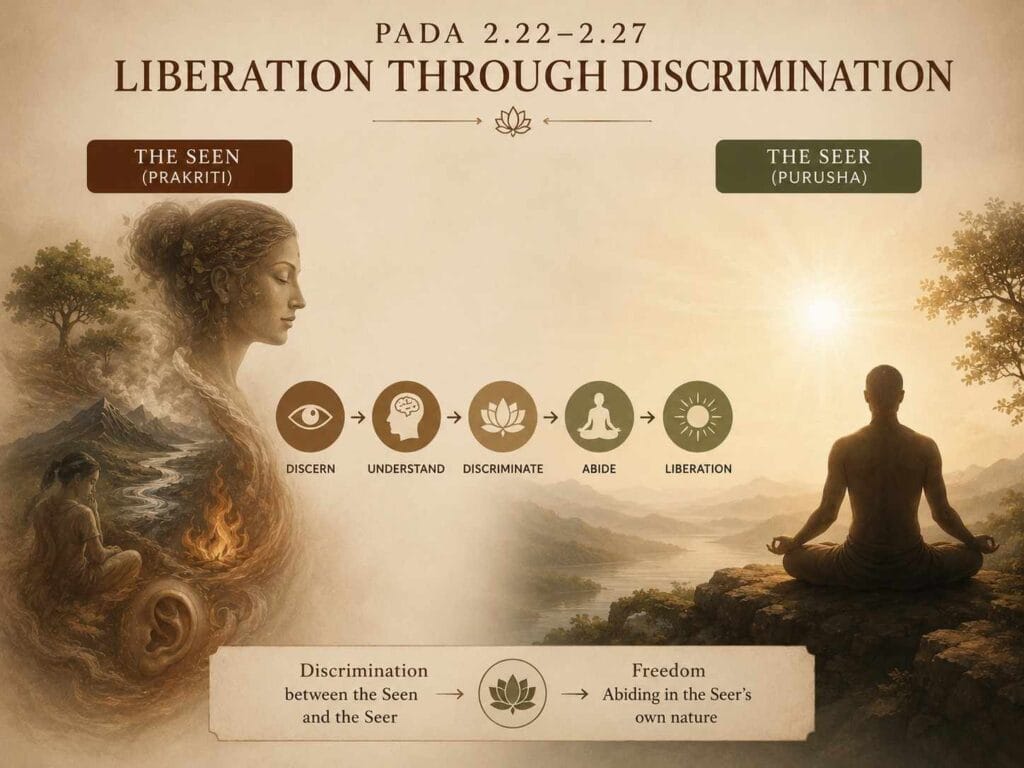
This sutra introduces one of the central teachings of the Yoga Sutras: the distinction between the seer and the seen.
The “seen” refers to everything observable within human experience, including thoughts, emotions, sensations, memories, mental activity, bodily experience, and external reality itself. All of these remain constantly changing.
The “seer,” however, refers to pure awareness, the witnessing consciousness capable of observing all these movements without itself being identical to them.
Ordinarily, people confuse the two completely.
A fearful thought appears and awareness becomes fear.
An emotional wound appears and identity becomes trapped within suffering.
External success appears and the ego expands around achievement.
The practitioner remains psychologically fused with mental movement almost continuously. Yoga begins when this confusion weakens. Through meditation and self-observation, the practitioner gradually realizes that thoughts are being observed, emotions are being observed, and mental states are being observed. This creates psychological distance between awareness and mental fluctuation. That distance is extremely important because it weakens unconscious identification.
The practitioner slowly begins recognizing:
“I am aware of fear” rather than “I am fear.”
“I am witnessing sadness” rather than “I am sadness.”
This shift changes the entire structure of consciousness.
Why This Teaching Remains So Relevant Today
These sutras feel remarkably modern because contemporary life intensifies psychological identification constantly. People increasingly define themselves through career, appearance, online identity, productivity, social approval, and emotional narrative.
As a result, mental suffering becomes deeply connected to external instability. Patañjali recognized this mechanism thousands of years ago. His solution was not withdrawal from humanity, but clarity within humanity. Liberation begins when awareness stops unconsciously losing itself inside every passing thought, emotional reaction, and external circumstance. That is the deeper purpose of discriminative wisdom in yoga philosophy.
Sutra 2.24
तस्य हेतुरविद्या ॥
Transliteration
Tasya hetur avidyā
Translation
“The cause of this union is ignorance.”
Avidyā as Existential Misperception
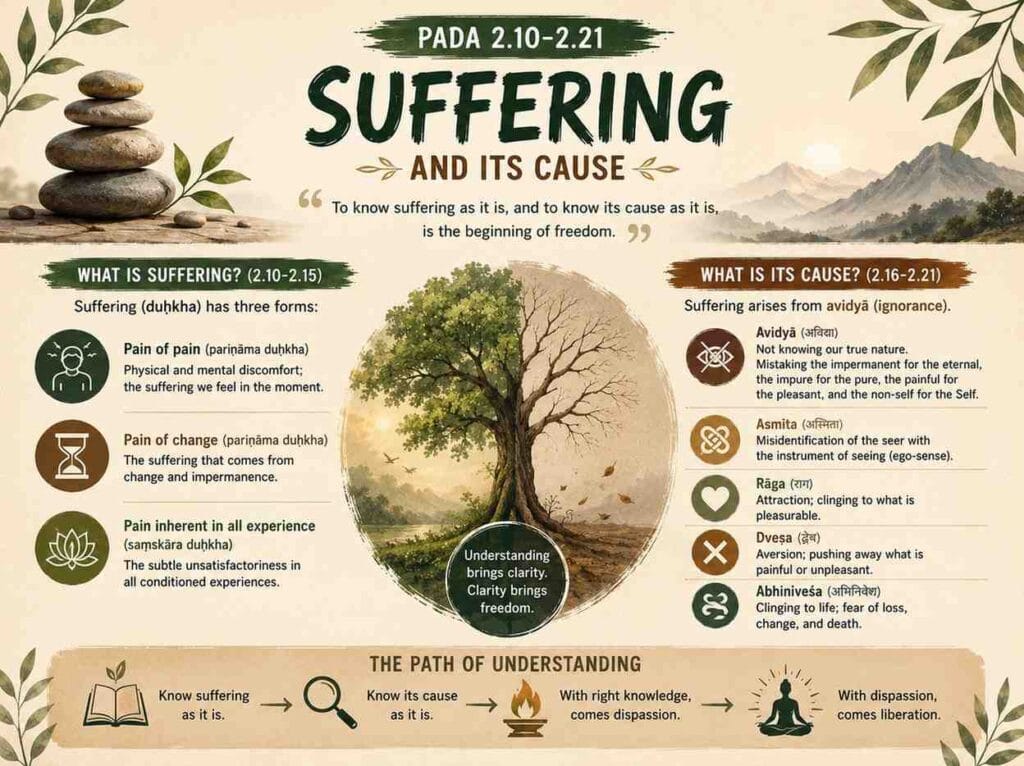
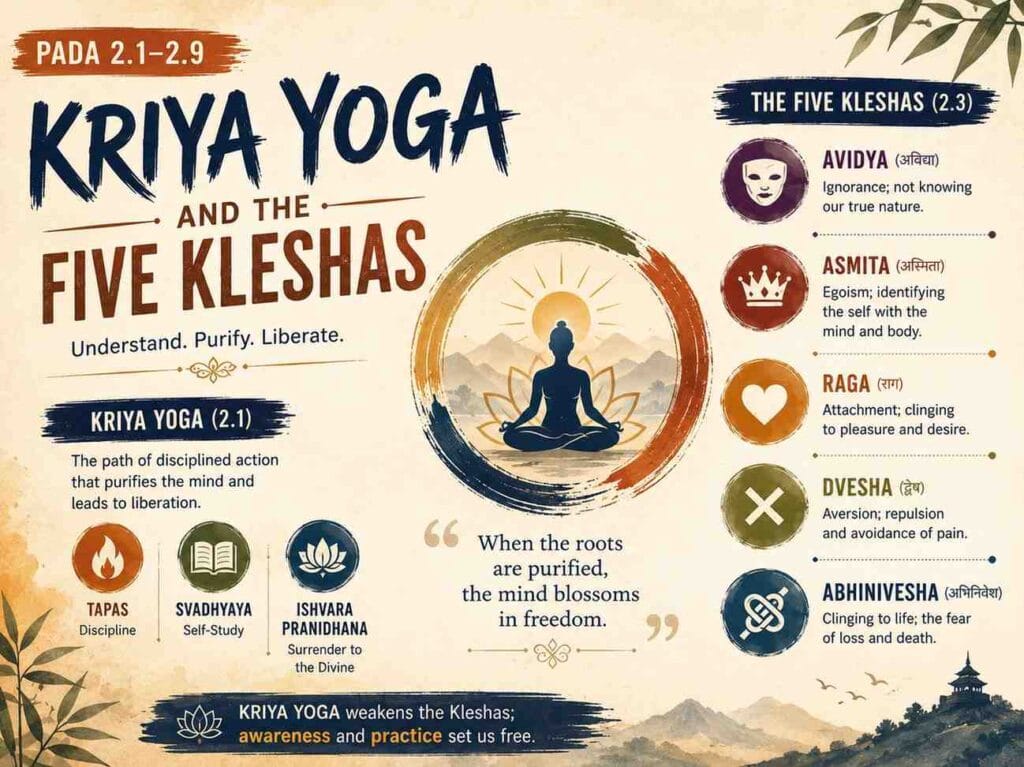
Patañjali now identifies the root cause behind human suffering and psychological bondage: avidyā – ignorance or misperception. This is one of the most important concepts in the entire Yoga Sutras of Patanjali because nearly all the other forms of suffering emerge from it.
Importantly, avidyā does not mean lack of education or intellectual weakness. A person may possess enormous knowledge, social success, academic achievement, or philosophical understanding while still remaining deeply trapped within fear, insecurity, attachment, egoic identity, and emotional conditioning.
Patañjali is describing a deeper form of ignorance: not seeing reality clearly.
Human beings begin mistaking temporary structures for lasting identity. The mind builds the sense of self around appearance, achievement, social status, relationships, memory, emotional history, beliefs, and psychological narrative. Over time, these changing experiences begin feeling inseparable from identity itself. This creates a fundamental inner instability because everything the mind identifies with eventually changes.
The body changes.
Relationships change.
Success changes.
Social image changes.
Emotions change.
Mental states change.
Yet consciousness continuously searches for permanent stability through these impermanent structures. This creates fear and attachment simultaneously. The mind then spends enormous psychological energy trying to protect fragile identity structures from uncertainty, rejection, loss, criticism, failure, aging, and change. Much of human anxiety emerges from this unconscious attempt to stabilize what is inherently unstable. Patañjali therefore presents suffering not merely as emotional pain, but as the consequence of mistaken identification itself.
Why Avidyā Is More Than Intellectual Confusion
One reason this sutra is so philosophically profound is because Patañjali distinguishes between information and wisdom.
A person may intellectually understand spiritual ideas while still remaining psychologically controlled by attachment and fear. Someone may speak beautifully about consciousness, meditation, or non-attachment while internally remaining dependent upon validation, approval, status, or emotional security. This is why yoga repeatedly emphasizes direct realization rather than conceptual knowledge alone.
Avidyā operates experientially. It shapes how human beings perceive themselves and reality moment to moment. The mind unconsciously believes:
“I am my success.”
“I am my emotional pain.”
“I am my social identity.”
“I am my thoughts.”
Awareness becomes psychologically fused with temporary experience. Yoga begins when this confusion slowly weakens.
Why Modern Life Intensifies Avidyā
Patañjali’s insight feels extraordinarily modern because contemporary culture strengthens external identification constantly.
People are increasingly encouraged to define themselves through productivity, appearance, online validation, social image, financial success, popularity, and public performance of identity. Modern systems continuously reinforce the belief that self-worth depends upon external achievement and recognition.
As a result, many individuals feel psychologically exhausted because their sense of identity requires constant maintenance and protection.
Social media intensifies comparison.
Consumer culture intensifies craving.
Achievement culture intensifies insecurity.
Constant stimulation weakens self-observation.
The mind becomes trapped in continuous outward identification. Patañjali recognized the root of this problem thousands of years ago. The deeper issue is not merely stress, technology, or society alone. The deeper issue is unconscious identification with unstable external conditions. This is avidyā.
The Psychological Consequences of Misidentification
When awareness becomes identified with temporary experience, suffering naturally follows.
Fear emerges because identity feels vulnerable.
Attachment emerges because the mind seeks permanence.
Comparison emerges because identity depends upon external validation.
Anxiety emerges because everything external can change unexpectedly.
People often attempt solving this suffering externally by acquiring more success, recognition, pleasure, or control. Yet the underlying instability remains because the root confusion has not yet been addressed. Patañjali therefore approaches suffering at its source.
He suggests that liberation does not begin through controlling the external world perfectly. It begins through seeing clearly enough that awareness stops unconsciously identifying with what is temporary. That clarity becomes the beginning of freedom.
Sutra 2.25
तदभावात्संयोगाभावो हानं तद्दृशेः कैवल्यम् ॥
Transliteration
Tad-abhāvāt saṁyoga-abhāvo hānaṁ tad-dṛśeḥ kaivalyam
Translation
“When ignorance ceases, the false union ceases. This is liberation for the seer.”
What Liberation Actually Means
Patañjali now describes liberation itself: kaivalya. This is one of the highest goals within classical yoga philosophy and one of the most misunderstood. Liberation does not mean physically escaping the world, rejecting emotion, abandoning relationships, or becoming emotionally numb. Patañjali is not describing withdrawal from human existence. He is describing freedom from unconscious psychological identification.
Ordinarily, awareness becomes trapped within every movement of the mind. Thoughts arise and identity immediately becomes those thoughts. Fear appears and consciousness becomes fear. Emotional pain appears and awareness becomes psychologically absorbed within suffering.
Human beings rarely experience thoughts and emotions as temporary movements occurring within awareness. Instead, they become completely fused with them. Patañjali suggests that liberation begins when this unconscious fusion weakens.
Life continues.
The body continues.
Thoughts continue arising.
Emotions continue appearing.
But consciousness no longer loses itself completely inside every mental movement. This creates a fundamentally different relationship with experience.
The End of False Identification
The “false union” mentioned in this sutra refers to the confusion between awareness itself and the constantly changing contents of the mind.
Ordinarily, people mistake: thoughts for identity, emotion for identity, social role for identity, memory for identity, and external experience for identity. Because these things continuously change, the mind also becomes unstable and fearful.
But when avidyā weakens, awareness gradually recognizes that all mental activity is observable and temporary. Thoughts are seen rather than unconsciously believed. Emotional states are experienced without becoming the entire identity of the self.
This realization creates inner freedom. Not because experience disappears, but because awareness stops becoming psychologically imprisoned by experience.
Freedom From Psychological Dependence
Most human beings unknowingly depend upon external conditions for emotional stability.
Praise creates confidence.
Criticism creates insecurity.
Success strengthens identity.
Failure weakens identity.
As long as awareness remains identified with unstable conditions, inner peace also remains unstable. Liberation weakens this dependency gradually. The practitioner becomes less psychologically controlled by approval, comparison, fear, attachment, and external fluctuation. Awareness develops a deeper steadiness because identity no longer rests entirely upon changing experiences.
This does not remove emotion or humanity. The liberated person may still feel sadness, joy, love, disappointment, and grief. The difference is that awareness no longer becomes completely trapped within these states unconsciously. There is experience, but less bondage to experience.
Why Kaivalya Is Inner Freedom
The word kaivalya is often translated as liberation, isolation, or absolute freedom. In the Yoga Sutras, it points toward consciousness resting within its own true nature rather than remaining continuously entangled with mental fluctuation.
This is not cold detachment from life. It is clarity within life. The practitioner no longer depends entirely upon external conditions to feel complete because awareness gradually recognizes a deeper dimension of identity beyond constant psychological movement. This is why Patañjali presents liberation not as dramatic escape from reality, but as profound freedom within reality itself.
Sutra 2.26
विवेकख्यातिरविप्लवा हानोपायः ॥
Transliteration
Viveka-khyātir aviplavā hānopāyaḥ
Translation
“Uninterrupted discriminative wisdom is the means to liberation.”
What Is Viveka?
Patañjali now introduces one of the most important ideas in classical yoga philosophy: viveka – discriminative wisdom or clear discernment. This concept stands at the very center of liberation in the Yoga Sutras because Patañjali believes suffering continues primarily through confusion. Human beings constantly mistake what is temporary for what is permanent, what is changing for what is stable, and what is observable for the true Self.
Viveka is the gradual dissolution of this confusion. Importantly, viveka is not mere intellectual analysis or philosophical debate. A person may understand spiritual concepts intellectually while still remaining emotionally trapped within attachment, fear, egoic identity, insecurity, and psychological conditioning.
Patañjali is speaking about a deeper form of clarity: direct inner discernment. This discernment allows consciousness to recognize the difference between awareness itself and the constantly changing movements appearing within awareness.
Ordinarily, the mind becomes psychologically fused with experience. Fear arises and identity immediately becomes fear. Emotional pain appears and consciousness becomes consumed by suffering. Praise strengthens the ego, criticism disturbs identity, and desire pulls awareness outward continuously.
The mind rarely observes experience clearly. It becomes experience. Viveka interrupts this unconscious fusion. The practitioner gradually begins recognizing that thoughts, emotions, sensations, memories, and mental states are temporary movements appearing within awareness rather than awareness itself. This recognition weakens unconscious identification slowly but profoundly.
The Difference Between Awareness and Mental Activity
One of the deepest insights within yoga philosophy is the distinction between awareness itself and the activity occurring within awareness.
Thoughts constantly change. Emotions constantly change. Mental states continuously arise and disappear. Even personality shifts over time. Yet awareness remains capable of observing all these changes.
Ordinarily, people remain so absorbed within mental activity that they never recognize this distinction directly. A passing thought may define identity for hours. A temporary emotional wound may shape perception for years.
Patañjali suggests that liberation begins when awareness stops identifying completely with every movement of the mind. This does not mean suppressing thought or becoming emotionally cold. Rather, it means consciousness develops the ability to observe experience clearly without becoming unconsciously trapped inside it.
The practitioner slowly shifts from: “I am angry” toward “Anger is being experienced.” This may sound subtle philosophically, but psychologically it changes everything.
Why Consistent Awareness Matters
Patañjali specifically emphasizes uninterrupted discriminative wisdom because temporary insight alone is not enough. Many people experience moments of clarity during meditation, silence, emotional difficulty, nature, or self-reflection. For a brief moment, the mind becomes quieter and awareness feels expansive and clear.
But old conditioning often returns quickly afterward. Fear returns. Attachment returns. Emotional habits return. The ego reconstructs itself again. This is why Patañjali emphasizes continuity rather than occasional inspiration.
Transformation occurs through sustained clarity repeated over time. Through meditation, observation, discipline, and self-awareness, consciousness gradually becomes steadier and less reactive. The mind loses some of its compulsive power because awareness no longer identifies with every passing movement automatically.
The practitioner becomes less psychologically fragmented and more inwardly stable.
Why Viveka Is the Real Beginning of Freedom
Most people attempt solving suffering externally. They try changing circumstances, relationships, possessions, environments, or social identity while the deeper patterns of attachment and identification remain unchanged internally.
Patañjali approaches suffering differently. He suggests that real freedom begins not through controlling the world perfectly, but through seeing clearly enough that consciousness stops unconsciously binding itself to temporary experience.
This is why viveka becomes the means to liberation. The clearer awareness becomes, the weaker unconscious bondage becomes. Liberation therefore emerges not from escape, but from deep understanding.
Sutra 2.27
तस्य सप्तधा प्रान्तभूमिः प्रज्ञा ॥
Transliteration
Tasya saptadhā prānta-bhūmiḥ prajñā
Translation
“For that person, wisdom unfolds in seven stages.”
The Gradual Nature of Awakening
Patañjali now explains that wisdom develops progressively. This is an extremely important teaching because modern spirituality often romanticizes sudden enlightenment, dramatic awakening, or instant transformation. Contemporary culture frequently presents spiritual growth as a single powerful experience capable of changing everything permanently overnight.
The Yoga Sutras present a much more grounded and psychologically realistic understanding. Awareness deepens gradually. Conditioning developed over many years through repetition, attachment, fear, emotional habit, egoic identification, and unconscious reaction. Naturally, dissolving these patterns also requires continuity, patience, and sustained practice.
Patañjali therefore presents liberation as an unfolding process rather than an instant achievement. Wisdom develops in stages because consciousness slowly becomes capable of greater clarity and less psychological confusion over time.
Why Spiritual Growth Often Feels Slow
One reason authentic inner transformation feels slow is because the mind constantly recreates familiar patterns automatically. Even after moments of deep clarity, old tendencies may still return: fear, comparison, attachment, egoic reaction, emotional dependency, or insecurity. This does not mean practice has failed. It simply reflects how deeply conditioning operates within human consciousness.
Patañjali repeatedly emphasizes practice because transformation occurs through gradual reorganization of awareness itself. The practitioner slowly develops greater steadiness, greater discernment, and greater freedom from compulsive identification.
Over time, reactions that once felt overwhelming begin losing intensity. Emotional turbulence weakens. External validation loses some of its psychological control. Awareness becomes more stable even amidst uncertainty. This is the quiet progression of wisdom Patañjali describes.
Why Real Transformation Often Appears Quiet
Authentic spiritual growth often appears subtle externally because the deepest transformations happen inwardly.
A person may simply become: less reactive, less emotionally dependent, more inwardly steady, less controlled by fear, and more capable of observing experience clearly.
There may be no dramatic performance outwardly. No sudden mystical identity. No constant display of spirituality. Yet internally, consciousness experiences reality differently.
The practitioner becomes less psychologically consumed by praise and criticism, success and failure, attachment and fear. Mental activity still arises, but awareness no longer becomes completely trapped within it.
This is one reason genuine spiritual maturity often appears quieter than modern spiritual culture expects. Real wisdom usually expresses itself through increasing simplicity, steadiness, clarity, and freedom from unnecessary psychological struggle.
The Meaning of Progressive Wisdom
When Patañjali says wisdom unfolds in stages, he is pointing toward the gradual refinement of perception itself.
At first, awareness remains heavily identified with the mind.
Later, moments of observation begin appearing.
Eventually, discernment becomes more continuous.
Over time, attachment weakens and clarity deepens.
The practitioner slowly recognizes reality with less distortion from fear, projection, ego, and conditioning. This is not escape from human life. It is clearer participation within human life.
Patañjali therefore presents liberation not as rejection of the world, but as freedom from unconscious identification while living fully within the world itself.
Conclusion
In Sutras 2.22–2.27, Patañjali presents one of the deepest psychological and philosophical teachings within the Yoga Sutras: human suffering continues because awareness becomes unconsciously identified with constantly changing experience.
People search for lasting security through success, relationships, social identity, emotional validation, and external achievement, yet all these conditions remain unstable. As long as consciousness mistakes temporary experience for the true Self, fear, attachment, insecurity, and inner conflict continue repeating.
Patañjali therefore introduces viveka – discriminative wisdom, as the path toward liberation. Through sustained awareness, meditation, self-observation, and clarity, the practitioner gradually recognizes the difference between awareness itself and the movements appearing within awareness. This recognition weakens psychological bondage.
Liberation, according to the Yoga Sutras, does not mean escaping the world. It means living within the world without becoming unconsciously imprisoned by every thought, fear, emotion, or external fluctuation.
The body continues.
Life continues.
Relationships continue.
But awareness slowly becomes freer, steadier, and less psychologically dependent upon changing conditions for inner stability. These sutras remain profoundly relevant today because modern culture intensifies distraction, comparison, external validation, and identity construction constantly. Patañjali’s teachings remind us that real freedom cannot emerge merely from controlling the external world. It begins through understanding consciousness itself.
My Take
One of the most powerful aspects of these sutras is how psychologically honest they feel even thousands of years later.
Modern life has made identity more external than ever before. People constantly measure themselves through productivity, appearance, social image, online validation, achievement, and comparison. As a result, many individuals feel emotionally exhausted because their inner stability depends upon conditions they cannot fully control.
Patañjali recognized this mechanism long before modern psychology existed.
What makes these teachings so profound is that they do not ask people to hate the world or abandon life. Instead, they teach a healthier relationship with experience itself. The problem is not relationships, success, ambition, or emotion. The deeper problem begins when awareness becomes completely trapped inside them and forgets its own deeper stability.
I think this is why the Yoga Sutras still feel incredibly modern today. They are not merely religious teachings. They are a detailed exploration of how human consciousness becomes fragmented and how clarity slowly becomes possible again.
The more I study these sutras, the more it feels that yoga was never only about physical posture. It was a science of understanding the mind, identity, suffering, and awareness itself.
A Life Lesson From These Sutras
Most suffering does not come only from what happens to us. It comes from how deeply we become identified with what happens to us.
A failure becomes devastating when identity depends upon success.
Criticism becomes painful when self-worth depends upon approval.
Loss becomes psychologically unbearable when attachment becomes absolute.
Patañjali’s teaching is not emotional suppression. It is clarity. The more awareness learns to observe experience without becoming completely consumed by it, the more inner freedom becomes possible.
Life will continue changing.
People will continue changing.
Situations will continue changing.
But awareness does not need to collapse with every change.
That may be one of the deepest lessons within the Yoga Sutras: true stability cannot be built entirely upon unstable things.