An authentic and deeply researched explanation of true renunciation and who is a true renunciant according to Krishna in the Bhagavad Gita.
The Deeper Meaning of Renunciation in the Bhagavad Gita
Renunciation is one of the most misunderstood ideas in spiritual philosophy. Across centuries, many people have imagined renunciation as physical withdrawal from ordinary life, leaving society, abandoning possessions, rejecting relationships, escaping responsibility, or living in isolation away from the world. The renunciant is often pictured as someone who has externally separated from worldly existence through austerity and detachment.
The Bhagavad Gita presents a much deeper understanding.
Krishna repeatedly explains that true renunciation is not merely external. A person may abandon worldly life outwardly while still remaining inwardly controlled by fear, craving, ego, attachment, insecurity, comparison, anger, and psychological restlessness. Another person may continue living amidst ordinary responsibilities while gradually becoming inwardly free from compulsive emotional dependence and attachment.
According to the Bhagavad Gita, the second person may actually be closer to genuine renunciation.
This teaching completely transforms the meaning of spirituality because Krishna shifts the focus away from outer appearance toward inner consciousness itself. Renunciation is no longer measured by clothing, lifestyle, social withdrawal, or physical isolation. Instead, the real question becomes whether the mind remains psychologically imprisoned by desire, egoic identity, emotional dependence, and attachment.
This is why the Bhagavad Gita presents renunciation primarily as an inner discipline rather than merely an outer lifestyle.
The psychological depth of this teaching is extraordinary. Human beings often believe suffering is caused only by external conditions, yet Krishna repeatedly shows that suffering deepens through the mind’s unconscious relationship with those conditions. The ego constantly seeks security through temporary things such as success, recognition, status, relationships, control, achievement, and validation. Because these conditions continuously change, the mind also becomes unstable.
As long as identity depends entirely upon external circumstances, emotional peace remains fragile.
This insight feels remarkably modern because contemporary life intensifies exactly these forms of attachment. Modern culture constantly encourages individuals to define themselves through productivity, visibility, appearance, wealth, achievement, social approval, and comparison. The mind therefore becomes continuously dependent upon external feedback in order to feel secure and valuable.
As a result, many people remain psychologically exhausted despite outward success.
The Bhagavad Gita addresses this problem at its root. Krishna explains that lasting freedom cannot emerge merely through rearranging external life. Real transformation requires a change in consciousness itself.
Renunciation therefore means gradually loosening the mind’s compulsive dependence upon external identity and emotional attachment. It means participating fully in life without becoming psychologically consumed by every fluctuation within life.
This does not mean becoming passive, emotionless, or indifferent. Krishna never teaches rejection of responsibility. Instead, he teaches inward freedom amidst responsibility. The true renunciant continues acting sincerely, loving deeply, fulfilling duties, and participating in the world while becoming less psychologically controlled by praise and criticism, gain and loss, success and failure.
This balance between participation and detachment forms one of the central teachings of the Bhagavad Gita.
The Common Misunderstanding of Renunciation
In many spiritual traditions, renunciation has historically been associated with physical withdrawal from society. The renunciant is imagined as someone who leaves behind family life, career, possessions, ambition, comfort, and social identity in pursuit of liberation. Spirituality therefore becomes associated primarily with external austerity and separation from ordinary life. The Bhagavad Gita does not completely reject this path, but Krishna repeatedly warns that outer withdrawal alone cannot create inner freedom automatically.
A person may live in isolation while the mind continues generating fantasy, anger, fear, craving, jealousy, comparison, insecurity, attachment, and egoic pride. Someone may abandon wealth externally while remaining inwardly obsessed with status and identity. Another may reject society physically while secretly strengthening the ego through spiritual superiority and self-image.
In such cases, external renunciation remains incomplete because psychological bondage still continues internally. Krishna therefore redirects the entire discussion inward. Renunciation is not ultimately about changing clothing, location, possessions, lifestyle, or social role. It is about transforming the relationship between consciousness and attachment itself.
This insight gives the Bhagavad Gita profound psychological sophistication. Krishna recognizes that suffering does not arise only from external conditions. Suffering deepens because the mind unconsciously depends upon those conditions for identity, emotional security, and self-worth.
The ego continuously seeks permanence through impermanent things. Human beings attempt to build stable identity through achievement, relationships, recognition, wealth, image, and control. Yet all external conditions remain vulnerable to change. Success fades, relationships evolve, circumstances shift, the body ages, public opinion changes, and external security remains uncertain.
Because the ego builds itself upon unstable foundations, fear naturally develops.
The mind then spends enormous energy trying to protect identity and maintain psychological control over life. This creates anxiety, attachment, emotional instability, and inner tension. Krishna therefore explains that genuine renunciation is not merely rejection of the world. It is freedom from unconscious psychological dependence upon the world.
This distinction is essential. A person may possess very little while remaining deeply attached internally. Another may live amidst ordinary responsibilities while remaining inwardly freer. The Bhagavad Gita always prioritizes consciousness over appearance.
This teaching remains extraordinarily relevant today because modern life often encourages external performance of identity rather than inner understanding. Many individuals pursue endless achievement believing success alone will create fulfillment. Others romanticize escaping society altogether. Yet neither extreme necessarily creates peace if the mind itself remains emotionally conditioned and attached.
The Bhagavad Gita offers a more balanced vision. Participate in life sincerely. Fulfill responsibilities consciously. Act with discipline and integrity.
But gradually free the mind from compulsive attachment, egoic dependence, and psychological slavery to external outcomes. This is the deeper meaning of renunciation according to Krishna.
Krishna’s Definition of a True Renunciant
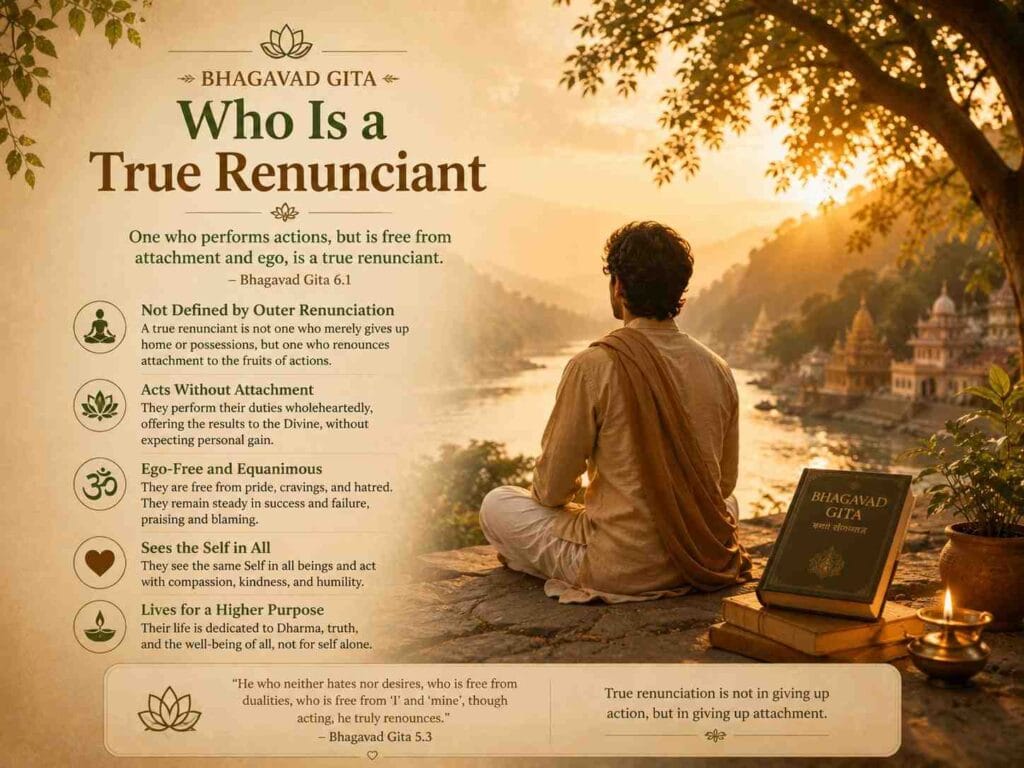
One of the clearest and most revolutionary definitions of renunciation in the Bhagavad Gita appears in Chapter 6:
अनाश्रितः कर्मफलं कार्यं कर्म करोति यः ।
स संन्यासी च योगी च न निरग्निर्न चाक्रियः ॥ (6.1)
“One who performs necessary action without dependence upon its results is a true renunciant and yogi, not one who merely abandons external activity.”
This verse completely transforms conventional ideas about spirituality and renunciation.
Ordinarily, people assume that renunciation means abandoning worldly life, leaving responsibilities behind, or physically withdrawing from society. Krishna challenges this assumption directly. He explains that renunciation is not fundamentally about inactivity. It is about freedom from psychological dependence. This distinction is extremely important.
Human beings rarely act from pure clarity alone. Most actions are unconsciously shaped by emotional motives such as desire for recognition, fear of failure, attachment to success, need for control, craving for validation, insecurity, comparison, and egoic ambition. Because identity becomes emotionally tied to outcomes, the mind also becomes emotionally controlled by outcomes.
Success strengthens pride and attachment because the ego feels confirmed and important. Failure creates anxiety because identity feels threatened. Praise produces emotional excitement because the mind depends upon approval for self-worth, while criticism creates emotional disturbance because the ego experiences rejection and insecurity.
As a result, consciousness continuously fluctuates according to external circumstance. Krishna identifies this psychological dependence as bondage. The deeper problem is not action itself. The deeper problem is attachment within action.
This is why the Bhagavad Gita does not teach passivity or laziness. Krishna never asks Arjuna to abandon responsibility. Instead, he teaches him how to act without becoming psychologically imprisoned by action and its results.
The true renunciant therefore continues fulfilling responsibilities sincerely, yet inwardly becomes less dependent upon reward, recognition, praise, success, and personal gain. Action continues fully, but compulsive emotional dependence gradually weakens. This creates a fundamentally different relationship with life.
The individual still works, serves, creates, struggles, leads, and participates in the world, but awareness becomes less psychologically reactive to success and failure. Emotional balance no longer depends entirely upon external validation.
This is why Krishna unites renunciation and yoga together. Real spirituality is not withdrawal from action. It is freedom within action.
This insight gives the Bhagavad Gita extraordinary psychological depth because Krishna recognizes that suffering often comes less from responsibility itself and more from the ego’s attachment to identity through responsibility.
Why External Withdrawal Alone Cannot Create Freedom
One of the deepest teachings in the Bhagavad Gita is that the mind carries suffering wherever it goes.
Human beings often imagine that changing external circumstances alone will create peace: “If I leave this environment, I will become calm.” “If I escape responsibility, I will finally feel free.” “If I withdraw from worldly life, suffering will disappear.” Krishna challenges this belief directly.
Without inner transformation, psychological conflict continues regardless of external location or lifestyle. Fear, insecurity, craving, jealousy, attachment, ego, anger, comparison, and emotional restlessness do not disappear automatically simply because a person changes environment.
The mind recreates suffering internally wherever it goes.
This insight is profoundly important because it shifts the focus of spirituality away from external escape toward inner mastery. Krishna recognizes that the real battlefield is not only outside in the world. The deeper battlefield exists within consciousness itself.
A person may sit in solitude while the mind continues producing fantasy, anxiety, resentment, fear, desire, and comparison. Another person may abandon possessions externally while remaining inwardly obsessed with status and identity. Someone may physically withdraw from society while psychologically remaining trapped by egoic superiority and emotional attachment.
In such cases, external renunciation changes appearance without transforming consciousness. This is why the Bhagavad Gita repeatedly emphasizes self-mastery rather than mere withdrawal.
This teaching feels remarkably modern because contemporary individuals still search for fulfillment primarily through external change. Some pursue endless achievement believing success alone will create peace. Others romanticize escape from ordinary life, imagining that leaving society or responsibility will automatically produce freedom.
Yet both paths may continue producing suffering if the mind itself remains emotionally conditioned and attached. Krishna therefore points toward something far deeper: lasting peace does not come merely from changing external conditions. It emerges through transformation of consciousness itself. The Bhagavad Gita does not reject ordinary life. It teaches freedom amidst ordinary life.
Ego, Identity, and Psychological Bondage
The Bhagavad Gita repeatedly explains that egoic identification lies at the root of human suffering.
Human beings construct identity through achievement, status, appearance, relationships, wealth, recognition, beliefs, memory, social image, and personal narrative. The ego constantly seeks stability through these external structures because it wants certainty, importance, and emotional security.
But all these structures continuously change. Success fades. Relationships evolve. Public opinion shifts. The body ages. Circumstances transform. External security remains uncertain. Because the ego builds itself upon unstable foundations, fear naturally develops.
The mind then spends enormous energy trying to protect identity and maintain control over life. This creates anxiety, attachment, emotional instability, comparison, insecurity, and continuous inner tension.
Krishna identifies this compulsive identification as bondage. The true renunciant gradually loosens this psychological dependence. This does not mean becoming passive, emotionally disconnected, or indifferent to life. Rather, awareness becomes less trapped within the ego’s endless need for superiority, validation, certainty, and control.
The person still acts fully within life, but identity no longer collapses completely into every success and failure. Emotional stability becomes less dependent upon external approval.
This is why Krishna teaches that renunciation begins internally before it manifests externally. A wealthy person may remain inwardly detached. An ascetic may still remain deeply attached psychologically. The Bhagavad Gita therefore focuses not upon appearance, but upon consciousness itself.
This insight remains deeply relevant because modern culture increasingly encourages individuals to build identity entirely through external achievement and public validation. Social media amplifies comparison constantly. Professional culture often ties self-worth to productivity and success. As a result, many individuals feel emotionally exhausted because identity becomes psychologically dependent upon unstable external conditions.
Krishna’s teaching offers another possibility: participate in life sincerely without becoming psychologically enslaved by life.
Karma Yoga and the Path of Inner Renunciation
One of the most revolutionary teachings in the Bhagavad Gita is that action itself can become a path toward liberation.
Before the Bhagavad Gita, spirituality was often strongly associated with withdrawal from ordinary life. Krishna transforms this understanding through Karma Yoga.
The practitioner continues acting fully within life while gradually renouncing attachment internally. Work continues, relationships continue, responsibility continues, and participation in society continues. What changes is the quality of consciousness behind action itself.
The individual learns to work without egoic obsession, serve without craving recognition, act without psychological dependence upon success, and fulfill responsibility without surrendering inner peace to external outcomes. This is true renunciation according to Krishna.
The Bhagavad Gita therefore dissolves the rigid separation between spiritual life and ordinary life. Everyday responsibilities themselves become opportunities for awareness, discipline, self-mastery, compassion, and inner growth. The battlefield becomes part of yoga.
This teaching remains extraordinarily relevant because many modern individuals feel divided between ambition and spirituality, success and peace, worldly achievement and inner freedom. Krishna demonstrates that liberation does not necessarily require abandoning ordinary life completely.
What must be transformed is consciousness itself. This is the genius of Karma Yoga. The individual continues participating fully in the world while gradually becoming inwardly freer from attachment, egoic dependence, emotional reactivity, and compulsive identification.
Action remains. Life remains. Responsibility remains. But consciousness changes. And according to Krishna, that inner transformation is the beginning of true renunciation.
The Renunciant and Inner Stability
A true renunciant gradually develops inner steadiness amidst the changing conditions of life. This inner stability becomes one of the clearest signs of spiritual maturity in the Bhagavad Gita.
Ordinarily, the human mind rises and falls continuously according to external circumstance. Pleasure creates excitement and attachment, while pain creates resistance and emotional disturbance. Gain strengthens confidence temporarily, while loss creates insecurity and fear. Praise inflates the ego, criticism wounds identity, success produces pride, and failure weakens self-worth.
As a result, emotional balance becomes dependent upon conditions that constantly change. This makes consciousness fragile and reactive.
Krishna repeatedly explains that the problem is not merely the existence of pleasure and pain, success and failure, or praise and criticism. The deeper problem is that human beings unconsciously build identity and emotional security around these unstable experiences.
The ego continuously seeks permanence through temporary conditions.
A person feels valuable when recognized, confident when successful, secure when praised, and emotionally stable when circumstances appear favorable. But because life itself remains uncertain and constantly changing, the mind also remains unstable.
This creates continuous psychological fluctuation. The true renunciant gradually becomes free from this compulsive emotional dependence.
This does not mean becoming emotionally numb, indifferent, or disconnected from life. The Bhagavad Gita never glorifies emotional suppression. Krishna does not ask human beings to stop feeling emotion or withdraw from ordinary experience completely.
Instead, the renunciant develops equanimity, the ability to remain inwardly steadier amidst changing external conditions. This distinction is extremely important.
Ordinarily, consciousness becomes psychologically trapped within emotional reaction. Anger appears and awareness immediately becomes anger. Fear appears and the mind collapses into anxiety. Praise creates emotional intoxication, while criticism creates emotional suffering.
The renunciant slowly changes this relationship with experience.
Awareness begins observing emotional movement without becoming completely consumed by it. The individual still experiences joy, grief, uncertainty, challenge, love, responsibility, and disappointment, but consciousness becomes less mechanically controlled by these fluctuations. This creates psychological freedom.
The wise person continues participating fully in life while remaining inwardly steadier amidst life’s instability. Emotional experiences continue, but identity no longer collapses entirely into them.
This is why Krishna repeatedly presents equanimity as a sign of spiritual maturity:
समदुःखसुखं धीरं सोऽमृतत्वाय कल्पते ॥ (2.15)
“One who remains steady amidst pleasure and pain becomes fit for liberation.”
Inner steadiness therefore becomes one of the clearest signs of genuine renunciation.
The renunciant no longer depends entirely upon temporary external conditions for identity, emotional security, or self-worth. Instead, stability gradually moves inward. Consciousness becomes less psychologically enslaved by praise and criticism, gain and loss, pleasure and pain.
This is not weakness. It is profound inner strength. The Bhagavad Gita therefore presents renunciation not as escape from life, but as freedom from compulsive psychological reaction within life itself.
Why the Teaching of Renunciation Remains Timeless
One reason the Bhagavad Gita remains profoundly relevant is because modern life intensifies exactly the forms of attachment Krishna describes thousands of years ago.
Today, people increasingly define themselves through productivity, achievement, appearance, social image, wealth, visibility, influence, and public validation. Social media amplifies comparison continuously, while professional culture often conditions individuals to measure self-worth entirely through success and recognition.
As a result, many people experience chronic emotional exhaustion.
The mind becomes trapped in endless psychological pressure: the pressure to succeed, the pressure to appear important, the pressure to remain visible, the pressure to outperform others, and the pressure to maintain external identity constantly. Because emotional security becomes dependent upon unstable external conditions, inner peace also becomes unstable.
This creates anxiety, insecurity, comparison, emotional fatigue, and psychological restlessness. Krishna recognized this mechanism long before modern psychology formally studied emotional dependency and identity formation.
The Bhagavad Gita therefore feels astonishingly modern because it addresses the root of human instability itself.
Krishna’s teaching offers another possibility. Act sincerely. Participate fully in life. Fulfill responsibilities courageously. Pursue excellence with discipline and integrity. But do not surrender inner peace entirely to constantly changing outcomes. This becomes the deeper meaning of renunciation in the Bhagavad Gita.
Renunciation is not rejection of life. It is freedom from compulsive psychological attachment within life. The individual continues working, creating, loving, serving, struggling, and participating in society, yet consciousness gradually becomes less dependent upon external validation for stability and self-worth.
This teaching remains timeless because human psychology itself has not fundamentally changed. People still seek security through temporary conditions. The ego still fears uncertainty and loss. The mind still becomes attached to recognition, achievement, comparison, and control.
And therefore Krishna’s insight remains eternally relevant: lasting peace cannot emerge from unstable external conditions alone. Real freedom begins when consciousness itself changes.
Conclusion
The Bhagavad Gita radically transforms the meaning of renunciation. Krishna teaches that true renunciation is not merely external withdrawal from society or abandonment of responsibility. A person may leave the world outwardly while remaining inwardly trapped by fear, craving, ego, comparison, insecurity, and attachment.
The true renunciant is the one who gradually becomes inwardly free. Action may continue. Responsibility may continue. Relationships may continue. Ordinary life may continue. But consciousness changes.
The mind becomes less dependent upon validation, less attached to outcomes, less controlled by emotional fluctuation, and less psychologically imprisoned by egoic identity. This is why Krishna unites renunciation with yoga itself. Real spirituality is not escape from life. It is freedom within life.
The Bhagavad Gita ultimately teaches that liberation does not necessarily require abandoning the world externally. What must be transformed is the mind’s unconscious attachment to the world.
The battlefield remains. Life remains. Responsibility remains. But awareness becomes freer. And according to Krishna, that inner freedom is the essence of true renunciation.