
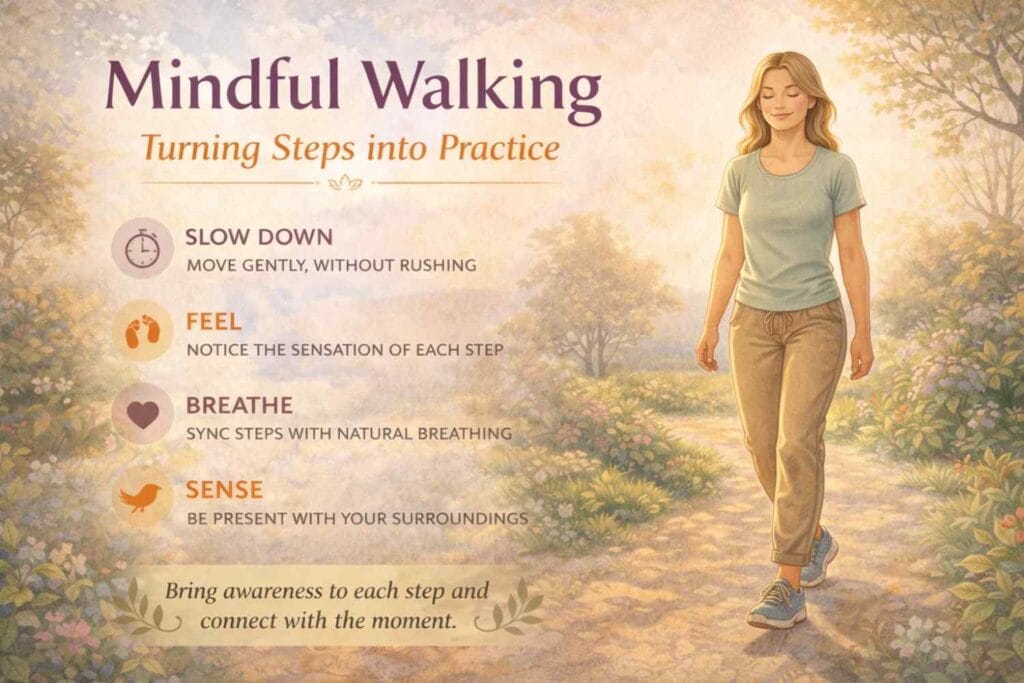
Learn mindful walking meditation and how to turn simple steps into a daily awareness practice that improves focus, calmness, and clarity.
When Walking Becomes Mechanical Instead of Conscious
Walking is one of the most repetitive actions in daily life, yet it is rarely experienced fully. The body moves continuously, step after step, while the mind is occupied elsewhere, thinking, planning, or reacting. Over time, this creates a pattern where movement continues, but awareness does not accompany it. The act remains, but the experience fades.
This is where mindful walking begins, not by changing the action, but by restoring attention to it. Instead of moving unconsciously from one place to another, each step becomes something that is actually noticed, felt, and experienced in real time.
What Makes Walking a Powerful Meditation Practice
In the Yoga Sutras of Patanjali, the mind is understood as something that continuously takes the form of what it engages with. When it moves without direction, experience becomes scattered. Walking offers a natural structure to stabilize this movement because it is rhythmic, repetitive, and continuous.
Each step follows the next in a predictable pattern, allowing attention to settle gradually without being forced. Unlike complex practices that demand effort, walking provides a simple and accessible field where awareness can remain anchored through movement itself.
The Core Shift: From Destination to Awareness
Ordinarily, walking is driven by purpose, you walk to reach somewhere. In mindful walking, this orientation changes. The destination still exists, but it is no longer the primary focus. The process becomes central.
You begin to notice the contact of the foot with the ground, the shift of weight from one leg to the other, and the subtle balance that keeps the body upright. This shift does not slow you down artificially; it changes the quality of attention within the movement.
How to Practice Mindful Walking (Simple Approach)
You do not need a special technique or environment to begin. Start with these simple steps:
- Walk at a natural pace, without forcing slowness
- Bring attention to the sensation of each step
- Notice the lifting, moving, and placing of the foot
- When the mind drifts, gently return to the next step
This is not about maintaining perfect focus. It is about repeatedly returning attention to movement.
The First Challenge: The Mind Keeps Wandering
In the beginning, attention does not stay with the steps for long. Within seconds, the mind moves toward thoughts, memories, or distractions. This is not failure, it is a direct observation of how the mind functions. The practice is not about stopping this movement but recognizing it and returning to the act of walking. Each return, however small, strengthens the ability to remain present.
Over time, these small returns begin to create continuity.
The Role of Breath in Mindful Walking
The Hatha Yoga Pradipika highlights the relationship between breath and internal balance. This becomes noticeable in walking as well. When attention is absent, breathing tends to be irregular or unnoticed. When awareness is present, breath naturally aligns with movement. You may observe that a few steps occur during inhalation and a few during exhalation.
There is no need to control this rhythm. Observing it is enough to bring a sense of coordination between body and breath.
Observing Thoughts Without Interrupting Movement
Thoughts continue to arise during mindful walking, just as they do in seated meditation. The difference lies in how they are experienced. Instead of being carried fully into each thought, you begin to notice that the step is still happening alongside it. This creates a subtle distance.
Thoughts are present, but they do not dominate attention completely. This aligns with the observational approach described in the Yoga Sutras of Patanjali, where awareness is maintained without immediate reaction.
The Body as a Moving Anchor
In walking meditation, the body itself becomes the anchor. Each step provides a clear point of reference. When attention drifts, you do not need to search for a method, you return to the next step. This makes the practice continuous and accessible.
There is always another moment to observe, another step to return to. This immediacy supports the development of steady awareness.
Common Mistakes Beginners Make
To maintain clarity in practice, it helps to avoid certain common mistakes:
- Forcing the pace to be unnaturally slow
- Trying to control the breath deliberately
- Expecting thoughts to stop completely
- Becoming frustrated when attention drifts
These tendencies create unnecessary effort. Mindful walking develops through ease and repetition, not force.
Choosing the Right Environment
While mindful walking can be practiced anywhere, certain environments support it more easily:
- Quiet paths or open spaces reduce distraction
- Natural surroundings help maintain steady attention
- Less crowded areas allow smoother observation
However, the goal is not dependency on ideal conditions. With practice, awareness can remain even in more active environments.
The Gradual Deepening of Awareness
At first, attention feels effortful. You have to remind yourself repeatedly to return to the step. But gradually, awareness begins to stabilize. You start noticing finer details, the exact moment the foot touches the ground, the subtle shift of balance, the coordination between movement and breath. This refinement does not come from forcing concentration, but from repeated observation.
Over time, the movement becomes clearer, and the mind becomes less reactive.
From Practice to Daily Life Integration
One of the most significant aspects of mindful walking is that it bridges the gap between practice and daily activity.
Unlike seated meditation, which often feels separate, walking is already part of everyday life. When awareness is brought into walking, it begins to extend into other actions, standing, turning, reaching. Gradually, practice is no longer confined to a specific time. It becomes part of movement itself.
Why This Practice Aligns with Yogic Teaching
The Bhagavad Gita emphasizes awareness within action rather than withdrawal from it. Mindful walking reflects this principle directly. You do not step away from activity to practice awareness, you bring awareness into activity.
This changes the nature of practice from something separate to something integrated.
Mindful walking begins as a simple act of paying attention to something that was always happening unnoticed. At first, it may feel like an effort, bringing the mind back to each step, again and again, but gradually, this effort softens. The movement remains the same, yet the experience of it becomes more continuous and less fragmented.
As awareness settles into the rhythm of walking, the need to control or structure the practice reduces. The steps themselves become enough. What once required intention begins to sustain itself through familiarity, and attention starts to remain not because it is forced, but because it has found a natural point to rest on.
Over time, this shift does not stay limited to walking. It begins to reflect in other movements and actions, where awareness appears without deliberate effort. In this way, walking is no longer just a means of reaching somewhere-
It becomes a quiet way of remaining present while moving, where each step carries a sense of continuity rather than distraction.