Understand Yoga Sutra 1.3 (Tada Drashtuh Svarupe Vasthanam) with Sanskrit translation and a deep explanation of the Seer and true awareness.
Sanskrit
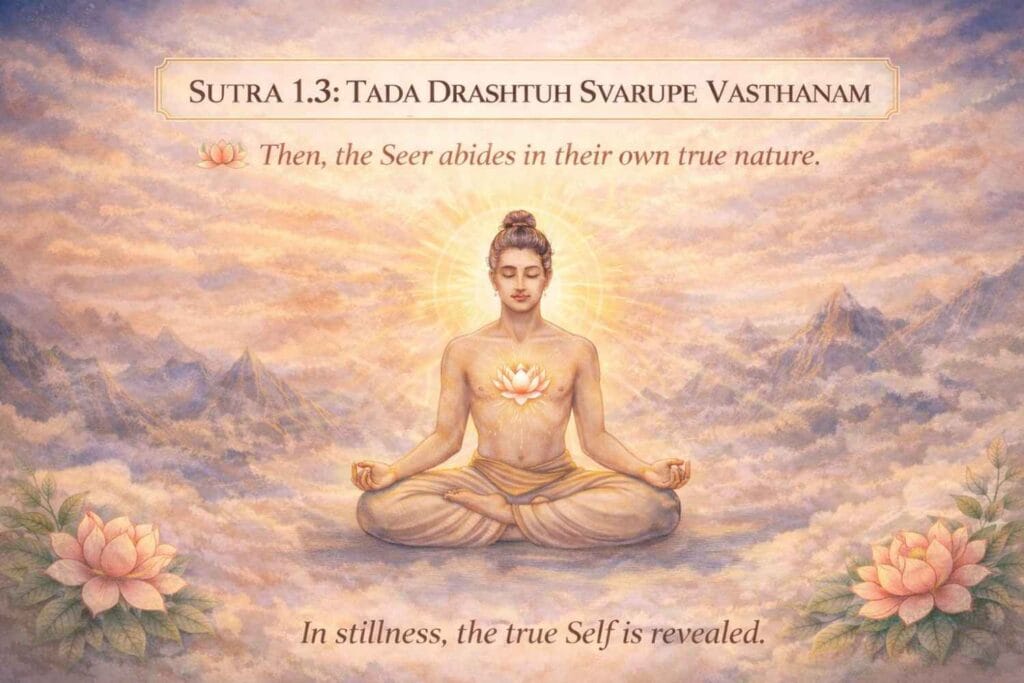
तदा द्रष्टुः स्वरूपेऽवस्थानम् ॥1.3॥
Translation
- तदा (Tada) – Then
- द्रष्टुः (Drashtuh) – The Seer (the observer, pure awareness)
- स्वरूपे (Svarupe) – In its own nature
- अवस्थानम् (Avasthanam) – Abides, rests, remains
Full Meaning:
Then, the Seer abides in its own true nature.
What “Then” Actually Refers To
The sutra begins with the word Tada, “then.” This is not a general statement; it points directly to what was established in the previous sutra (1.2), where the fluctuations of the mind are restrained. This means the state described here does not arise independently. It appears only when the disturbances of the mind settle.
This connection is important. The sutra does not describe something to be created, but something that becomes evident when interference is removed.
Who Is the “Seer”?
The term Drashtuh refers to the Seer, the one who observes. This is not the mind, not the body, and not the stream of thoughts. It is the underlying awareness that remains constant while everything else changes.
In ordinary experience, this distinction is not clear. The Seer becomes identified with thoughts, emotions, and perceptions. Instead of observing them, it appears to become them. This identification creates confusion, because what is changing is taken to be the self.
The Meaning of “Abiding in One’s Own Nature”
Svarupe Avasthanam describes a state where the Seer rests in its own nature. This does not mean acquiring something new. It means remaining as what is already present, without distortion.
When the mind is active, attention is pulled outward toward thoughts, reactions, and interpretations. In that movement, the Seer appears hidden. When the movement settles, nothing new is added, the Seer simply becomes evident.
This is why the sutra is simple in wording but profound in implication. It does not describe transformation through addition, but through clarity.
Why This State Is Not Commonly Recognized
Even though the Seer is always present, it is not always recognized. The reason is not its absence, but the constant activity of the mind. Thoughts, memories, and reactions create a continuous stream that occupies attention.
When attention is fully engaged with these movements, there is no space to recognize the underlying awareness. The Seer is not lost, it is obscured by identification.
The Relationship Between Mind and the Seer
the Seer does not become disturbed, it only appears so when identified with the movements of the mind. The mind is active by nature, constantly changing through thoughts, memories, and reactions, while the Seer remains a steady presence that observes these changes without participating in them. In ordinary experience, this distinction is not clear, and the state of the mind is taken to be the state of the self.
This can be understood more simply:
- Thoughts arise and pass, but they are observed
- Emotions change, but their presence is noticed
- The mind fluctuates, while awareness remains constant
When the fluctuations of the mind settle, this identification begins to dissolve. The mind continues to function, but it is no longer mistaken for the self. The Seer remains unchanged, revealing that the mind is something that is observed, while the Seer is that which observes.
What Actually Happens in This State
In this state, nothing new is added to experience. Instead, what usually occupies attention begins to settle. The constant movement of thought, reaction, and interpretation reduces, and with that reduction, clarity becomes evident. It is not that awareness becomes something different, but that it is no longer obscured by continuous mental activity.
What changes here is not the presence of the mind, but the way it is related to. Thoughts may still arise, but they are no longer followed or taken as identity. There is a natural separation between what appears and what observes. This separation is not created through effort, it becomes visible when the usual involvement with mental activity decreases.
This can be seen more directly:
- Mental activity may continue, but it does not dominate attention
- Experience unfolds, but without the need to react or interpret immediately
- Awareness remains present, without being shaped by what appears
There is a simplicity to this state. It is not intense or extraordinary, but steady and undisturbed. The Seer remains as it is, not influenced by the changing nature of the mind, allowing experience to arise and pass without creating confusion.
Why This Sutra Follows Immediately After 1.2
The placement of this sutra after 1.2 is not accidental. In Sutra 1.2, the restraint of mental fluctuations is established, and Sutra 1.3 describes what becomes evident when that condition is present. This sequence shows that the state of the Seer abiding in its own nature is not something separate, it is directly dependent on the settling of the mind.
As long as the mind remains in constant movement, attention stays engaged with its fluctuations, and the Seer appears identified with them. When those movements reduce, this identification weakens, and clarity arises naturally. The sutras are arranged to reflect this progression: first the condition, then the result.
This relationship can be understood simply:
- When the mind is active → identification with thoughts continues
- When the mind settles → awareness becomes clear
- When clarity is present → the Seer is recognized in its own nature
The sequence emphasizes that nothing new is achieved in Sutra 1.3. It is a direct outcome of what is described in Sutra 1.2, showing that clarity is revealed when disturbance ends.
The Simplicity of the Teaching
The simplicity of this teaching lies in the fact that nothing new needs to be added or achieved. In Sutra 1.3 of the Patanjali Yoga Sutras, the Seer is not something to be reached, but something that is already present. The difficulty does not come from its absence, but from the constant activity of the mind that obscures it. When that activity settles, what remains is not something new, it is simply seen clearly.
This makes the teaching direct, though not always easy. The mind tends to seek methods and complexity, while this sutra points toward recognition rather than construction. There is nothing to build, only something to notice. As attention is no longer absorbed in mental movement, awareness becomes evident on its own, revealing a clarity that was always present but previously unnoticed.
Sutra 1.3 describes a state that is not achieved through addition, but revealed through stillness. When the movements of the mind settle, the Seer does not transform, it simply remains as it always is, in its own nature. This state is not distant or abstract; it is obscured only by identification with what is constantly changing.
The teaching of the Patanjali Yoga Sutras here is direct: clarity is not something to be constructed, but something that becomes evident when disturbance ends.