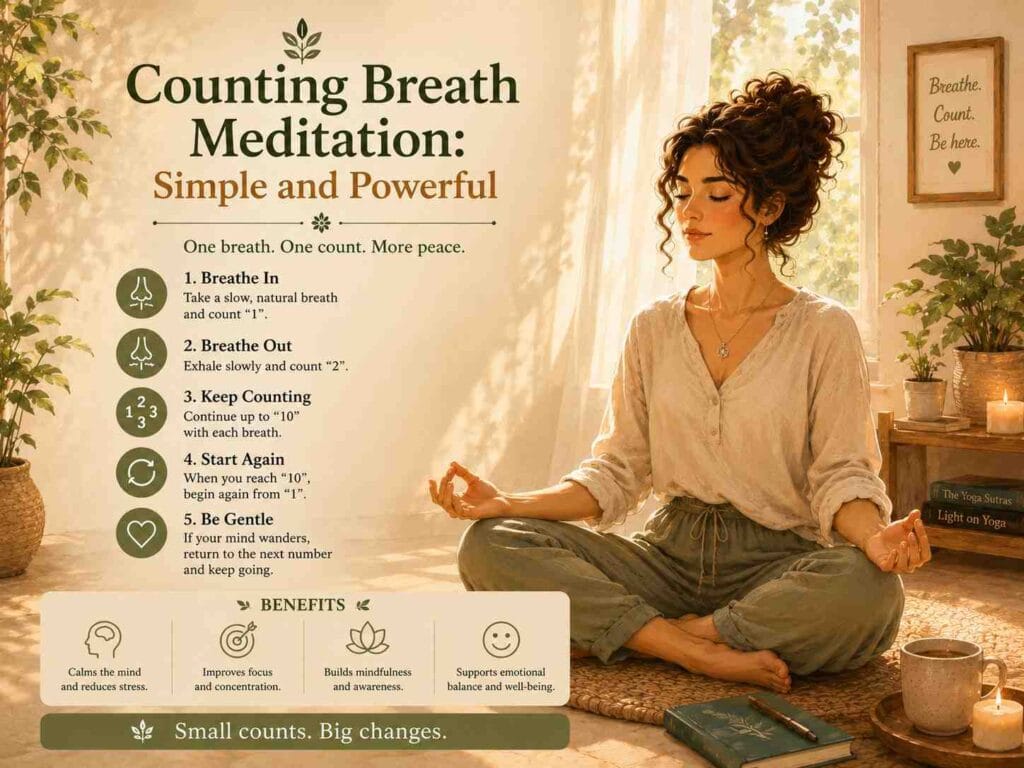
Learn Counting Breath Meditation with this complete guide covering mindfulness, breath awareness, focus, nervous system regulation, and the deeper yogic significance of breath meditation.
Introduction
Among the many meditation techniques found across contemplative traditions, few are as simple, accessible, and psychologically effective as counting breath meditation.
The practice appears almost minimal:
the breath is observed
and counting is added to stabilize attention.
Yet beneath this simplicity lies a remarkably sophisticated method for training awareness.
In an age dominated by distraction, overstimulation, fragmented attention, and constant cognitive activity, the ability to sustain attention steadily on something as subtle as breathing has become increasingly difficult. This is precisely why counting breath meditation remains so powerful. The technique does not attempt to overwhelm the mind with complexity. It simplifies experience deliberately.
By reducing the field of attention to breath and number, the practice interrupts habitual mental movement and gradually develops steadiness, clarity, and internal observation.
Although counting breath meditation is widely taught today in mindfulness traditions, its deeper principles align closely with teachings found throughout contemplative systems such as the Yoga Sutras of Patanjali, the Bhagavad Gita, Buddhist meditation traditions, and the Hatha Yoga Pradipika.
These traditions repeatedly emphasize:
- regulation of attention
- steadiness of the mind
- observation without reactivity
- breath awareness
- and gradual reduction of mental fluctuation
Counting breath meditation embodies all of these principles in an unusually direct and practical form. Its effectiveness lies not in dramatic experience, but in disciplined simplicity.
What Is Counting Breath Meditation?
Counting breath meditation is a mindfulness practice in which awareness is placed on the natural rhythm of breathing while silently counting each breath cycle.
Typically, the practitioner counts:
- each inhalation and exhalation together as one breath
- or each exhalation individually
The count usually progresses from:
1 to 5
or
1 to 10
before beginning again from the start.
For example:
- inhale
- exhale
- “one”
then:
- inhale
- exhale
- “two”
and so forth.
If attention drifts and counting is lost, the practitioner simply returns to the beginning without frustration or self-judgment. This detail is important. The purpose of the practice is not perfect concentration through force. The purpose is the training of awareness through repeated returning.
In many ways, the moment of realizing distraction is itself part of the meditation.
The practitioner begins recognizing directly how frequently the mind moves automatically toward:
- memory
- anticipation
- planning
- emotional reaction
- fantasy
- and internal commentary
Counting provides a gentle cognitive structure that helps stabilize attention without creating excessive mental effort. The mind receives a simple task that prevents it from wandering as easily while still allowing awareness to remain calm and observant.
Why the Breath Is Central in Meditation Traditions
Across contemplative traditions, breath occupies a unique position because it exists at the meeting point between body and mind. Breathing reflects emotional and nervous system states continuously.
Stress often creates:
- shallow breathing
- muscular tension
- rapid respiratory rhythm
- and heightened physiological activation
Calmness tends to produce slower, steadier, and more regulated breathing patterns. This relationship works in both directions. Mental states influence breathing. But breathing also influences mental states. This is one reason breath awareness appears so consistently throughout traditional yoga and meditation systems.
The Hatha Yoga Pradipika repeatedly emphasizes the connection between breath regulation, prāṇa, nervous system steadiness, and mental stability.
Similarly, the Yoga Sutras of Patanjali describes yoga as the calming of mental fluctuations (vṛttis), while later sutras connect breath regulation with increased steadiness and preparation for deeper concentration.
The breath therefore becomes more than a physical process. It becomes an anchor for awareness itself. Unlike thoughts, which constantly change in complexity and emotional charge, breathing remains immediate, rhythmic, and continuously available. The practitioner learns to stabilize attention by repeatedly returning to something simple, direct, and present.
Why Counting Makes the Practice More Effective
Many beginners struggle with meditation not because awareness is impossible, but because unstructured attention quickly becomes absorbed into thought. The mind naturally seeks stimulation and movement. Without support, attention often drifts within seconds. Counting helps solve this problem.
The addition of numerical structure creates gentle continuity within attention. Instead of merely “trying not to think,” the practitioner performs a simple observational task.
This has several important effects:
- attention becomes easier to sustain
- distraction becomes easier to notice
- mental wandering decreases
- and awareness develops greater continuity
Importantly, counting should remain light and quiet. The numbers are not meant to dominate awareness. They function more like subtle markers supporting attentional steadiness. Eventually, some practitioners naturally transition toward pure breath observation without counting. But counting often provides an essential bridge toward deeper concentration.
The Psychological Value of Repetition
One reason counting breath meditation is so effective is that it trains the nervous system through repetition rather than intensity. Modern culture often values dramatic transformation and rapid results. Meditation works differently. Its effects usually emerge gradually through repeated moments of returning attention.
Every time the practitioner notices distraction and gently returns to the breath, several processes strengthen simultaneously:
- attentional regulation
- self-awareness
- emotional observation
- and reduction of compulsive mental momentum
This process reflects an important principle found throughout contemplative traditions: awareness develops through consistency more than force. The repetition itself gradually reshapes the relationship between awareness and thought. Instead of being pulled automatically into every mental movement, the practitioner begins observing thoughts without immediately following them. This shift is subtle but profound.
How to Practice Counting Breath Meditation
Preparing for Practice
The environment does not need to be perfect, but reducing unnecessary distraction helps support steadier attention. Choose a quiet space where the body can remain relatively comfortable and undisturbed.
The posture may be:
- seated on the floor
- seated in a chair
- or kneeling comfortably
The spine should remain upright without excessive rigidity. The purpose of posture is alert stability rather than forced stillness. Hands may rest naturally on the knees or lap. The eyes may remain gently closed or softly unfocused. Before beginning counting, allow breathing to settle naturally for a few moments. There is no need to manipulate the breath aggressively. Counting breath meditation is based primarily on observation rather than control.
Step-by-Step Practice
Step 1 – Bring Attention to the Breath
Notice the natural movement of breathing.
Observe:
- inhalation
- exhalation
- movement in the chest or abdomen
- and the rhythm of respiration
Simply become aware of breathing as it already exists.
Step 2 – Begin Counting
After each complete breath cycle, silently count:
“One.”
Then:
“Two.”
Continue gradually until reaching five or ten. After reaching the final number, begin again from one. The pace should remain natural and unforced.
Step 3 – Notice Distraction
At some point, attention will drift.
Thoughts may arise involving:
- planning
- memory
- worry
- analysis
- emotion
- or random internal dialogue
This is normal. The goal is not to prevent thought entirely. The important moment is recognizing that attention has wandered. Once awareness notices distraction, gently return to the breath and begin counting again. No frustration is necessary. Returning is the practice.
Step 4 – Continue With Steady Observation
Gradually, attention becomes more stable. Breathing may naturally slow. Mental activity may soften slightly. The practitioner learns to remain present with immediate experience rather than continuously pulled into mental projection.
Common Difficulties
Restlessness
Many people initially discover how active the mind truly is. This is not failure. It is increased awareness of normal mental movement.
Sleepiness
If attention becomes dull, posture may need adjustment. Slightly deeper breathing or practicing earlier in the day may help.
Frustration About Distraction
One of the most common misunderstandings is believing meditation means “never thinking.” Meditation is not the absence of thought through force. It is the cultivation of awareness in relationship to thought.
Over-Control of Breathing
The breath should remain mostly natural. Forcing or manipulating breathing excessively often creates tension rather than steadiness.
The Relationship Between Counting and Mindfulness
Counting breath meditation is sometimes misunderstood as merely a concentration technique designed to “block out” thoughts or force the mind into silence.
In reality, the practice develops mindfulness and concentration together. This distinction is important.
Concentration alone can narrow attention temporarily, but mindfulness introduces awareness into the process itself. The practitioner is not attempting to escape experience or become mentally numb. Instead, awareness remains active, observant, and responsive throughout the meditation.
While counting the breath, the practitioner gradually begins noticing subtle patterns within the mind:
- distraction arising automatically
- emotional reactions forming
- impatience developing
- restlessness increasing or decreasing
- and shifts in attention occurring moment by moment
These observations are significant because they reveal how the mind normally functions beneath conscious awareness.
Ordinarily, thoughts and reactions happen so quickly that they remain unnoticed. The individual becomes absorbed into mental activity automatically.
Counting breath meditation interrupts this unconscious momentum.
The breath and counting act as a stable reference point from which observation becomes possible. Instead of being completely pulled into every thought, awareness begins recognizing mental movement while remaining anchored in the present moment. This changes the relationship with thought itself.
For example, instead of unconsciously following anxiety, irritation, or distraction immediately, the practitioner begins seeing these experiences arise as observable mental events. That moment of observation creates psychological space. And within that space, compulsive identification weakens.
This is one of the foundations of mindfulness practice. True mindfulness is not passive drifting or vague relaxation. It is conscious observation without becoming completely entangled in every mental reaction. The practitioner learns not only to focus, but also to see clearly.
The Deeper Yogic Significance
Within yogic philosophy, the restless movement of the mind is considered one of the primary causes of inner instability and suffering.
The mind continuously moves toward:
- memory
- anticipation
- attachment
- fear
- comparison
- and emotional reactivity
This constant movement fragments attention and weakens clarity.
The Bhagavad Gita repeatedly emphasizes steadiness amidst changing conditions rather than automatic emotional reaction. Similarly, the Yoga Sutras of Patanjali describes yoga as the calming or regulation of mental fluctuations (vṛttis).
Counting breath meditation reflects these principles directly through practical experience rather than abstract theory.
The practice trains:
- steadiness without force
- awareness without suppression
- and observation without compulsive reaction
This balance is essential.
The practitioner is not aggressively fighting the mind, nor passively following every thought. Instead, attention repeatedly returns to the breath with steadiness and patience.
Over time, an important realization begins to emerge. Thoughts, sensations, emotions, and mental states continuously arise and disappear on their own. Restlessness changes. Calmness changes. Attention shifts. Feelings appear and dissolve. Yet awareness itself gradually becomes more stable amidst this movement.
This insight is central within contemplative traditions. The practitioner begins recognizing that mental activity is constantly changing, while awareness can remain present without being completely controlled by each passing experience.
Counting breath meditation therefore becomes more than a relaxation technique. It becomes a method for understanding the movement of the mind directly.
Counting Breath Meditation in Modern Life
The relevance of counting breath meditation has become even greater within modern conditions because contemporary attention is continuously fragmented.
Most people now live within environments dominated by:
- notifications
- rapid information exchange
- social media stimulation
- multitasking
- constant screen exposure
- and continuous cognitive engagement
As a result, sustained attention has become increasingly rare. Many individuals move rapidly from one stimulus to another without experiencing prolonged moments of mental stillness or uninterrupted awareness.
This continuous fragmentation often contributes to:
- mental fatigue
- emotional overstimulation
- anxiety
- reduced concentration
- nervous system exhaustion
- and difficulty remaining present
Counting breath meditation functions almost like attentional rehabilitation within this environment. The practice retrains the ability to remain consciously present rather than automatically pulled outward by stimulation.
At first, many practitioners are surprised by how difficult it feels simply to remain attentive to ten breaths without distraction. Yet this difficulty itself reveals the condition of modern attention. The practice develops the capacity to pause, observe, and stabilize awareness intentionally.
This is one reason short breath-counting practices are increasingly incorporated into:
- stress management programs
- mindfulness-based therapeutic approaches
- emotional regulation techniques
- nervous system recovery practices
- and workplace wellness systems
The technique remains especially valuable because it does not require elaborate philosophy, equipment, or ideal conditions.
A few minutes of breath awareness can be practiced:
- before sleep
- during work breaks
- after emotional stress
- before important decisions
- or during moments of mental overwhelm
Its simplicity makes it accessible. Its depth makes it transformative over time.
Counting breath meditation remains one of the simplest yet most effective methods for developing attentional steadiness, mindfulness, emotional regulation, and nervous system balance. By combining breath awareness with gentle counting, the practice creates a stable anchor amidst the constant movement of thought and emotional activity.
Although externally simple, the practice gradually reveals deeper insights into:
- distraction
- reactivity
- mental conditioning
- emotional movement
- and the nature of awareness itself
Its effectiveness lies not in dramatic experiences or mystical complexity, but in disciplined repetition and careful observation. Again and again, the practitioner learns to return attention to direct experience rather than becoming completely absorbed in mental projection. This repeated returning gradually changes the quality of awareness itself.
Attention becomes steadier. Reaction becomes less automatic. Observation becomes clearer.
For this reason, counting breath meditation has remained valuable across contemplative traditions for centuries.
In a world increasingly dominated by overstimulation, fragmentation, and continuous distraction, the ability to rest awareness consciously upon a single breath may be one of the most important forms of inner training available today.