Siddhasana is more than a yoga pose. Explore the ancient science of stillness, meditation, posture, prāṇa, and consciousness through this deeply researched guide inspired by classical Hatha Yoga traditions.
Siddhasana and the Lost Science of Sitting Still
There is something deeply ironic about the way modern culture approaches yoga today. Most people enter yoga searching for movement, flexibility, fitness, mobility, strength, or stress relief. Yoga is often presented as a physical activity meant to improve the body externally. But when we begin reading ancient yogic texts more carefully, a completely different picture emerges.
For many classical yogis, the ultimate purpose of yoga was never endless movement. It was the stabilization of consciousness.
The body was trained not simply to become flexible or aesthetically impressive, but to become steady enough for deep meditation. In other words, ancient yoga treated the body as a support for awareness rather than as the final goal itself. This is precisely why one deceptively simple seated posture received extraordinary importance across traditional yoga systems:
Siddhāsana – “The Accomplished Pose.”
At first glance, Siddhasana appears almost unimpressive compared to modern social media yoga culture. There are no acrobatic transitions, dramatic balances, or extreme stretches involved. The posture looks quiet, minimal, and still. Yet ancient yogis considered it one of the most important meditation postures ever taught.
The Hatha Yoga Pradipika praises Siddhasana so highly that some passages suggest mastery of this single posture alone could support liberation. To modern readers, that statement may sound exaggerated or symbolic. How could sitting still possibly matter so much?
The answer reveals something profound about how ancient yoga understood the relationship between posture, breathing, attention, the nervous system, and consciousness itself.
What Is Siddhasana?
The Sanskrit word Siddha carries several meanings, including: accomplished, perfected, fulfilled, or spiritually attained. The word āsana means seat or posture. Thus, Siddhāsana literally translates as:
“The Accomplished Seat.”
This name itself is important because it reflects the original purpose of the posture. Siddhasana was not primarily designed for physical performance. It was developed as a stable seat for meditation.
Ancient yogis recognized a problem that many modern practitioners still discover quickly during meditation:
the body and mind constantly disturb each other.
When the body becomes uncomfortable, awareness loses steadiness. Small physical tensions repeatedly interrupt concentration. The knees ache, the spine collapses, the shoulders tighten, breathing changes, and attention immediately becomes distracted. What appears like a “mental” problem often begins physically.
Siddhasana was designed to reduce unnecessary disturbance.
The posture encourages an upright spine, grounded positioning, and relative physical stability for extended periods of sitting. Ancient yogis believed this physical steadiness directly supported psychological steadiness. The less the body demanded attention, the easier it became for awareness to move inward.
This is why seated postures became so central within classical yoga traditions. Meditation was not viewed as purely mental effort. The condition of the body strongly influenced the condition of consciousness.
The Extraordinary Importance of Siddhasana in the Hatha Yoga Pradipika
Among classical yoga texts, Siddhasana receives especially high praise within the Hatha Yoga Pradipika. The text repeatedly presents the posture not merely as a physical technique, but as an important support for higher states of awareness.
One verse states:
हठस्य प्रथमाङ्गत्वादासनं पूर्वमुच्यते ।
कुर्यात्तदासनं स्थैर्यमारोग्यं चाङ्गलाघवम् ॥
This verse emphasizes that āsana creates: steadiness, health, and lightness within the body.
Later passages elevate Siddhasana above many other postures because of its connection to meditation and energetic balance.
Another famous instruction states:
योनिस्थानकमङ्घ्रिमूलघटितं कृत्वा दृढं विन्यसेत् ॥
The posture is described not only mechanically, but energetically and spiritually. Ancient yogis believed Siddhasana influenced the movement of prāṇa, the vital force or subtle life-energy described throughout yogic traditions.
Whether one interprets these teachings symbolically, psychologically, or energetically, the underlying principle remains consistent:
the posture was believed to help stabilize consciousness internally.
This is a crucial point because classical yoga did not separate the body, breath, nervous system, and awareness into isolated categories. They were viewed as deeply interconnected dimensions of human experience.
Why Ancient Yogis Valued Sitting More Than Movement
One of the biggest differences between ancient yoga and much of modern yoga culture lies in what each tradition considers difficult.
Today, difficult yoga often means physically advanced postures requiring flexibility, balance, or strength.
In earlier yogic systems, however, the real challenge was stillness.
The ability to remain physically and mentally steady without collapsing into distraction was considered a profound discipline. Ancient practitioners discovered that sitting quietly is far more psychologically difficult than it first appears.
Within minutes of attempting stillness, most people encounter the same experience: the legs become uncomfortable, the spine begins collapsing, the breath changes, thoughts accelerate, restlessness increases, and the mind immediately starts searching for stimulation or escape.
Ancient yogis observed this process carefully. They realized the body and mind mirror each other continuously. Restless posture contributes to restless awareness. Physical instability amplifies mental instability.
Siddhasana therefore became less of a “pose” and more of a meditative technology designed to minimize unnecessary disturbance.
The goal was not physical performance. The goal was creating conditions supportive of deep inward attention. That distinction changes the entire meaning of yoga.
How to Practice Siddhasana
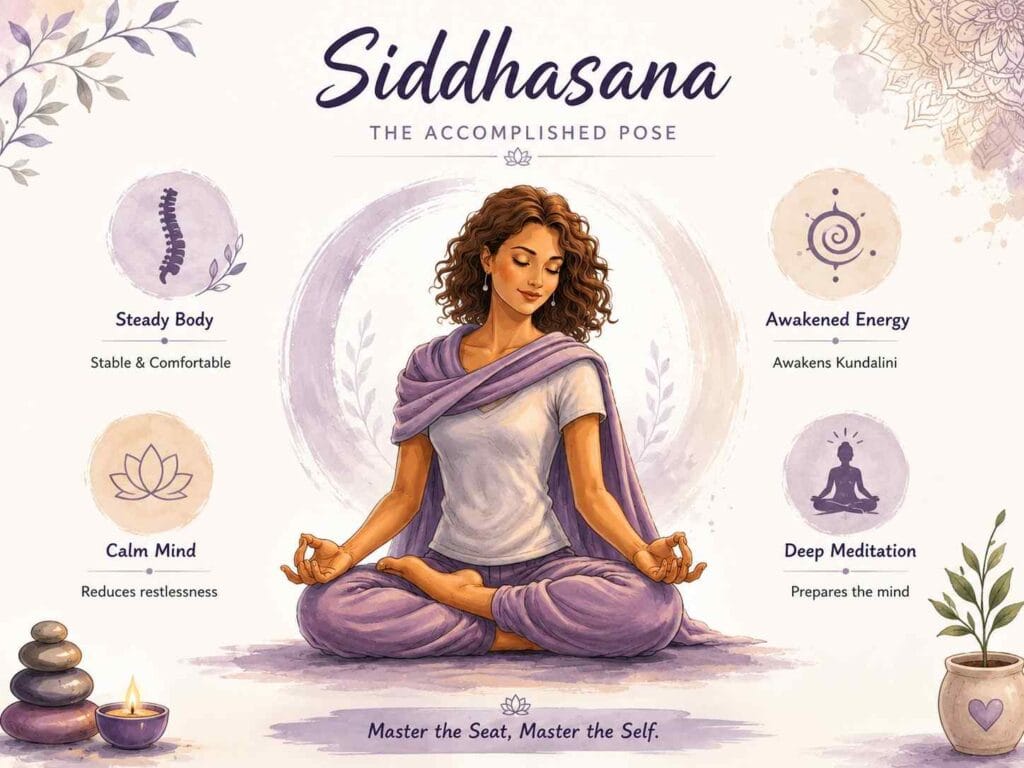
Traditional Siddhasana is practiced seated on the floor in a stable cross-legged position designed specifically for meditation rather than physical stretching. In the classical version of the posture, one heel is placed close to the perineum or pelvic floor region, while the opposite foot rests comfortably above or in front of it. The spine remains upright, the shoulders relaxed, and the hands rest gently on the knees or lap.
At first glance, the posture appears extremely simple. But the simplicity is deceptive.
The real challenge of Siddhasana is not flexibility. It is sustained stillness.
Most people today are not accustomed to sitting on the floor comfortably for long periods. The hips feel tight, the lower back collapses, the knees become uncomfortable, and the body quickly begins demanding movement. Ancient yogis understood this problem very clearly. That is why meditation postures were developed carefully over centuries, not to create visual beauty, but to reduce physical disturbance during contemplation.
The position of the spine is especially important in Siddhasana. The back should not become rigid like a military posture, nor should it collapse forward passively. Instead, the posture attempts to create a state of relaxed alertness where the body remains naturally lifted without excessive strain.
Breathing also plays an important role. In Siddhasana, the breath is usually allowed to become calm and unforced. Ancient yogic traditions repeatedly emphasized that meditation deepens more naturally when breathing becomes steady rather than aggressive or controlled forcefully.
Importantly, Siddhasana should never become painful or ego-driven. Classical texts sometimes describe very precise energetic alignments, but modern practitioners should approach the posture gradually and intelligently. Forcing the knees, hips, or spine into discomfort defeats the purpose of meditative steadiness entirely.
For many people today, especially beginners or individuals unfamiliar with floor sitting, modifications are not only acceptable but often necessary. Sitting on a folded blanket, meditation cushion, or yoga block can significantly improve pelvic positioning and spinal comfort. Elevating the hips slightly often reduces pressure on the knees and lower back while making upright sitting far more sustainable.
This is an important point often ignored in modern yoga culture: a meditation posture is successful not when it looks impressive, but when it allows awareness to remain steady with minimal physical distraction.
Ancient yoga valued sustainability over performance.
Siddhasana and the Nervous System
One reason seated meditation postures affect the mind so deeply may involve the nervous system itself.
Modern life keeps people in a nearly continuous state of psychological activation. Even when the body remains physically still, the mind often stays overloaded by stimulation: messages, notifications, screens, music, conversation, multitasking, travel, constant information, and uninterrupted cognitive engagement.
Many people rarely experience complete stillness anymore.
As a result, the nervous system begins adapting to constant stimulation as its normal condition. Silence starts feeling unfamiliar. Stillness becomes uncomfortable. The mind immediately searches for distraction because it has been conditioned to remain externally engaged almost all the time.
Siddhasana interrupts this pattern.
When a person intentionally sits upright, reduces unnecessary movement, and breathes steadily, the psycho-physical system gradually begins shifting into a different mode of functioning. External stimulation decreases. Attention stops scattering in multiple directions simultaneously. Awareness begins moving inward rather than outward continuously.
This shift may appear subtle externally, but internally it can feel profound.
Ancient yogis observed these effects directly through meditative experience long before modern neuroscience existed. Although they used different philosophical language, they consistently recognized a close relationship between: posture, breathing rhythm, mental fluctuation, attention, and emotional steadiness.
In many ways, Siddhasana became a physical environment designed to support inward attention.
The posture itself does not magically create enlightenment. However, it helps create conditions where concentration, observation, and meditative absorption become more accessible.
That distinction is extremely important.
The Symbolism of the Upright Spine
In yogic traditions, the upright spine carries both practical and symbolic significance.
Practically, an upright spine helps maintain wakefulness and stable breathing during meditation. When the body collapses forward, breathing often becomes restricted and awareness tends to become dull or sleepy. Excessive tension, however, creates agitation and discomfort.
Siddhasana attempts to establish a middle state between these extremes: relaxed but alert, grounded but awake, steady without rigidity.
This balance reflects one of the deepest goals of meditation itself.
Ancient yogic systems repeatedly emphasized that true meditative awareness is not unconsciousness or trance. The aim is clarity without restlessness, calmness without mental dullness.
The upright posture symbolizes this state psychologically. The practitioner remains awake to experience rather than collapsing into passivity or distraction.
Many meditation traditions across Asia eventually adopted similar principles because posture directly influences attention. The body and mind continuously communicate with one another. Slumped posture affects breathing, mood, and awareness differently than grounded upright sitting.
Ancient yogis understood this through observation long before posture and nervous system regulation became modern research topics.
Why Siddhasana Feels So Different From Modern Fitness Culture
One reason Siddhasana feels unusual today is because modern culture values visible activity constantly.
People are conditioned toward movement, productivity, entertainment, achievement, and external performance. Even wellness culture often treats intensity as progress. The assumption becomes:
more movement equals more value.
Siddhasana quietly challenges this entire mindset.
The posture asks the practitioner to stop seeking stimulation momentarily. There is no dramatic movement involved. No visual performance. No athletic achievement. No comparison with others.
Only stillness and observation.
For many people, this becomes unexpectedly difficult.
The moment external activity decreases, the mind becomes louder. Thoughts accelerate. Restlessness appears. Attention seeks distraction almost automatically. Ancient yogis discovered that stillness exposes the condition of consciousness very honestly.
This is why seated meditation postures became so important historically.
Movement can sometimes distract the mind from itself. Stillness reveals it.
Siddhasana therefore represents something much deeper than physical positioning alone. It reflects the ancient yogic understanding that awareness cannot stabilize fully while the body and mind remain in continuous agitation.
Siddhasana and Prāṇa in Hatha Yoga
Within classical Hatha Yoga traditions, Siddhasana became strongly associated with regulation of prāṇa.
The word prāṇa is often translated simply as “breath” or “life-force,” but its meaning in yogic philosophy is broader and more subtle. Prāṇa refers to the vital movement underlying physical, mental, sensory, and energetic processes within life itself.
Ancient yogis believed disturbed awareness reflected disturbed prāṇic movement. When the body, breath, and mind remained scattered continuously, prāṇa also became unstable. Conversely, when posture stabilized and breathing steadied, consciousness gradually became calmer and more focused.
This is why classical yoga did not separate meditation, posture, and breathing into unrelated practices. They were viewed as interconnected dimensions of the same process.
The Hatha Yoga Pradipika repeatedly suggests that seated postures influence energetic balance, and energetic balance influences awareness.
Whether modern practitioners interpret these teachings literally, symbolically, psychologically, or physiologically, the central insight remains powerful: body and mind constantly shape one another.
The condition of the posture affects breathing. Breathing affects attention. Attention affects emotional state. Emotional state affects perception.
Ancient yoga explored these relationships with remarkable depth long before modern psychology or neuroscience developed formal language for them.
Why the Pose Was Called “Accomplished”
The name Siddhasana itself carries deep philosophical meaning. The posture was not called “accomplished” because it looked impressive externally. It was called accomplished because it supported inner accomplishment. Ancient yoga valued mastery over attention more than external appearance. A person capable of sitting steadily, breathing calmly, remaining inwardly aware, and observing consciousness clearly, was considered far more advanced spiritually than someone performing dramatic physical movements without inner steadiness.
This reverses many modern assumptions about yoga completely.
The Modern Rediscovery of Stillness
Ironically, Siddhasana may feel more relevant today than ever before. Modern life produces unprecedented mental stimulation and attention fragmentation.
People spend much of their lives in continuous cognitive motion. Many individuals now struggle simply to remain quietly present without reaching for distraction.
This is why meditation, mindfulness, breathwork, and nervous system regulation have become increasingly popular globally. The ancient seated postures of yoga suddenly feel psychologically important again.
Siddhasana reminds practitioners that yoga was never only about movement. At its deepest level, yoga explored how human consciousness could become steady amidst constant mental fluctuation.
Important Clarification
It is important not to romanticize ancient postures unrealistically. Siddhasana is not a magical shortcut to enlightenment. Nor must every practitioner force themselves into uncomfortable seated positions.
Bodies differ significantly in mobility, structure, injury history, and comfort. The purpose of meditation posture is steadiness and support, not pain or physical struggle.
For some individuals, modified seated positions or even chair meditation may be healthier and more sustainable. Ancient yoga emphasized awareness far more than egoic performance.
My Personal Reflection on Siddhasana
What makes Siddhasana so powerful to me personally is that it completely changes the way we look at yoga.
Today, yoga is often reduced to movement, flexibility, aesthetics, or performance. People usually think the “best” yoga pose is the most difficult one physically. But when I started reading ancient yogic texts more deeply, especially the Hatha Yoga Pradipika, I realized something surprising: ancient yogis were obsessed with stillness, not performance.
That changed my perspective entirely.
Siddhasana looks almost too simple from the outside. There is no dramatic shape, no intense flexibility, nothing that immediately impresses social media. But internally, the posture can feel incredibly confronting because the moment the body becomes still, the mind becomes visible.
You begin noticing: how restless attention actually is, how difficult silence feels, how quickly the mind seeks distraction, and how uncomfortable stillness has become in modern life.
I think that is why ancient yogis respected seated meditation postures so deeply. They understood that sitting quietly is not passive at all. It is psychological work.
Personally, I also feel Siddhasana represents something modern wellness culture is slowly rediscovering again: the nervous system needs pauses.
Not every practice needs intensity. Not every form of healing comes through pushing harder.
Sometimes the deepest shift happens when the body stops running constantly and awareness finally gets space to observe itself. That is what makes Siddhasana feel timeless to me.
It is not just a yoga pose. It feels like a direct challenge to the speed, overstimulation, and endless mental noise of modern life. And maybe that is exactly why ancient yogis called it “The Accomplished Pose.”
Also read: Swatmarama: The Yogi Who Brought Hatha Yoga Into a System