Explore the deeper meaning of Padmasana (Lotus Pose) through the teachings of the Hatha Yoga Pradipika. Learn its connection to meditation, prāṇa, nervous system balance, consciousness, and inner stillness.
Introduction
Modern yoga culture often presents Padmasana, the Lotus Pose, as a symbol of flexibility or advanced practice. Images of perfectly folded legs and serene meditation dominate social media, yoga posters, and wellness branding worldwide.
But within classical yoga traditions, Padmasana was never important because it looked impressive. It was important because of what it was believed to do to consciousness.
Ancient yogic texts, especially the Hatha Yoga Pradipika, treated Padmasana as far more than a stretching posture. The pose was associated with meditation, prāṇic balance, nervous system steadiness, breath regulation, and deep contemplative practice.
The word “lotus” itself carries symbolic meaning throughout Indian spiritual traditions. The lotus grows from mud yet remains unstained by the water around it. Yogic philosophy often used this image to represent consciousness rising beyond confusion, attachment, and mental turbulence while still existing within the world.
This symbolism reflects the deeper purpose of Padmasana. The posture was designed to support inner stillness.
What Does Padmasana Mean?
The Sanskrit word Padma means “lotus,” while āsana means posture or seat. Thus, Padmāsana literally translates as:
“The Lotus Seat.”
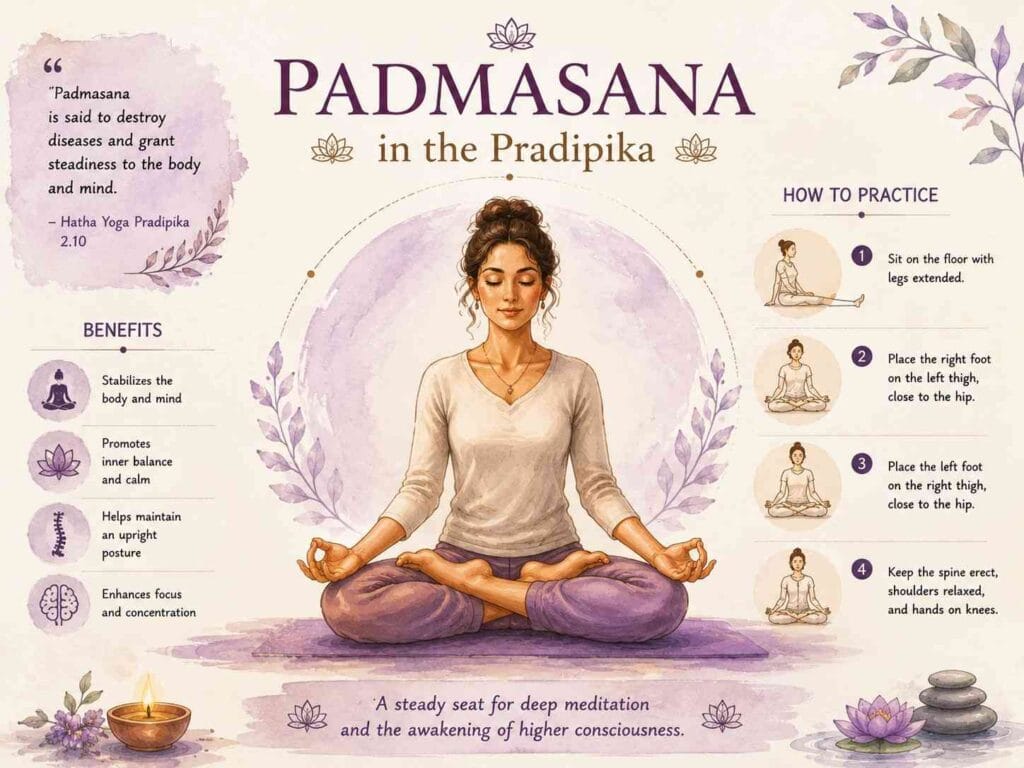
At the physical level, the posture involves placing each foot upon the opposite thigh while sitting upright on the floor. When practiced fully, the legs form a stable and symmetrical structure that helps reduce unnecessary movement during meditation.
But the deeper importance of Padmasana was never purely physical.
Ancient yogis valued the posture because of what it allowed the mind to do.
Meditation requires long periods of steadiness. The moment the body becomes uncomfortable, attention immediately gets pulled outward. The knees ache, the spine collapses, the hips tighten, and awareness begins shifting constantly between physical sensations and mental distraction. Ancient practitioners observed that the body and mind disturb one another continuously.
An unstable body often creates unstable attention.
This is why seated meditation postures became so important in classical yoga systems. Padmasana was developed as a posture that could help minimize unnecessary physical disturbance so awareness could remain inwardly steady for longer periods.
The symmetrical structure of the pose also mattered greatly. Ancient yogis believed balanced posture influenced balanced attention. When the body became grounded evenly on both sides, breathing often became steadier, muscular effort reduced, and concentration deepened more naturally.
This is one reason Padmasana became associated not just with sitting, but with meditative absorption itself.
The pose was never simply about flexibility.
It was about creating the physical conditions supportive of stillness.
For modern practitioners, Padmasana can appear intimidating because contemporary lifestyles significantly reduced natural hip mobility. Most people now spend years sitting in chairs, cars, desks, and highly restricted positions. As a result, the hips become less open and the body loses familiarity with deep seated postures.
Ancient yogic cultures, however, were much more accustomed to floor sitting in everyday life itself. Padmasana emerged within a completely different physical environment than modern sedentary culture.
That context is important.
Difficulty with Lotus Pose today does not necessarily mean failure. Often, it reflects broader changes in how modern bodies move and live.
Padmasana in the Hatha Yoga Pradipika
The Hatha Yoga Pradipika gives Padmasana extraordinary importance within traditional yoga practice. The posture is repeatedly described not merely as an exercise, but as a support for meditation, prāṇic balance, and higher states of awareness.
One verse states:
उत्तानौ चरणौ कृत्वा ऊरुसंस्थौ प्रयत्नतः ।
ऊरुमध्ये तथोत्तानौ पाणी कृत्वा तु दृढम् ॥
The text carefully describes how the posture should be established with steadiness and balance. But the most important aspect is not mechanical positioning alone. The Pradipika repeatedly connects Padmasana with regulation of prāṇa and stabilization of consciousness.
Another verse says:
पद्मासने स्थितो योगी नाडी-द्वारेषु पूरिते ।
मारुतं धारयेद्यस्तु स मुक्तो नात्र संशयः ॥
This reflects one of the central ideas within Hatha Yoga:
posture, breath, energy, and awareness are deeply interconnected.
Ancient yogis believed the body contained subtle energetic pathways called nāḍīs through which prāṇa moved. When awareness remained distracted and emotionally agitated, prāṇic movement was believed to become disturbed as well. Stable posture and breath regulation were therefore used to calm this inner movement gradually.
Whether one interprets these teachings symbolically, energetically, psychologically, or physiologically, the underlying insight remains remarkably sophisticated:
physical stillness influences mental stillness.
The Pradipika does not present Padmasana as a decorative yoga pose. It presents it as a meditative technology designed to support inward steadiness.
This is a completely different way of understanding yoga than much of modern fitness culture.
Why the Lotus Pose Became Spiritually Symbolic
The lotus is one of the most important symbols throughout Indian spiritual traditions, Buddhism, tantra, and yogic philosophy.
The flower grows through mud and water yet rises above the surface untouched. Ancient traditions repeatedly used this image to describe consciousness itself.
Human beings live amidst distraction, attachment, emotional conflict, desire, fear, and suffering. Yet yoga suggests awareness can still develop clarity and steadiness despite these conditions.
The lotus became symbolic of this possibility.
Padmasana gradually inherited the same meaning.
Meditation was viewed as a process of inner unfolding. Just as a lotus slowly opens petal by petal, consciousness was believed to unfold gradually through discipline, observation, stillness, and awareness.
This symbolism appears throughout Asian spiritual art and philosophy. Countless depictions of sages, yogis, Buddhas, and meditative figures are shown seated in lotus posture because the pose came to represent centered awareness itself.
Over time, Padmasana became more than a physical position.
It became an image of inner balance.
The posture communicates something psychologically powerful even today. In a world dominated by speed, distraction, and overstimulation, the image of someone sitting completely grounded and inwardly calm carries enormous symbolic weight.
That is one reason Lotus Pose continues fascinating modern culture thousands of years later.
How to Practice Padmasana Safely
Traditional Padmasana begins seated on the floor with the spine upright and relaxed. One foot is gently placed upon the opposite thigh, followed by the second foot resting upon the opposite thigh symmetrically. Ideally, the knees move comfortably toward the floor while the spine remains naturally lifted.
However, modern practitioners should approach the posture carefully and patiently.
One of the biggest mistakes people make is forcing the knees into lotus position without sufficient hip mobility. In reality, Padmasana primarily requires openness in the hips, not pressure on the knees. When the hips remain restricted, the knees absorb excessive rotational stress, which may create injury over time.
Ancient yoga emphasized awareness and steadiness, not ego-driven force.
For many people, gradual preparation is essential before attempting full Padmasana safely. Postures such as:
Baddha Konasana,
Ardha Padmasana,
Sukhasana,
and gentle hip-opening movements
often help develop the mobility necessary for lotus posture progressively.
Using meditation cushions or folded blankets beneath the hips may also improve pelvic alignment and reduce strain on the lower back. Slight elevation often helps the spine remain upright more naturally during seated practice.
Most importantly, Padmasana should never become painful.
Pain is not spiritual progress.
This point is extremely important because modern yoga culture sometimes glorifies forcing advanced postures aggressively. Classical yoga traditions approached meditation postures very differently. The purpose of Padmasana was not performance or visual perfection.
Its purpose was sustainable stillness.
A successful meditation posture is one that supports awareness rather than constantly disturbing it through discomfort and strain.
Ancient yogis were not trying to impress anyone externally.
They were trying to stabilize consciousness internally.
Padmasana and the Nervous System
One reason Padmasana became so important in meditation traditions may involve the way posture influences the nervous system and attention itself.
Modern life keeps human awareness in a nearly continuous state of outward engagement. From the moment people wake up, attention is pulled toward screens, notifications, conversations, deadlines, movement, traffic, entertainment, multitasking, and endless streams of information. Even during moments of physical rest, the mind often remains overstimulated internally.
As a result, many people rarely experience genuine stillness anymore.
The nervous system gradually adapts to this constant stimulation. Silence begins feeling uncomfortable. The mind seeks distraction automatically because continuous engagement becomes psychologically normal.
Padmasana creates the opposite condition.
The posture intentionally reduces unnecessary movement and external activity. The body becomes grounded and symmetrical. The spine remains upright. Breathing gradually slows. Muscular effort decreases once the posture stabilizes comfortably.
As physical movement decreases, attention often begins shifting inward naturally rather than scattering outward constantly.
Ancient yogis observed this relationship very carefully. They repeatedly recognized that posture affects consciousness directly. A restless body usually produces restless awareness, while stable posture often supports steadier concentration.
This does not mean Padmasana magically creates enlightenment. Rather, the posture helps create conditions where inward attention becomes easier to sustain.
Modern neuroscience increasingly explores similar relationships between posture, breathing rhythm, nervous system state, and attention regulation. Although ancient yogic traditions used different language, their experiential observations were remarkably sophisticated.
For example, slower breathing patterns are now widely studied for their influence on stress regulation and autonomic nervous system balance. Ancient yogis discovered long ago that steady breathing and stable posture profoundly affect mental state.
Padmasana therefore functioned as more than a seated position.
It became part of a complete meditative environment involving: stillness, breath, attention, and inward observation.
The Importance of Symmetry in Padmasana
One of the most distinctive features of Padmasana is its strong structural symmetry.
Unlike casual seated positions where weight shifts unevenly through the body, Lotus Pose creates a balanced and centered foundation. Both sides of the body participate equally, and the spine naturally aligns above the pelvis when the posture is practiced comfortably.
Ancient yogic systems considered symmetry deeply important because balance in posture was associated with balance in awareness.
The body feels grounded without collapsing. The spine remains upright without excessive muscular strain. The posture becomes steady without rigidity. This balance matters psychologically as well as physically.
Many practitioners describe symmetrical meditation postures as creating a subtle sense of internal centeredness. When the body becomes physically balanced, awareness often feels less fragmented and more unified internally.
Ancient yogis likely discovered these effects through direct contemplative experience over long periods of meditation.
Within Hatha Yoga traditions, symmetry was also associated with balanced movement of prāṇa through the nāḍīs, the subtle energetic channels described throughout yogic philosophy. The body was not viewed merely as a mechanical structure, but as part of a larger psycho-energetic system connected to attention and consciousness.
Even for practitioners who interpret these teachings symbolically rather than literally, the insight remains meaningful:
the condition of the body influences the quality of awareness.
Padmasana was designed to reduce unnecessary imbalance and disturbance so concentration could deepen more naturally.
Why Padmasana Feels Difficult Today
One important reason Padmasana feels challenging for modern people is because modern lifestyles changed the way human bodies move completely.
Historically, many cultures sat on the ground regularly throughout daily life. People ate, worked, rested, socialized, and meditated while seated on the floor. As a result, hip mobility developed naturally over years of habitual movement.
Modern environments are entirely different. Most people now spend large portions of life sitting in: chairs, cars, office desks, airplanes, couches, and highly restricted seated positions. Over time, this dramatically reduces hip mobility and external rotation capacity. The joints and connective tissues gradually lose familiarity with deep seated positions like Padmasana.
This is why many people experience stiffness or discomfort attempting Lotus Pose today. The posture itself did not suddenly become impossible. Human movement culture changed.
This context is important because difficulty with Padmasana is not necessarily a personal failure. Often, it reflects the physical consequences of modern sedentary living.
Ancient yogis developed these meditation postures within lifestyles involving very different movement patterns than contemporary digital culture.
That historical difference matters.
Padmasana Beyond Physical Flexibility
One of the biggest misunderstandings about Padmasana today is reducing it to flexibility alone.
Modern yoga culture often treats Lotus Pose as a visual milestone or advanced physical achievement. The focus becomes external appearance rather than meditative purpose.
Classical yoga traditions approached the posture very differently.
Ancient yogis did not value Padmasana because it looked impressive. They valued it because it supported inward steadiness.
A practitioner capable of extreme flexibility but unable to stabilize attention would not necessarily have been considered spiritually advanced within traditional yoga systems.
In fact, many classical texts consistently place far greater importance on: concentration, awareness, detachment, breath regulation, and meditative steadiness than on physical performance alone. Padmasana symbolized these inner qualities.
The posture represented grounded awareness rather than athletic accomplishment. This changes the entire meaning of Lotus Pose.
It becomes less about external achievement and more about creating a condition where consciousness can settle deeply without constant interruption.
Important Clarification
It is important not to romanticize Padmasana unrealistically or force the posture aggressively.
Not every body is structurally suited for full Lotus Pose safely. Hip anatomy, bone structure, mobility history, injuries, and connective tissue flexibility vary greatly between individuals.
Forcing the knees into Padmasana without sufficient hip mobility can create serious strain and injury.
Ancient yoga never required self-harm for spiritual growth.
This point is often forgotten today because social media sometimes encourages visual perfection over bodily awareness. Classical yoga traditions emphasized steadiness and sustainability far more than aesthetic achievement.
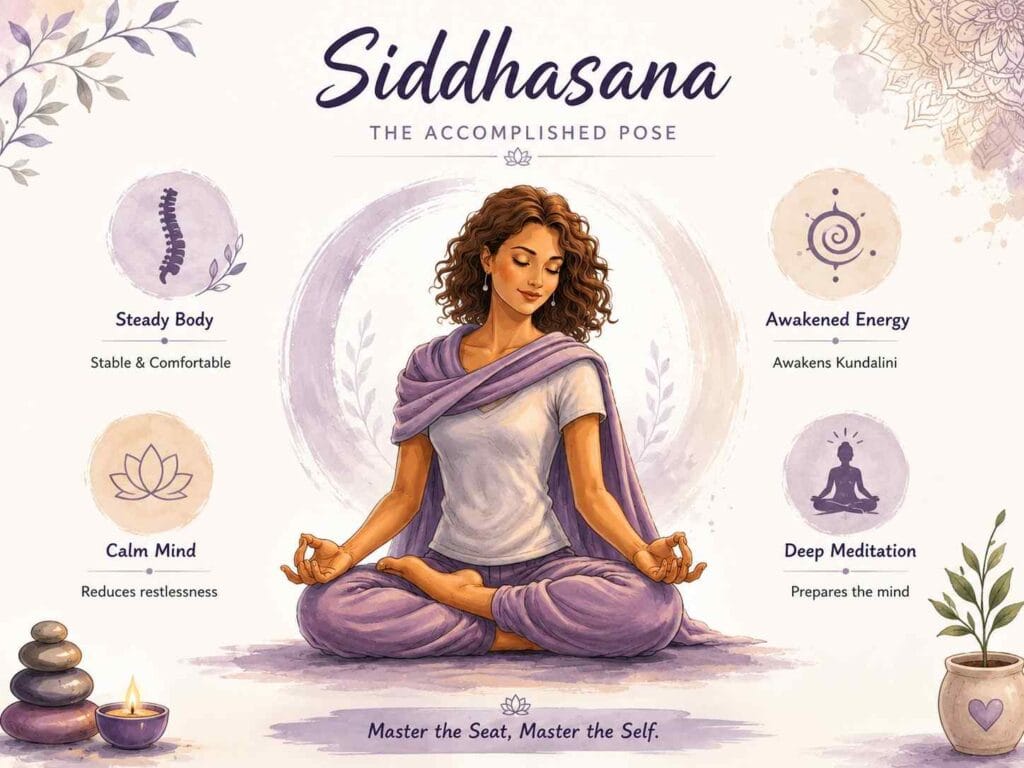
Modified seated positions can still support deep meditation effectively. Postures such as: Sukhasana, Ardha Padmasana, Siddhasana, or supported seated variations, may provide far safer and more sustainable meditation seats for many practitioners.
The essential principle remains the same: the posture should support awareness rather than disturb it. Meditation should never become sacrificed to physical ego.
Why Padmasana Still Fascinates the Modern World
Despite existing for thousands of years, Padmasana continues to fascinate people globally because the posture symbolizes something increasingly rare in modern life:
inner stillness.
The image of someone sitting completely grounded, steady, and inwardly calm carries enormous psychological power today. In a culture dominated by speed, stimulation, noise, productivity, and distraction, stillness itself begins feeling almost mysterious.
Padmasana visually represents the possibility of centered awareness amidst chaos.
That may be one reason the Lotus Pose became one of the most enduring symbols of yoga across the world.
Even people unfamiliar with yogic philosophy often intuitively associate the posture with: peace, meditation, clarity, presence, and inner balance. The pose communicates something deeper than flexibility.
It symbolizes the human search for steadiness within an increasingly restless world.
My Personal Reflection on Padmasana
What fascinates me most about Padmasana is that the posture completely changes meaning once you stop looking at it as a flexibility challenge.
Before studying ancient yogic texts more deeply, I used to think Lotus Pose was important mainly because it looked “advanced.” That is how modern culture usually presents it, as a symbol of high-level yoga ability. But after reading texts like the Hatha Yoga Pradipika, I realized ancient yogis respected Padmasana for an entirely different reason.
They cared less about how the posture looked and more about what it did to awareness. That shift in perspective changed everything for me.
Padmasana is difficult not only because of hip mobility, but because the posture forces stillness. The moment the body stops moving, the mind becomes more visible. You start noticing how restless attention actually is. Even after sitting for a few minutes, the urge to adjust posture, check something, think about something else, or escape discomfort appears very quickly. I think ancient yogis understood this deeply.
Modern life trains people to remain constantly stimulated. Most individuals rarely sit quietly without music, screens, conversation, or distraction. Because of that, stillness itself starts feeling uncomfortable. Padmasana directly confronts this condition.
Personally, I do not think the true value of Lotus Pose lies in achieving a “perfect shape.” I think its real value lies in what the posture reveals psychologically. It exposes the relationship between body, breath, restlessness, attention, and awareness in a very honest way.
That is probably why the lotus became such a powerful symbol across yoga traditions.
The flower grows through mud yet remains untouched above the water. In a similar way, yoga never promised escape from life completely. Instead, it explored whether consciousness could remain steady amidst distraction, emotional turbulence, and external chaos.
To me, Padmasana represents that possibility. Not perfection. Not performance. But centeredness.