A deep and authentic explanation of the wandering mind, meditation, and inner mastery in the Bhagavad Gita.
Understanding Restlessness, Attention, and Inner Mastery in the Bhagavad Gita
One of the most timeless and psychologically profound themes in the Bhagavad Gita is the problem of the wandering mind. Long before modern neuroscience, psychology, cognitive science, or mindfulness-based therapies attempted to study mental restlessness, the Bhagavad Gita explored why the human mind struggles to remain steady and why inner peace becomes so difficult to sustain.
Krishna recognizes something fundamental about human consciousness: the ordinary mind is not naturally calm. It constantly moves between memory and anticipation, desire and fear, attraction and resistance, imagination and emotional reaction. Human attention rarely remains fully present because awareness becomes continuously pulled outward toward stimulation, comparison, craving, insecurity, emotional attachment, and sensory engagement.
This insight forms one of the central foundations of spiritual life in the Bhagavad Gita. The real struggle of human existence is not merely external conflict. The deeper struggle exists within consciousness itself. A person may conquer external challenges while remaining inwardly overwhelmed by fear, anxiety, emotional instability, attachment, confusion, compulsive thinking, and psychological restlessness. External success alone cannot create lasting peace because the deeper disturbance originates within the mind itself. The Bhagavad Gita therefore places extraordinary importance upon self-mastery and awareness.
Krishna repeatedly teaches that the quality of life depends largely upon the quality of consciousness through which life is experienced. Two individuals may face similar external circumstances, yet one remains inwardly balanced while the other becomes psychologically overwhelmed. The difference lies not merely in the situation itself, but in the condition of the mind experiencing it. This gives the Bhagavad Gita remarkable psychological sophistication.
The wandering mind becomes the source of emotional suffering because it continuously pulls awareness away from inner steadiness. Thoughts move compulsively toward fear, resentment, fantasy, craving, comparison, insecurity, and anticipation. The mind becomes trapped within endless mental movement, making silence and clarity increasingly difficult.
Modern life intensifies this condition dramatically.
Today, human attention is continuously fragmented through social media, endless information, notifications, entertainment, comparison, advertising, productivity pressure, and digital overstimulation. Many individuals struggle to remain fully present even for a few moments because consciousness has become conditioned toward constant stimulation and distraction. The nervous system rarely experiences genuine stillness.
This is why the teachings of the Bhagavad Gita feel astonishingly modern. Krishna understood that an uncontrolled mind eventually becomes a source of suffering because consciousness loses its center amidst endless mental movement.
Without inner discipline, the mind becomes reactive rather than conscious. Fear begins controlling decisions. Desire clouds discernment. Comparison weakens self-worth. Emotional impulses dominate attention. External validation determines inner stability. The individual gradually loses clarity because awareness becomes psychologically scattered.
This is why Krishna repeatedly presents yoga not merely as physical practice or religious ritual, but as mastery of consciousness itself.
The Sanskrit word yoga fundamentally implies union, integration, and inner alignment. The wandering mind represents fragmentation, attention scattered across countless desires, fears, memories, distractions, and emotional reactions. Yoga gradually restores inward integration.
Meditation, self-observation, discipline, and detachment therefore become essential because they train awareness to stop reacting mechanically to every thought and emotional impulse. This process is not about suppressing the mind violently. It is about understanding the mind deeply. Krishna recognizes that restlessness cannot be removed through force alone. The mind becomes calmer gradually as awareness develops greater clarity and less compulsive attachment to external stimulation.
This is why inner mastery stands at the center of the Bhagavad Gita’s philosophy. A person without mastery over the mind remains emotionally dependent upon constantly changing external conditions. Praise creates excitement, criticism creates disturbance, success strengthens identity, and failure produces insecurity. Consciousness continuously rises and falls according to circumstance.
Such a mind cannot remain truly peaceful because its stability depends entirely upon unstable conditions. Inner mastery changes this relationship. The practitioner gradually develops the ability to observe thoughts, emotions, desires, and reactions without becoming completely psychologically consumed by them. Awareness becomes steadier amidst mental movement. Emotional experiences continue naturally, yet consciousness develops greater balance and clarity.
This creates freedom within ordinary life itself. The Bhagavad Gita therefore presents self-mastery not as rejection of the world, but as freedom from unconscious enslavement to the wandering mind.
Arjuna’s Honest Confession About the Mind
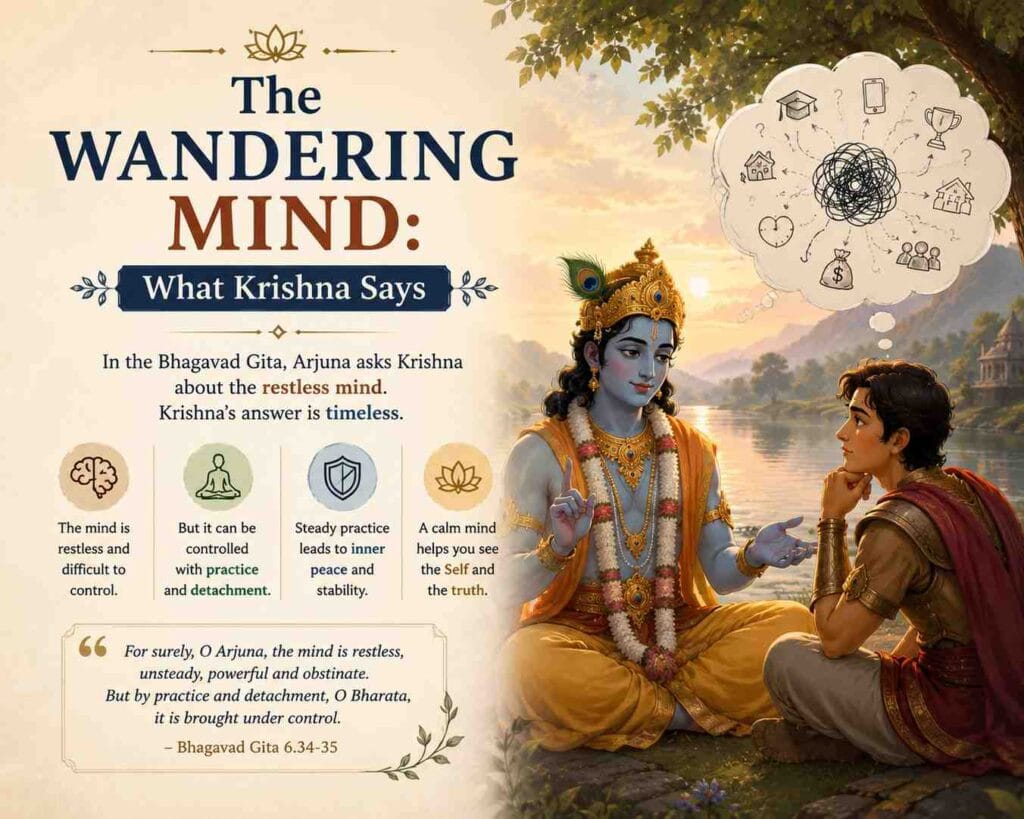
One of the most psychologically honest and deeply human moments in the Bhagavad Gita occurs during Arjuna’s conversation with Krishna in Chapter 6. After hearing Krishna’s teachings on meditation, discipline, self-mastery, and equanimity, Arjuna openly admits how difficult controlling the mind truly feels.
He says:
चञ्चलं हि मनः कृष्ण प्रमाथि बलवद्दृढम् ।
तस्याहं निग्रहं मन्ये वायोरिव सुदुष्करम् ॥ (6.34)
“The mind is restless, turbulent, powerful, and obstinate. Controlling it seems as difficult as controlling the wind.”
This verse remains profoundly relatable because Arjuna expresses an experience almost every human being recognizes internally. The mind rarely obeys intention easily.
A person may sincerely wish to remain calm, focused, disciplined, compassionate, or inwardly balanced, yet attention repeatedly drifts toward fear, distraction, memory, fantasy, emotional reaction, anxiety, desire, and internal dialogue. Even during meditation, the mind often jumps continuously between thoughts, worries, plans, sensations, and emotional movement. Arjuna speaks with complete honesty about this struggle.
This honesty is one of the reasons the Bhagavad Gita feels psychologically authentic rather than idealistic. Arjuna does not pretend to possess perfect discipline or effortless control over consciousness. He openly acknowledges the turbulence of the ordinary mind.
The comparison with the wind is especially profound. Wind constantly changes direction, moves unpredictably, and resists complete control. Similarly, the ordinary mind shifts rapidly between thoughts, emotions, desires, fears, and sensory impressions. One moment attention feels concentrated, while the next moment it becomes scattered again.
The Sanskrit words Arjuna uses carry remarkable depth.
He describes the mind as:
चञ्चलम् (cañcalam) – restless and constantly moving,
प्रमाथि (pramāthi) – turbulent and disturbing,
बलवत् (balavat) – powerful,
दृढम् (dṛḍham) – stubborn and difficult to restrain.
Together, these words reveal a sophisticated understanding of mental activity. The Bhagavad Gita recognizes that the mind is not weak merely because it wanders. In fact, its very power creates difficulty. Thoughts, emotions, desires, fears, and memories possess enormous psychological force because consciousness unconsciously identifies with them. This creates inner conflict. A person may intellectually understand what is beneficial, yet emotional impulses still pull awareness elsewhere. The mind becomes divided between intention and conditioning.
The Bhagavad Gita does not treat this condition as moral failure or spiritual inadequacy. Krishna understands that restlessness is deeply rooted within ordinary consciousness itself. Human beings have spent years strengthening habits of distraction, attachment, emotional reaction, craving, and sensory dependence. Naturally, the mind does not suddenly become silent merely through wishful thinking.
This makes the Bhagavad Gita extraordinarily compassionate and realistic. Spiritual growth is not presented as instant perfection. The struggle with distraction and emotional turbulence is acknowledged openly as part of the human condition itself.
Krishna’s response to Arjuna becomes equally important because he neither dismisses the problem nor romanticizes it. He acknowledges the difficulty honestly while still affirming that transformation is possible through practice and discipline.
This balance between realism and hope gives the Bhagavad Gita timeless depth. It recognizes both the difficulty of mastering consciousness and the possibility of gradually transforming consciousness itself.
Why the Mind Wanders
Krishna explains throughout the Bhagavad Gita that the mind wanders because consciousness remains attached to external stimulation and psychological dependence.
The senses continuously move outward toward pleasure, recognition, excitement, entertainment, emotional gratification, stimulation, and novelty. Human beings naturally become attracted toward experiences that promise satisfaction, security, pleasure, or emotional fulfillment. At the same time, the ego constantly seeks validation, certainty, importance, control, superiority, and emotional stability.
As a result, awareness rarely remains inwardly centered. Thoughts repeatedly move toward desires, fears, ambitions, memories, regrets, resentments, fantasies, and imagined futures. The mind therefore becomes fragmented because it is continuously pulled in multiple directions simultaneously.
The Bhagavad Gita recognizes a profound psychological principle: attention follows attachment.
Whatever consciousness becomes emotionally attached to begins occupying the mind repeatedly. A person attached to success constantly thinks about achievement and recognition. Someone consumed by fear continuously anticipates danger and uncertainty. An individual emotionally dependent upon validation becomes psychologically controlled by praise and criticism.
The mind keeps returning toward whatever the ego believes is necessary for security, identity, or fulfillment. This is why attachment and mental restlessness are deeply connected.
Krishna explains this psychological mechanism with remarkable precision:
ध्यायतो विषयान्पुंसः सङ्गस्तेषूपजायते ।
सङ्गात्सञ्जायते कामः कामात्क्रोधोऽभिजायते ॥ (2.62)
“When a person continuously dwells upon objects, attachment develops. From attachment arises desire, and from desire arises anger.”
This verse reveals that emotional suffering begins long before outward reaction appears.
The mind first dwells repeatedly upon certain thoughts, desires, fantasies, fears, and sensory experiences. Continuous mental attention gradually creates attachment. Once attachment develops, desire intensifies because the ego begins depending upon specific outcomes for satisfaction and emotional security.
From there, psychological disturbance naturally follows.
If desire is fulfilled, attachment strengthens further.
If desire is obstructed, frustration develops.
If identity feels threatened, fear intensifies.
If expectations collapse, anger and suffering emerge.
The wandering mind therefore becomes deeply connected to attachment itself. The more consciousness depends upon external conditions for emotional security, the more unstable the mind becomes. This insight explains why even pleasurable experiences often produce anxiety. The ego fears losing what it has become attached to. As a result, the mind cannot remain peaceful because it continuously attempts controlling uncertain circumstances.
The Bhagavad Gita therefore identifies attachment as one of the central causes of mental restlessness. Modern life intensifies this process dramatically. Social media strengthens comparison and validation-seeking. Consumer culture continuously stimulates new desire. Productivity culture ties self-worth to achievement and performance. Endless digital stimulation weakens attention further.
The mind becomes trapped within continuous craving and reaction. Krishna recognized this mechanism thousands of years ago. This is why the Bhagavad Gita repeatedly emphasizes awareness, discipline, detachment, and self-observation. Without inner mastery, the mind remains psychologically enslaved by whatever captures attention most strongly.
The wandering mind is therefore not merely a problem of concentration. It is a problem of attachment, identity, and emotional dependence within consciousness itself.
The Modern Crisis of Attention
The teachings of the Bhagavad Gita feel extraordinarily relevant today because modern life intensifies exactly the psychological patterns Krishna describes. Although the external forms of society have changed dramatically over thousands of years, the fundamental structure of human consciousness remains remarkably similar. The mind still seeks stimulation, emotional security, recognition, pleasure, certainty, and distraction. What has changed is the intensity and speed with which these impulses are constantly activated. Human attention today is under continuous assault.
Digital technology, endless notifications, social media, advertising, entertainment platforms, comparison culture, productivity pressure, and constant information overload continuously fragment awareness. The mind rarely experiences uninterrupted stillness because attention is repeatedly pulled outward toward stimulation and reaction. The nervous system therefore remains in a state of almost permanent engagement.
Many individuals now struggle to remain fully present even for a few moments without reaching toward distraction. Silence itself begins feeling uncomfortable because the mind has become conditioned toward continuous movement. Moments that once allowed reflection and inward quiet are now immediately filled with scrolling, stimulation, content consumption, or internal overthinking.
This condition is psychologically significant. The human mind gradually adapts to whatever patterns it repeats continuously. When consciousness becomes trained toward constant stimulation, attention loses its capacity for depth, steadiness, and inward stability. The mind begins craving novelty compulsively because silence no longer feels familiar.
As a result, many people experience chronic mental fatigue despite living in conditions of unprecedented convenience. Externally, life may appear more comfortable and technologically advanced than ever before. Yet inwardly, many individuals struggle with: anxiety, restlessness, emotional exhaustion, difficulty concentrating, overthinking, attention fragmentation, comparison, and inability to remain mentally still.
The Bhagavad Gita recognized that the mind loses clarity when it becomes enslaved to compulsive sensory engagement and emotional reactivity.
This insight becomes increasingly important today because modern culture often rewards distraction rather than awareness. People are encouraged to consume constantly, respond instantly, compare continuously, and remain psychologically available to stimulation at all times.
Attention becomes scattered across countless external demands. The mind jumps rapidly between screens, conversations, ambitions, worries, emotional reactions, memories, entertainment, and future projections. Even rest often becomes another form of stimulation rather than genuine recovery.
This weakens the capacity for inward steadiness. The Bhagavad Gita understands that attention is not merely a mental function. Attention shapes consciousness itself. Whatever repeatedly captures awareness gradually shapes emotional life, perception, behavior, and identity.
A distracted mind therefore becomes vulnerable to emotional instability because awareness loses its center. This is why Krishna teaches not escape from the world, but mastery within the world. The Bhagavad Gita never suggests that external life itself is the enemy. The deeper issue is unconscious dependence upon stimulation and emotional reaction. Technology itself is not inherently harmful. The problem arises when consciousness loses the ability to remain inwardly free amidst external engagement. Without awareness, the mind becomes trapped within continuous reaction.
Every notification pulls attention outward.
Every comparison weakens inner stability.
Every emotional impulse demands immediate engagement.
Every fear and desire begins controlling awareness automatically.
The individual gradually loses the ability to simply remain present. Krishna’s teachings therefore become deeply relevant for modern psychological life. The Bhagavad Gita reminds human beings that inner peace cannot emerge from endless stimulation because compulsive engagement continuously agitates consciousness.
The mind requires stillness in order to regain clarity. This is why meditation, self-observation, discipline, and detachment become essential. They restore the capacity for sustained attention and inward steadiness within a culture increasingly built upon distraction. The Bhagavad Gita ultimately teaches that freedom depends upon whether consciousness controls attention, or whether external stimulation controls consciousness.
Krishna’s Solution: Practice and Detachment
Krishna responds to Arjuna’s struggle with one of the most important teachings in the Bhagavad Gita:
असंशयं महाबाहो मनो दुर्निग्रहं चलम् ।
अभ्यासेन तु कौन्तेय वैराग्येण च गृह्यते ॥ (6.35)
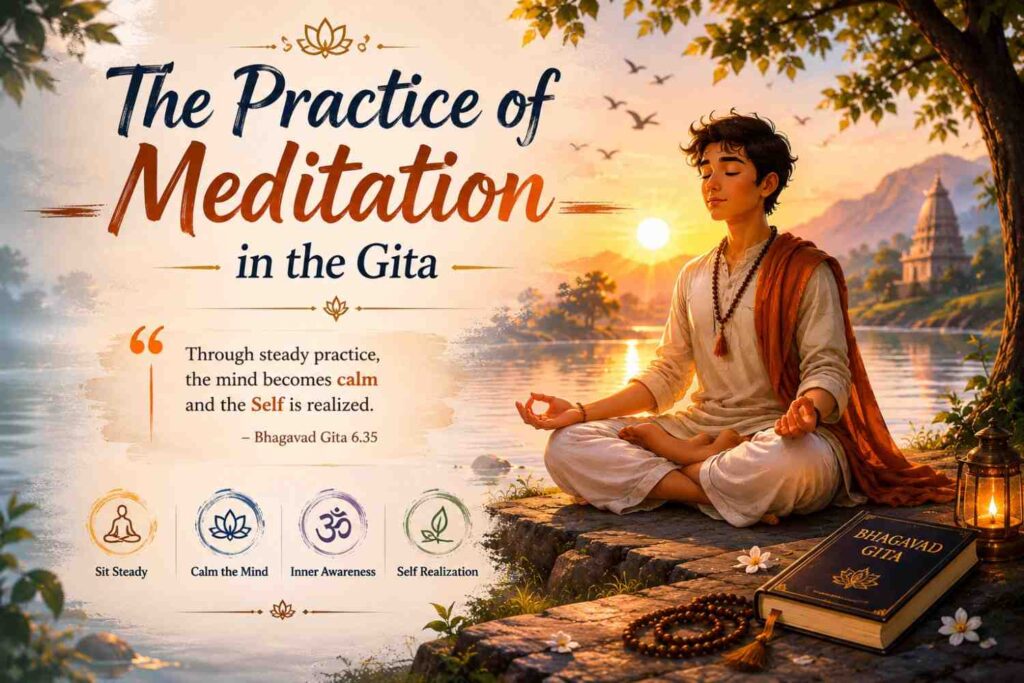
“Without doubt, the mind is restless and difficult to control, but through practice and detachment it can be restrained.”
This verse contains the heart of meditation and self-mastery in the Bhagavad Gita. Krishna begins with complete honesty. He does not deny the difficulty of stabilizing the mind. Consciousness has spent years strengthening habits of distraction, emotional reaction, attachment, craving, fear, and compulsive thinking. Naturally, the mind does not become silent immediately.
This realism is extremely important. The Bhagavad Gita does not promise instant enlightenment or effortless peace. Inner transformation develops gradually through disciplined training of awareness.
Krishna identifies two essential principles: abhyāsa (practice) and vairāgya (detachment). Together, they form the foundation of meditation and inner mastery. Abhyāsa means sustained practice, repeatedly returning awareness whenever the mind wanders. Meditation is not about forcing thought to disappear instantly. The mind naturally drifts toward distraction because wandering has become habitual. Practice therefore means patiently bringing attention back again and again without frustration or self-condemnation.
Every return strengthens awareness. This insight reflects profound psychological understanding. Concentration develops not because distraction never occurs, but because awareness repeatedly learns how to return from distraction consciously. Over time, the mind slowly develops discipline.
Modern individuals often become discouraged during meditation because thoughts continue arising. The Bhagavad Gita approaches this differently. Krishna understands that wandering itself is part of ordinary consciousness. Practice means developing patience and continuity rather than demanding immediate perfection.
The second principle, vairāgya, is equally essential. Detachment does not mean emotional coldness, indifference, or rejection of life. It means freedom from compulsive psychological dependence upon thoughts, desires, fears, comparisons, and sensory stimulation. The mind cannot become steady while remaining emotionally addicted to every impulse and external reaction.
As long as consciousness continuously chases pleasure, validation, certainty, stimulation, and emotional gratification, attention remains fragmented. Detachment therefore creates inner space within awareness. The practitioner gradually learns how to observe desire and emotional movement without immediately becoming psychologically enslaved by them.
This weakens compulsive reactivity. Together, practice and detachment gradually create inner stability because consciousness becomes less mechanically controlled by distraction and emotional impulse. The Bhagavad Gita therefore presents meditation not as escape from reality, but as disciplined retraining of attention itself.
The Difference Between Suppression and Mastery
One of the most sophisticated psychological distinctions in the Bhagavad Gita is the difference between suppressing the mind and understanding the mind.
Krishna never teaches violent repression of thought or emotion. This distinction is extremely important because many people misunderstand spirituality as emotional suppression. They attempt forcing thoughts away, denying emotional experience, or pretending not to feel fear, anger, insecurity, or desire. Yet suppressed emotions often continue operating beneath awareness with even greater force.
Suppression creates internal conflict because unresolved psychological movement remains active unconsciously. The Bhagavad Gita therefore teaches observation rather than repression.
Meditation gradually trains the practitioner to witness thoughts, emotions, impulses, and reactions without automatically identifying with them. Fear may arise, but awareness no longer collapses completely into fear. Anger may arise, but consciousness develops the ability to observe anger before reacting impulsively. Desire may appear, but awareness slowly becomes capable of witnessing craving without immediate compulsion.
This creates psychological space within consciousness. That space becomes transformative because unconscious patterns lose power when they are clearly observed rather than mechanically acted out. The Bhagavad Gita understands that suffering deepens through unconscious identification. A person who immediately becomes absorbed within every thought and emotional reaction remains psychologically trapped by the mind. Observation weakens this entanglement.
This is the beginning of mastery. Mastery does not mean the total disappearance of thought or emotion. Human experience continues naturally. Rather, mastery means consciousness gradually becomes less unconsciously controlled by mental fluctuation. The wandering mind slowly loses its compulsive power because awareness stops feeding every impulse automatically. This creates freedom within consciousness itself.
Inner Stability and Freedom
The Bhagavad Gita ultimately teaches that freedom begins when awareness becomes less controlled by the wandering mind.
Ordinarily, human beings are emotionally controlled by unstable external conditions because consciousness remains psychologically dependent upon them. Praise creates excitement because the ego seeks validation. Criticism creates disturbance because identity feels threatened. Success strengthens self-worth temporarily, while failure weakens it.
The individual therefore becomes internally unstable because emotional balance depends entirely upon changing circumstances. This creates continuous psychological vulnerability. The Bhagavad Gita offers another possibility.
Krishna teaches that awareness can gradually become inwardly steadier amidst emotional fluctuation. Thoughts continue arising, emotions continue moving, responsibilities continue existing, and uncertainty remains part of life, yet consciousness becomes less psychologically consumed by these movements.
This is not emotional numbness. It is inner balance. The wise person still experiences joy, grief, challenge, responsibility, love, and uncertainty. But awareness develops greater steadiness amidst those experiences because identity no longer collapses completely into every emotional reaction.
The wandering mind slowly becomes quieter because consciousness develops clarity, discipline, self-observation, and detachment. This transformation changes the entire quality of human experience.
A calmer mind perceives reality more clearly.
A steadier mind reacts less impulsively.
A disciplined mind suffers less unnecessarily.
The Bhagavad Gita therefore presents inner mastery as liberation from compulsive psychological reactivity. The practitioner continues living fully within the world while becoming less emotionally enslaved by fear, craving, distraction, comparison, and unstable external conditions. This creates freedom within ordinary life itself. According to Krishna, true peace does not come from controlling every circumstance externally.
It emerges when consciousness itself becomes steadier inwardly.
Why the Wandering Mind Matters Spiritually
The Bhagavad Gita explains that the wandering mind is not merely a practical inconvenience or a problem of concentration alone. It is also a deeply spiritual problem because inner confusion prevents human beings from perceiving themselves and reality clearly.
According to Krishna, the quality of consciousness determines the quality of perception itself.
A restless mind struggles to see truth clearly because awareness becomes continuously distorted by fear, desire, attachment, emotional reaction, and egoic identification. Instead of perceiving reality directly, the mind interprets everything through psychological conditioning.
Fear distorts judgment because consciousness becomes preoccupied with protection and insecurity.
Desire clouds discernment because the ego sees only what it wants to gain or preserve.
Attachment weakens wisdom because awareness becomes emotionally dependent upon particular outcomes.
Emotional reactivity creates impulsive action because consciousness reacts mechanically rather than consciously.
As a result, the mind loses clarity.
The Bhagavad Gita recognizes that a disturbed mind cannot remain deeply aware because attention is continuously pulled outward toward distraction, craving, anxiety, comparison, memory, and emotional turbulence. The individual becomes trapped within mental movement and gradually loses contact with deeper awareness beneath thought itself. This separation from deeper awareness becomes spiritually significant.
Ordinarily, human beings identify completely with the movements of the mind. Thoughts arise and identity immediately becomes those thoughts. Fear appears and awareness collapses into fear. Anger appears and consciousness becomes absorbed within anger. Desire appears and the mind compulsively pursues gratification.
The individual therefore mistakes temporary mental movement for the deepest reality of the self. This is one of the central spiritual problems described in the Bhagavad Gita. Krishna repeatedly teaches that human beings suffer because consciousness becomes unconsciously entangled with constantly changing psychological activity. The mind continuously fluctuates, yet awareness forgets that it exists beyond those fluctuations.
Without self-mastery, consciousness remains outwardly scattered and inwardly fragmented. This is why Krishna places such extraordinary importance upon discipline, meditation, and inner steadiness before deeper spiritual realization. Wisdom cannot remain stable while awareness is continuously pulled outward by distraction and emotional reaction.
A person may intellectually understand spiritual ideas, yet without inner steadiness those insights easily disappear during moments of fear, anger, attachment, or emotional disturbance. Knowledge alone therefore becomes insufficient. The mind itself must gradually become clearer and more disciplined.
Meditation, self-observation, and detachment slowly restore this clarity. The practitioner begins observing thoughts, emotions, impulses, memories, fears, and desires directly instead of becoming automatically consumed by them. This creates a profound shift in consciousness.
Awareness gradually recognizes that thoughts are changing experiences appearing within consciousness, not consciousness itself. Emotions move continuously, yet awareness remains capable of observing those movements. Mental states arise and disappear repeatedly, while something deeper beneath them remains present as the witness of experience. This realization becomes one of the foundations of yoga.
The Bhagavad Gita therefore points toward a deeper distinction between awareness itself and the constantly changing contents of the mind. The wandering mind keeps consciousness trapped within surface-level fluctuation. Meditation gradually reveals the deeper stillness beneath mental movement. This is why spiritual realization requires inner steadiness.
A restless mind cannot easily perceive deeper truth because attention remains fragmented across countless distractions and emotional reactions. The more awareness becomes inwardly balanced, the more clearly reality begins revealing itself.
Krishna therefore teaches that mastery over the wandering mind is not merely about concentration or emotional control. It is part of awakening itself. The mind becomes quieter not because life disappears, but because consciousness gradually stops becoming unconsciously imprisoned by every passing thought and emotional impulse. This creates the possibility of true self-understanding.
Conclusion
The Bhagavad Gita presents the wandering mind as one of the central challenges of human existence. Krishna recognizes that ordinary consciousness becomes restless because it remains attached to desire, fear, emotional dependence, sensory stimulation, comparison, egoic identity, and compulsive mental movement. The mind continuously moves outward toward distraction and reaction, making lasting inner peace difficult to sustain.
This restlessness affects every dimension of life.
It weakens concentration.
It clouds discernment.
It intensifies emotional suffering.
It fragments attention.
It separates awareness from deeper inner clarity.
Yet the Bhagavad Gita also offers profound hope. Krishna teaches that the mind can gradually become steadier through disciplined practice, meditation, detachment, self-observation, and sustained awareness. Inner mastery does not arise instantly. It develops through patient transformation of consciousness itself. The practitioner continues living fully within the world while becoming less psychologically controlled by fear, craving, distraction, emotional turbulence, and external instability.
This is the deeper meaning of yoga in the Bhagavad Gita.
Not escape from thought.
Not destruction of emotion.
Not withdrawal from life.
But freedom from unconscious enslavement to the wandering mind.
The world continues.
Thoughts continue.
Responsibilities continue.
Human experience continues.
But awareness changes. And according to Krishna, that inner transformation is the beginning of true wisdom, self-mastery, and spiritual freedom.